
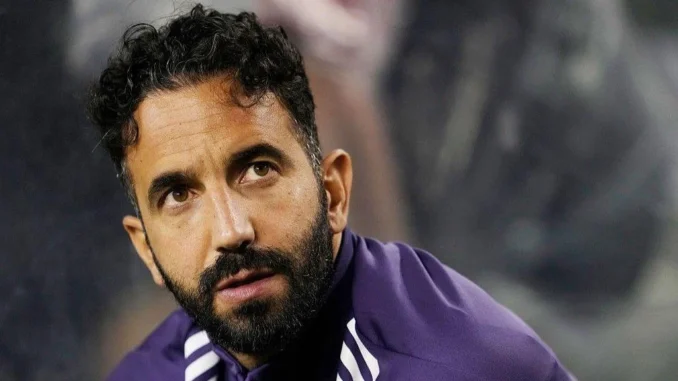
Who is Ruben Amorim?
Ruben Filipe Marques Amorim (born 27 January 1985) is a Portuguese football manager and former professional midfielder.
As a player, he spent the majority of his career at Belenenses and Benfica, winning ten major titles at the latter including three league titles, one Taça de Portugal, five Taças da Liga, and one Supertaça Cândido de Oliveira and earned 14 international caps for Portugal across two FIFA World Cups.
After retiring from playing in 2017, he quickly transitioned into coaching beginning at Casa Pia in 2018, before a formative stint at Braga B and a breakthrough role with Braga’s senior side in late 2019.
His defining achievement as a coach came at Sporting CP, where he ended the club’s 19-year Primeira Liga title drought in his very first season and won a second title in 2023–24. Appointed manager of Manchester United in November 2024, he was sacked on 5 January 2026 after overseeing the club’s worst-ever Premier League finish.
He is currently without a club as of May 2026. His preferred formation is the 3-4-2-1.
| Ruben Filipe Marques Amorim | |
|---|---|
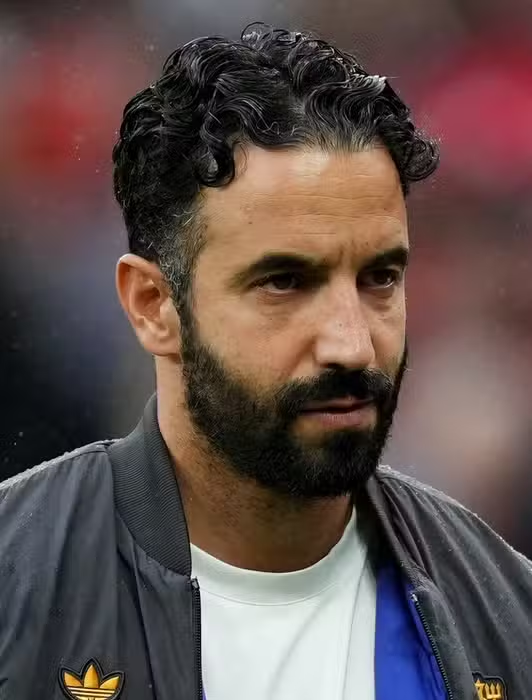 Ruben Filipe Marques Amorim: History · Bio · Photo
|
|
| Wiki Facts & About Data | |
| Full Name: | Ruben Filipe Marques Amorim |
| Born: | January 27, 1985 |
| Age: | 41 years old |
| Birthplace: | Lisbon, Portugal |
| Nationality: | Portuguese |
| Spouse: | Maria João Diogo |
| Children: | Two children (one son with Maria João) |
Early Life
Ruben Amorim was born on 27 January 1985 in Lisbon the Portuguese capital, a city that has produced generations of football talent through its network of storied clubs and their intensive youth development academies.
His parents divorced when he was just one year old a family rupture that shaped his early childhood and that he has occasionally referenced in public conversations about resilience and personal formation.
He was raised primarily in Lisbon, where football was the inevitable backdrop to his childhood in a country where the sport is a national religion.
His family connections to football run deep: his cousins Bruno Simão and David Simão are both professional footballers Bruno having since retired and David still active. The Simão-Amorim family’s collective involvement in professional football suggests a household environment in which the game was a constant presence and where talent, if it existed, would find encouragement and direction early.
Amorim is the godfather to Bruno Simão’s eldest daughter a reflection of the closeness of their bond, one that began on football pitches in Lisbon and has endured through professional careers that have touched some of the biggest clubs and stages in European football.
From an early age, Amorim displayed the qualities that would define both his playing and his coaching careers: intelligence, tactical awareness, the ability to read the game with unusual clarity, and a competitive intensity that was not always matched by raw physical gifts but which enabled him to perform at a high level for the duration of a career that stretched across more than fifteen years of professional football.
Education and Personal Background
Specific details about Amorim’s formal academic education beyond his football career have not been extensively documented in public sources. Like many professional footballers who enter the game’s elite youth academies at an early age, his formal education was pursued alongside the demands of football development.
His subsequent career as a coach particularly his tactical sophistication, his ability to communicate complex ideas clearly, and his evident intellectual engagement with the game suggests a natural analytical intelligence that has been developed and refined through decades of studying and practising football at the highest levels.
He holds a UEFA Pro Licence the highest level of coaching qualification available within UEFA’s framework, required for managing clubs in Europe’s top-tier competitions. Obtaining this licence requires substantial coursework, practical coaching experience, and assessment at the highest professional standard.
His wife, Maria João Diogo, has an academic degree in telecommunications engineering and has built her own business in interior design a personal professional trajectory that reflects both academic achievement and entrepreneurial initiative.
The couple were married in a ceremony held at the Palácio e Mosteiro de São Marcos (Saint Mark Palace and Monastery) in Coimbra one of Portugal’s most historic and beautiful architectural settings and together they have two children, including one son.
Playing Career
Benfica Youth Academy
Amorim began his professional football development at the youth academy of Benfica one of Portugal’s, and Europe’s, most prestigious clubs. The Benfica academy at Seixal is widely regarded as one of the finest youth development programmes in Iberian football, having produced generations of top Portuguese and international players. It was here, in the structured, competitive environment of Benfica’s youth system, that Amorim developed alongside other young players including his cousin Bruno Simão and Pedro Russiano.
He progressed through the Benfica youth ranks but was ultimately released without making the step to Benfica’s senior team a common fate for players in top academies where competition for places is fierce and the conversion rate from youth to senior professional is low.
The manner of his response to this setback going on trial with Belenenses at the suggestion of his cousin Bruno Simão, reportedly playing with a broken arm during the trial period offers an early and revealing glimpse of the determination and stoicism that would characterise both his playing and managerial careers.
Belenenses
Amorim went on trial with Belenenses one of Lisbon’s oldest football clubs and impressed sufficiently to earn a contract. He established himself as a central midfielder with Belenenses and spent a significant portion of his playing career at the club, becoming a reliable and tactically astute presence in their midfield.
His time at Belenenses gave him his professional foundation and shaped him into the kind of technically grounded, positionally intelligent midfielder that he would later seek to develop in his own players as a coach.
Benfica Senior Career and Trophy Haul
Amorim eventually fulfilled what had eluded him in youth football he joined Benfica’s senior squad in 2008 and went on to enjoy the most decorated phase of his playing career at the Estádio da Luz.
During his time with Benfica, he amassed an extraordinary ten major titles: three Primeira Liga championships, one Taça de Portugal, five Taças da Liga, and one Supertaça Cândido de Oliveira.
These medals placed him among the most decorated players of his generation in Portuguese domestic football and gave him an intimate understanding of what it meant to operate within a winning club culture an understanding he would later draw upon explicitly in his coaching.
International Career Portugal (14 Caps, 2 World Cups)
Amorim represented the Portugal national team, earning 14 international caps across his international career. He was included in Portugal’s squads for two FIFA World Cups a distinction that placed him among the select group of Portuguese footballers who have represented their country on the global stage’s biggest platform.
While he was not a central figure in Portugal’s World Cup campaigns Portugal’s golden generation of the same era included Cristiano Ronaldo, Luís Figo, and others his international inclusion confirmed his standing among Portugal’s professional elite.
Other Clubs and Retirement (April 4, 2017)
In addition to Belenenses and Benfica, Amorim’s playing career encompassed spells at Rio Ave, Olhanense, Nacional, and Braga giving him experience of Portuguese club football across multiple competitive tiers and geographies.
He retired from professional football on 4 April 2017, bringing an end to a playing career characterised by tactical intelligence, professional consistency, and a trophy-laden final chapter at Benfica.
Coaching Career
Casa Pia (2018) Debut and Controversy
Amorim made his coaching debut at Casa Pia a Lisbon-based club that has historically operated primarily in Portugal’s lower divisions in 2018.
His first management role, however, came to an abrupt and controversial end when he resigned that same year amid a dispute with the Portuguese Football Federation (FPF). The nature of the dispute involved the FPF’s decision to include Amorim in their coaching education programme which required him to take a leave of absence from his managerial role during the season in a manner that he found professionally and contractually untenable.
His resignation reflected a principled refusal to accept what he regarded as institutional interference with his coaching autonomy a character trait that would manifest again in his later career.
Braga B and Braga Senior Early Tactical Development (2018–2020)
Following his resignation from Casa Pia, Amorim was appointed head coach of Braga’s reserve team (Braga B) giving him both a return to the game and a structured developmental environment in which to refine his coaching philosophy.
His work with Braga B impressed the club’s hierarchy sufficiently that, in December 2019, he was promoted to head coach of Braga’s senior side a significant step up to one of Portugal’s major clubs. His time with Braga was brief but impactful: in the 2019–20 season, he guided Braga to victory in the Taça da Liga one of Portugal’s two domestic cup competitions confirming that his tactical ideas could deliver results at a competitive professional level.
Sporting CP The Golden Era (March 2020 – November 2024)
In March 2020, Amorim was appointed manager of Sporting CP the Lions of Lisbon, one of Portugal’s three great clubs alongside Benfica and Porto, and a club whose supporters had been waiting nineteen agonising years for a Primeira Liga title.
The appointment made him one of the most expensive managers in Portuguese history at the time, and it instantly divided opinion between those who saw him as a bold, exciting choice and those who questioned whether a 35-year-old with limited senior experience was ready for the pressure of restoring Sporting to the summit of Portuguese football.
He answered those questions definitively and almost immediately. In his first full season at Sporting (2020–21), he delivered a Primeira Liga title ending the club’s 19-year wait for domestic championship honours, a drought that had generated enormous institutional frustration and fan suffering at the club.
He achieved the title as part of a domestic double, also winning the Taça da Liga in the same season a comprehensive first-season achievement that was virtually unparalleled in recent Portuguese football management history. The Primeira Liga triumph earned him the Primeira Liga Manager of the Year award for 2020–21.
In European competition, his 2021–22 UEFA Champions League campaign brought Sporting to the Round of 16 a notable achievement for a club of Sporting’s financial scale competing against Europe’s wealthiest clubs, and a first last-16 appearance for the club in the Champions League in many years.
He sustained Sporting’s domestic competitiveness across subsequent seasons, leading them to another Primeira Liga title in the 2023–24 season and earning the Primeira Liga Manager of the Year award for 2023–24 his second such recognition. The two titles in three completed full seasons, combined with his Champions League campaigns, established him as the finest manager in Portugal and one of the most compelling managerial talents in Europe.
His tactical philosophy at Sporting was built around the 3-4-2-1 system a formation that had fallen out of fashion in European football but which Amorim deployed with such authority, consistency, and tactical intelligence that it became intimately associated with his identity.
Under his system, Sporting’s wide wing-backs became crucial attacking outlets while a high defensive line and aggressive pressing created the kind of organised, physically intense football that neutralised opponents and amplified the quality of his best players. The system was not just tactically effective it was visually compelling, and it attracted widespread attention from managers across Europe who studied it intensely.
Manchester United Appointment (November 2024)
On 4 November 2024, Manchester United announced the appointment of Ruben Amorim as head coach, ending the search for a successor to the sacked Erik ten Hag. The compensation payment to release him from his Sporting contract midway through the season made him, at the time, one of the most expensive managerial appointments in history.
United fans, media, and pundits greeted the appointment with genuine excitement here, it seemed, was the decisive, charismatic, tactically clear young manager who could restore purpose and identity to a club that had been drifting since Ferguson’s retirement in 2013. His record at Sporting, his Champions League pedigree, and his reputation as a developer of young talent made him, on paper, an ideal fit for a club with one of Europe’s finest academy systems.
Manchester United First Season (2024–25): Historic Low
The reality of Amorim’s United tenure proved brutally different from the promise of his arrival. His first game as United manager was a 1-1 draw away at Ipswich Town on November 24, 2024 a reasonable introduction given United’s depleted squad and the rushed circumstances of his appointment.
Positive early moments included his first Premier League win against Everton (4-0) on December 1, 2024, and on December 15, he became the first United manager to win his first Manchester derby since Alex Ferguson a dramatic 2-1 away win against Manchester City that gave supporters a glimpse of what his tenure might deliver.
But these were isolated bright spots in an overwhelmingly dark picture. Just over a month after his derby win, on 19 January 2025, following a 3-1 defeat to Brighton the club’s fourth home defeat in five games Amorim delivered one of the most extraordinary self-assessments in Premier League managerial history, publicly stating that Manchester United were “probably the worst team in the history” of the club. The quote was simultaneously shocking in its candour, revealing about the scale of the crisis he had inherited, and critics argued deeply counterproductive in its impact on team morale and public confidence.
Towards the end of the season, United’s league form collapsed, earning just four points from their final six matches, leaving them mathematically confirmed to finish in the bottom half of the Premier League table.
After joining in November 2024 from Sporting, he oversaw United’s lowest Premier League finish, ending last season in 15th place with just 42 points. The 15th-place finish was, by a significant margin, the worst in United’s Premier League history a genuinely shocking outcome for a club that had been champions nine times since the competition’s formation.
The one bright thread in an otherwise dismal campaign was United’s run in the UEFA Europa League, where they progressed through the extended league phase and the knockout rounds to reach the final in Bilbao. The Europa League final offered Amorim and United the chance to win a trophy and, crucially, to secure qualification for the Champions League the kind of season-saving achievement that would have transformed the narrative of his tenure.
United also lost the Europa League final to Tottenham Hotspur in Bilbao, meaning the club failed to secure European football for the first time since 2014. The defeat to Spurs was a devastating blow removing both the trophy and the Champions League place from United’s reach and leaving Amorim’s first season with nothing positive to show for its conclusion.
Manchester United Second Season (2025–26): Collapse and Sacking
The 2025–26 season had been intended as Amorim’s first full pre-season with United his first real opportunity to shape the squad in his own image and implement his system properly from the start of a campaign.
Manchester United’s summer transfer window, by the standards of previous summers, was productive: the arrivals of Benjamin Sesko, Bryan Mbeumo, and Matheus Cunha gave the squad significantly more quality in attacking areas and raised hopes that a genuine revival was possible.
Those hopes were immediately and brutally undermined. On 27 August 2025, United were knocked out of the EFL Cup by Grimsby Town an EFL League Two side after a 12-11 penalty shootout defeat following a 2-2 draw, with Grimsby leading 2-0 at half-time.
It was one of the most embarrassing results in United’s modern history. October brought a mixed picture: a notable 2-1 win at Anfield against Liverpool on October 20, 2025 United’s first away win at Anfield since 2016 along with wins against Brighton and Sunderland, earned Amorim the Premier League Manager of the Month award for October 2025. But these were isolated bright spots.
In December 2025, Amorim faced criticism for his public handling of two loan players. He stated that 18-year-old defender Harry Amass was “struggling in the Championship” with Sheffield Wednesday whereas Amass had in fact been named Sheffield Wednesday’s player of the month.
He also claimed that 18-year-old forward Chido Obi was “not always a starter in the Under-21s” a claim that both Obi and his team reportedly disputed. These incidents generated negative press and created an impression of a manager not fully in command of the information flow to and from his technical staff.
His final game as United manager was a 1-1 away draw at Elland Road against rivals Leeds United on 4 January 2026. Four days later on 5 January 2026 Manchester United sacked Ruben Amorim. He left with the worst win percentage of any permanent manager in United’s Premier League history winning just 15 of 47 league games, losing 19, for a win percentage of 31.9%. In just 47 games, Amorim’s side conceded 72 league goals and kept only seven clean sheets, with a clean sheet ratio of 14.9%. His tenure lasted 14 months.
Tactical Philosophy and Coaching Style
Ruben Amorim’s coaching identity is inseparable from his commitment to the 3-4-2-1 formation also expressed as a 3-2-4-1 or 5-4-1 depending on the phase of play. In this system, three centre-backs provide the defensive foundation, with two wing-backs providing the primary width in both defensive and attacking phases.
Two central midfielders sit in front of the back three, protecting the defence while also serving as the engine of transitions. Two attacking midfielders or number tens operate behind a single central striker, creating numerical advantages and combination opportunities in the final third.
At Sporting CP, this system was implemented with exceptional personnel particularly at wing-back, where the ability to cover the full width of the pitch required athletes with elite physical endurance, tactical discipline, and technical quality.
The system demands collective organisation, high intensity in pressing, and a clear, rehearsed build-up structure. Amorim has always been forthright about his commitment to the system, describing it as central to his football philosophy rather than a tactical convenience.
His unwillingness to adapt at Manchester United where the squad’s personnel were poorly suited to the 3-4-2-1 was widely cited as a primary reason for the team’s sustained underperformance.
Awards and Honours
As a Player
- Primeira Liga Championship Benfica (3 titles)
- Taça de Portugal Benfica
- Taça da Liga Benfica (5 titles)
- Supertaça Cândido de Oliveira Benfica
- Portugal International 14 caps; 2 FIFA World Cup squads
As a Manager
- Taça da Liga (2019–20) Braga
- Taça da Liga (2020–21) Sporting CP
- Primeira Liga (2020–21) Sporting CP (ended 19-year title drought)
- Primeira Liga Manager of the Year (2020–21) Sporting CP
- Primeira Liga (2023–24) Sporting CP
- Primeira Liga Manager of the Year (2023–24) Sporting CP
- UEFA Champions League Round of 16 (2021–22) Sporting CP
- UEFA Europa League Final (2024–25) Manchester United (lost to Tottenham Hotspur in Bilbao)
- Premier League Manager of the Month (October 2025) Manchester United
Social Media
Ruben Amorim maintains a modest social media presence consistent with the reserved personal style he projects publicly.
During his time at Manchester United, his social media activity was carefully managed and primarily confined to official club channels rather than personal platforms.
His public communications have consistently been delivered through formal press conferences and interviews rather than informal social media engagement.
Personal Life
Ruben Amorim is married to Maria João Diogo a woman whose intellectual and professional accomplishments are notably independent of his own career.
She holds an academic degree in telecommunications engineering from a Portuguese institution and has built her own business in interior design.
Their wedding ceremony was held at the historic Palácio e Mosteiro de São Marcos (Saint Mark Palace and Monastery) in Coimbra one of Portugal’s most beautiful historic settings a choice that reflects both aesthetic taste and a romantic connection to Portugal’s heritage. Together they have two children, including one son.
His close relationship with his cousin Bruno Simão who alongside him was a product of Benfica’s youth academy and who has since retired from professional football remains a constant in his personal life. Amorim’s role as godfather to Bruno Simão’s eldest daughter reflects the depth of their bond and the family-centred values that characterise his personal identity. His other cousin, David Simão, remains an active professional footballer.
Amorim’s character, as described by those who have worked closely with him, is one of principled intelligence, emotional directness, and a high personal standard for both himself and those around him.
His public willingness to describe his own Manchester United team as potentially “the worst in the club’s history” was characteristically direct a willingness to state uncomfortable truths that has both driven his achievements and, in the specific context of Manchester United, contributed to the narrative difficulties of his tenure.
Net Worth
Ruben Amorim’s net worth is estimated at approximately €5–10 million accumulated through his playing career at Benfica, his managerial contracts at Sporting CP (which made him one of Portugal’s highest-paid managers), and his compensation package from Manchester United, which included both his appointment fee and the significant severance payment associated with the early termination of his contract in January 2026.
Manchester United’s compensation payment to Sporting CP for his early release in November 2024, combined with his own contract value, is understood to represent one of the more substantial financial transactions in recent Premier League managerial history.
FAQs
Who is Ruben Amorim?
Ruben Filipe Marques Amorim is a Portuguese football manager and former professional midfielder. He guided Sporting CP to their first Primeira Liga title in 19 years in 2020–21, won a second title in 2023–24, and was appointed Manchester United head coach in November 2024 before being sacked in January 2026.
When was Ruben Amorim born?
He was born on January 27, 1985, in Lisbon, Portugal. He is 41 years old as of May 2026.
Why was Ruben Amorim sacked by Manchester United?
Amorim was sacked on January 5, 2026, after 14 months in charge. His tenure included United’s worst-ever Premier League finish (15th, 42 points), a Europa League final defeat to Tottenham in Bilbao, tactical inflexibility with his 3-4-2-1 system, the lowest win percentage (31.9%) of any permanent manager in the club’s Premier League era, and a series of embarrassing results including a League Cup exit to League Two Grimsby Town on penalties.
What was Ruben Amorim’s win record at Manchester United?
In 47 Premier League games, he won 15, drew 13, and lost 19 a win percentage of 31.9%, the lowest of any permanent Manchester United manager in the Premier League era. His side conceded 72 league goals and kept just 7 clean sheets in 47 league matches.
What is Ruben Amorim’s preferred formation?
His preferred formation is the 3-4-2-1 three centre-backs, two wing-backs, two central midfielders, two attacking midfielders, and one central striker. He deployed this system with great success at Sporting CP but was criticised for tactical inflexibility in maintaining it at Manchester United despite the squad’s unsuitability.
What did Ruben Amorim achieve at Sporting CP?
He guided Sporting CP to the Primeira Liga title in 2020–21 (ending a 19-year drought) and 2023–24, the Taça da Liga in 2020–21, and the UEFA Champions League Round of 16 in 2021–22. He won the Primeira Liga Manager of the Year award in both title-winning seasons.
Who is Ruben Amorim’s wife?
His wife is Maria João Diogo, a telecommunications engineering graduate who has built her own interior design business. They were married at the Palácio e Mosteiro de São Marcos in Coimbra and have two children, including one son.
Is Ruben Amorim currently managing a club?
No. As of May 2026, Ruben Amorim is without a club, having been sacked by Manchester United on January 5, 2026. His next managerial appointment, whenever it comes, will be widely anticipated given the talent he demonstrated at Sporting CP.
How many international caps did Ruben Amorim earn?
He earned 14 international caps for Portugal, appearing in two FIFA World Cup squads as a player.
What is the significance of Ruben Amorim’s Sporting CP tenure?
His 2020–21 Sporting CP title ended the club’s 19-year wait for a Primeira Liga championship one of the longest title droughts for a major Portuguese club in history. It is regarded as one of the most significant achievements in Sporting CP’s modern history and established Amorim as one of the finest managers in European football.
Conclusion
Ruben Amorim’s career, as of May 2026, contains a vivid and instructive contrast: the inspired architect of one of Portuguese football’s great title-winning moments at Sporting CP, and the manager of one of English football’s greatest institutional disappointments at Manchester United.
The gap between those two versions of Amorim is not simply a story of individual failure it is the story of a manager who arrived at a club in institutional crisis, with a squad badly mismatched to his system, without the full pre-season preparation needed to implement his ideas, and in a media and cultural environment where the pressure to succeed immediately was incompatible with the time required to build properly.
None of this erases the real failures of his United tenure the historically poor league finish, the tactical rigidity, the communication errors around loan players, the inability to inspire consistently improved performances from experienced internationals.
These were genuine failures of management. But they exist alongside a body of coaching work at Sporting CP that remains, by any objective standard, one of the most impressive achievements in European football management of the past decade.
At 41, Ruben Amorim has time, financial security, and when the noise of Old Trafford fades an enduring reputation as a builder, a title-winner, and a tactical innovator. His next chapter will tell us whether Manchester United was an aberration or a ceiling and given what he accomplished in Lisbon, the smart money remains on the aberration.
Related People





Leave a Reply