
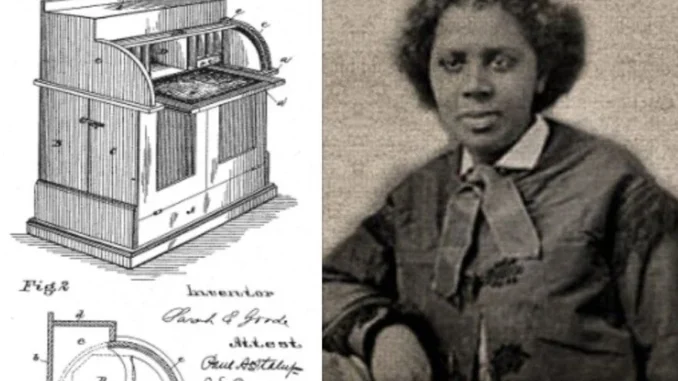
Sarah E. Goode was an American entrepreneur and inventor who, in 1885, became one of the first African American women to receive a United States patent.
Born into slavery and liberated at the end of the Civil War, Goode rose to become a furniture store owner in Chicago, where she invented a space-saving folding cabinet bed, a direct precursor to the modern Murphy bed and the hide-away bed/couch.
Her achievement, made in the face of profound racial and gender discrimination, stands as a landmark in American history and a symbol of Black entrepreneurial ingenuity in the post-Civil War era.
Profile
| Full Name | Sarah Elisabeth Goode (née Jacobs) |
| Date of Birth | c. 1850–1856 (exact date uncertain; born into slavery) |
| Date of Death | April 8, 1905, Chicago, Illinois |
| Birthplace | Toledo, Ohio (as a slave or free person; records disputed) |
| Nationality | American |
| Occupation | Entrepreneur; Inventor; Furniture Store Owner |
| Father | Oliver Jacobs (carpenter) |
| Mother | Harriet Jacobs |
| Spouse | Archibald Goode (carpenter; married c. 1880) |
| Patent | U.S. Patent No. 322,177 (Cabinet Bed, issued July 14, 1885) |
Early Life
Sarah Goode was born around 1850–1856, historical records provide varying dates, in circumstances that reflect the profound uncertainty of documentation for enslaved and newly freed people in nineteenth-century America. Some accounts indicate she was born into slavery; others, based on census records showing her living as a “free inhabitant” in Toledo, Ohio, around 1860, suggest she may have been born free. She was the second child of seven children born to Oliver and Harriet Jacobs. Her father was a carpenter, which would later prove formative for her own entrepreneurial instincts.
By 1870, Goode had relocated to Chicago, Illinois. By 1880, she had married Archibald Goode, a carpenter from Virginia, and the couple shared their home with a daughter and several boarders. Chicago’s rapid industrial and population growth during this era created tremendous opportunity for enterprising individuals, and also profound obstacles for Black residents navigating a deeply segregated city and economy.
Entrepreneurship and Invention
Together, Sarah and Archibald Goode operated a furniture store on Chicago’s State Street, a remarkable achievement for any woman of that era, and especially extraordinary for a Black woman who had been born into, or lived in close proximity to, slavery. The store catered primarily to working-class residents of Chicago who lived in small apartments and tenement buildings with limited space.
Listening to her customers’ needs, Goode developed an innovative solution to the problem of cramped living quarters: a folding cabinet bed that converted into a roll-top desk during the daytime. The bed featured hinged sections that could be raised or lowered, with compartments for writing supplies and stationery built into the desk configuration. The design balanced the weight of the folding mechanism so the bed could be easily raised and held securely in place, with additional support for the center of the mattress when open.
Goode submitted her patent application with the help of Chicago attorney George P. Barton in November 1883. After paying $35 in fees, having the application rejected, making revisions, and resubmitting, a process taking twenty months, she was finally granted U.S. Patent No. 322,177 on July 14, 1885.
As of that date, Sarah E. Goode became one of the first African American women known to have received a patent from the United States Patent and Trademark Office. She is sometimes described as the “first,” though this distinction is shared with Judy W. Reed, who received a patent for a dough-kneading machine in 1884, and Miriam Benjamin, who patented a hotel chair in 1888. The Patent Office of that era did not require applicants to disclose their race, so the historical record is incomplete. Regardless of precise ranking, Goode’s achievement was historic.
In September 1884, the Chicago Tribune noted that “S. E. Goode” was exhibiting her “French Flat Folding-Bed” at the 32nd Annual Illinois State Fair. Her invention predated the better-known Murphy Bed, patented in 1916, by more than thirty years and is considered a direct predecessor to the hide-away bed and other space-saving furniture innovations that are now commonplace worldwide.
Legacy
Sarah E. Goode was one of four African American women inventors highlighted at the Paris Exposition of 1900 in the Exhibit of American Negroes, organized by Thomas J. Calloway and W.E.B. Du Bois. In 2012, the Sarah E. Goode STEM Academy, a public science, technology, engineering, and mathematics-focused school in south Chicago, was named in her honour, a testament to the enduring significance of her life and work as a model for young people in the city where she made history.
She is buried at Graceland Cemetery in Chicago, Illinois.
Personal Life
Little is documented about Sarah E. Goode’s personal life beyond what census records and business documentation reveal. She and Archibald Goode had multiple children, though the exact number is uncertain, records suggest at least three survived to adulthood. Her husband Archibald was also an inventor; his design for an automatic garbage box was praised by the Chicago Civic Federation in 1895. The furniture store the Goodes operated on State Street appears to have closed by 1887, though Archibald continued listing furniture-related business at other locations.
Net Worth
No verified net worth figure is applicable. Sarah E. Goode was a nineteenth-century businesswoman and inventor whose financial records have not been preserved in accessible historical documentation.
Conclusion
Sarah E. Goode lived a life of extraordinary accomplishment against extraordinary odds. Born in an era when Black Americans faced systemic exclusion from virtually every avenue of economic and civic participation, she built a business, served her community, and created an invention so ahead of its time that it continues to influence furniture design more than a century later. Her story is a reminder that American history is full of innovators whose contributions have been obscured by the inequities of their era, and that recovering those contributions is both a historical obligation and an inspiration.
Related People








Leave a Reply