
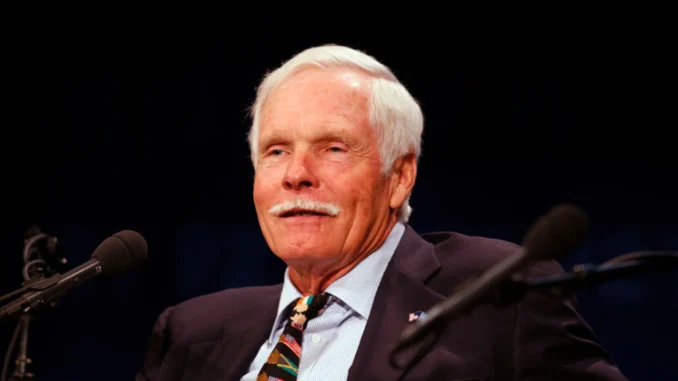
On May 6, 2026, the world lost one of the most audacious, visionary, and impactful media entrepreneurs in the history of American broadcasting. Ted Turner the man who founded CNN, the world’s first 24-hour cable news network passed away at his home in Tallahassee, Florida, at the age of 87, after a long battle with Lewy body dementia.
His death drew tributes from world leaders, journalists, broadcasters, athletes, philanthropists, and ordinary people on every continent a testament to the scope and depth of a legacy that genuinely changed the world.
Ted Turner was not merely a businessman. He was a sailor who won the America’s Cup. He was a sports owner who turned the Atlanta Braves into a nationally beloved franchise. He was an environmentalist who pledged $1 billion to the United Nations and dedicated millions of acres of land to conservation.
He was a father of five, a three-time husband, and a man who battled bipolar disorder, personal tragedy, and professional setbacks with the same relentless, sometimes reckless energy that defined his entire life. He earned the nicknames “The Mouth of the South” and “Captain Outrageous” for his bombastic, unpredictable, and brilliantly provocative public persona.
| Robert Edward Turner III | |
|---|---|
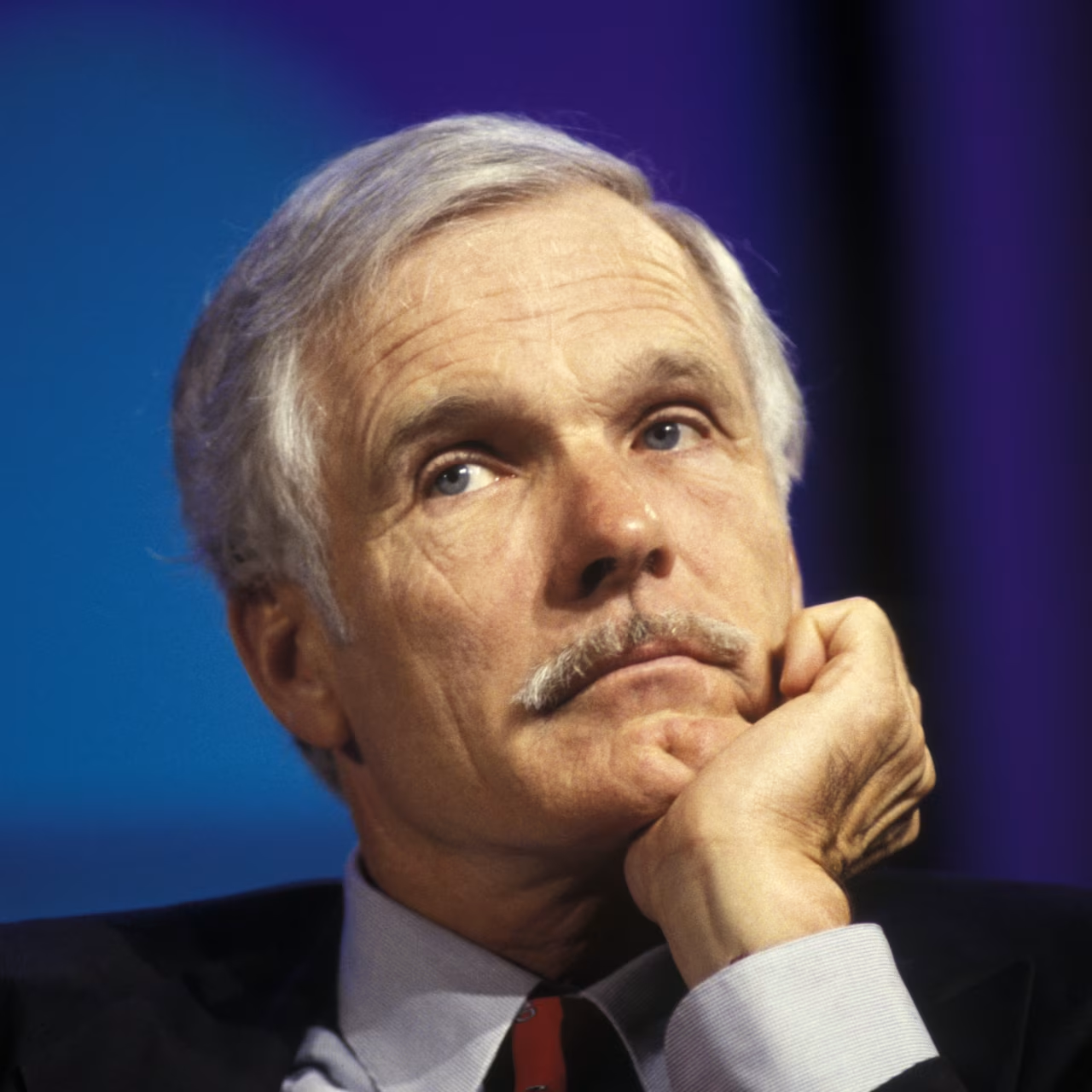 Robert Edward Turner III: History · Bio · Photo
|
|
| Wiki Facts & About Data | |
| Full Name: | Robert Edward Turner III |
| Stage Name: | Ted Turner |
| Born: | November 19, 1938 |
| Age: | 87 years old |
| Death: | May 6, 2026 (aged 87) |
| Birthplace: | Cincinnati, Ohio, USA |
| Nationality: | American |
| Occupation: | Media Mogul, Entrepreneur, Philanthropist, Environmentalist, Sports Owner, Sailor |
| Religion: | Christianity (evolved; often questioned and reflected on faith openly) |
| Parents: | Robert Edward Turner Jr. (Father), Florence Rooney Turner (Mother) |
| Siblings: | Mary Jean Turner (sister, deceased) |
| Spouse: | Julia "Judy" Gale Nye (1960–1964), Jane Shirley Smith (1965–1988), Jane Fonda (1991–2001) |
| Children: | Laura Lee Turner Seydel, Robert Edward "Teddy" Turner IV, Rhett Turner, Beau Turner, Jennie Turner |
| Net Worth: | Approximately $2.5 billion – $2.8 billion (as of May 2026, per Forbes) |
Early Life
Robert Edward Turner III known throughout his life simply as Ted Turner was born on November 19, 1938, in Cincinnati, Ohio, to Robert Edward “Ed” Turner Jr. and Florence Rooney Turner.
He was the eldest child in the family, with a younger sister named Mary Jean Turner. The Turner family name would one day grace one of the most powerful media empires in history, but Ted’s childhood was defined not by glamour but by instability, discipline, and emotional complexity.
His father, Ed Turner, was a driven and ultimately troubled man who owned and operated a billboard advertising company. Ed was a good provider in material terms but was afflicted by bipolar disorder, which manifested in violent mood swings, emotional volatility, and a demanding, sometimes physically abusive approach to parenting.
Ted later discovered as an adult that he had inherited the same condition, which he managed with lithium for much of his later life. The parallels between father and son were striking the same ambition, the same energy, the same capacity for both brilliance and destruction.
When World War II broke out, Ted’s father signed up for the Navy and brought his wife and Ted’s sister with him to the Gulf Coast, leaving young Ted behind. At just a few years old, Ted was placed in a Cincinnati boarding school, where he felt profoundly abandoned. That early experience of rejection left an emotional mark that persisted for decades. It was, in many ways, the wound that fueled him the constant need to prove himself worthy of attention and respect.
After the war, Ed relocated the family to Savannah, Georgia, where he established himself in the billboard advertising business. In 1949, in a rare and significant moment of tenderness, Ed gave young Ted a Penguin sailing dinghy.
It was one of the family’s African American domestic staff members, Jimmy Brown, who taught Ted to sail a man whom Ted would later describe throughout his life as the person he regarded as his true father. That gift and those early sailing lessons would set the course of Turner’s entire life.
Ted also worked at his father’s company from the age of twelve, spending summers doing manual labor with outdoor billboard crews learning the rhythms of business, salesmanship, and physical work from the ground up.
These formative experiences instilled in him a work ethic, a competitive drive, and a visceral understanding of the advertising and communications business that no classroom education could have provided.
Tragedy struck the family again when Ted’s younger sister Mary Jean died at just 17, a loss that deepened his capacity for grief and his complex relationship with mortality and purpose.
Education
At age 12, Ted Turner was enrolled at McCallie School, an elite all-boys Christian military academy in Chattanooga, Tennessee, where his father hoped the discipline and structure would channel his son’s explosive energy constructively. McCallie provided military training, rigorous academics, and a structured environment though Ted immediately set about testing every boundary.
He accumulated so many demerits reportedly 1,000 that the school had to invent new punishments, as it was physically impossible for him to walk the required miles. Yet, remarkably, his defiance eventually gave way to leadership, and he rose from troublemaker to student leader at McCallie, a pattern that would repeat itself throughout his life.
After McCallie, Turner had hoped to attend the United States Naval Academy, but his father overruled him and insisted on a more prestigious civilian institution. Unable to gain entry to Harvard his father’s first choice Turner enrolled at Brown University in Providence, Rhode Island, in 1956. The choice of Brown was not accidental: Turner later revealed that his love of sailing was a factor, as Brown is located near Narragansett Bay.
At Brown, Turner served as vice-president of the Brown Debating Union and was captain of the sailing team, excelling in both activities. He initially declared a major in classics a decision that infuriated his father, who wrote to his son saying the choice made him “appalled, even horrified” and that he “almost puked.” Turner later switched to economics.
However, his time at Brown came to an abrupt end in 1959 when he was expelled for having a female student in his dormitory room, violating the school’s regulations.
Turner rejoined the United States Coast Guard Reserve to complete his service obligation and then entered his father’s business.
In November 1989, Brown University awarded him an honorary Bachelor of Arts degree when he returned to campus to deliver the keynote address at the National Association of College Broadcasters annual conference a belated recognition of what he had accomplished in the decades since his expulsion.
Career
Taking Over Turner Advertising
After leaving Brown and completing his Coast Guard service, Turner joined his father’s billboard advertising company Turner Advertising Company in 1960, starting as branch manager of the Macon, Georgia, office. His talent for sales and business development was immediately apparent: he more than doubled the office’s revenue within his first year.
In 1962, as Ted moved up within the company, his father made a costly strategic error buying out a competitor at a price that saddled the business with dangerous debt. The financial pressure broke Ed Turner’s spirit. On March 5, 1963, Ed Turner took his own life, a devastating event that left 24-year-old Ted suddenly in control of a struggling, debt-ridden enterprise worth approximately $1 million.
Faced with offers to sell the business and walk away, Ted Turner refused. He chose instead to run the company himself. Through exceptional discipline, salesmanship, and an instinct for opportunity, he paid down the debts, restored profitability, and began expanding. The billboard business became the financial foundation upon which everything else would be built.
Birth of Turner Broadcasting System
In 1970, Ted Turner made the boldest move of his early career: he purchased WTCG-Channel 17, a financially struggling UHF television station in Atlanta, Georgia, for approximately $2.5 million. The station was considered an unpromising acquisition UHF stations were widely regarded as the backwaters of American broadcasting at the time but Turner saw something others did not: the potential to build a new kind of television, one that could reach beyond local markets through the emerging infrastructure of cable television.
Within three years, he had transformed it into one of the few genuinely profitable independent television stations in the United States. He filled the programming schedule with Atlanta Braves baseball games, old movies, syndicated sitcoms, and cartoons entertainment that was approachable, nostalgic, and cheap to acquire. The formula worked.
In 1975, Turner made another visionary leap: he became one of the first broadcasters to use a new communications satellite to transmit his station’s signal to cable systems across the country, essentially creating the first national cable “superstation.” The station was eventually renamed WTBS (Turner Broadcasting System), which entered over 160 million cable-connected homes. This innovation fundamentally changed the economics and geography of American television.
Founding CNN The World’s First 24-Hour News Network
Ted Turner’s most consequential contribution to human history came on June 1, 1980, when he launched Cable News Network CNN the world’s first 24-hour cable news channel. The concept was radical, widely mocked, and considered commercially suicidal by virtually every established media executive in the country. No one believed that there was enough news to fill 24 hours a day, that enough viewers would watch, or that the economics could work. Turner pressed forward regardless.
Before CNN launched, Turner famously declared: “We won’t be signing off until the world ends. We’ll be on, and we will cover the end of the world, live, and that will be our last event.” The statement captured perfectly the audacious, total-commitment spirit that defined everything he did.
CNN’s headquarters were established in Atlanta rather than New York or Washington a deliberate choice reflecting Turner’s Southern identity and his desire to build something outside the establishment. The network hired journalists, anchors, producers, and technical staff from across the country and beyond. Its first broadcast on June 1, 1980, covered a shooting at a parade in Fort Wayne, Indiana unscheduled, immediate, and breaking. Within days, CNN had demonstrated precisely why 24-hour news was not only viable but essential.
The network’s value was proved dramatically in the years that followed. CNN’s coverage of the assassination attempt on President Ronald Reagan in 1981, the 1986 Space Shuttle Challenger disaster, the 1989 Tiananmen Square protests, and most definitively the 1991 Gulf War during which CNN’s reporters, including Bernard Shaw, Peter Arnett, and John Holliman, broadcast live from Baghdad as U.S. bombs fell established CNN as the definitive source for breaking international news. The phrase “I saw it on CNN” entered the global lexicon. In 1982, Turner launched CNN2 (later CNN Headline News), a 24-hour condensed news service.
Building the Media Empire: TBS, TNT, Cartoon Network, and More
Turner did not stop with CNN. Throughout the 1980s and 1990s, he continued to build one of the most extraordinary media empires in American history:
In 1988, he launched Turner Network Television (TNT), which debuted with an original colorized broadcast of Gone with the Wind and quickly became a major cable entertainment network known for sports, movies, and original programming.
In 1986, Turner made an audacious and enormously expensive bid for CBS a hostile takeover attempt that ultimately failed due to financing challenges but demonstrated his ambition to operate at the very highest level of American broadcasting.
In 1986, he purchased MGM/UA Entertainment for $1.5 billion, acquiring one of the most significant film libraries in Hollywood history more than 3,000 titles including classic films from MGM and Warner Bros. Though he sold most of the studio back almost immediately to recover debt, he retained the film library, which became the backbone of his programming across TBS, TNT, and the later Turner Classic Movies channel.
In 1992, he launched Cartoon Network, which became a globally beloved entertainment channel for children and adults alike, eventually spawning its own original programming tradition that included beloved series and animated films.
In 1994, he launched Turner Classic Movies (TCM), a commercial-free channel dedicated to the presentation of classic Hollywood cinema widely regarded as one of the greatest contributions to the preservation and celebration of film heritage in the history of American television.
The Time Warner Merger and Loss of Control
In 1996, Turner Broadcasting System merged with Time Warner in a landmark deal that valued TBS at approximately $7.5 billion. The merger was one of the largest in media history and made Turner one of the wealthiest individuals in America. He was appointed Vice Chairman of Time Warner’s Board. However, the merger also began a gradual erosion of his direct control over the empire he had built.
The subsequent AOL-Time Warner merger in 2000 widely considered one of the most disastrous corporate mergers in American business history further diminished Turner’s role and destroyed enormous amounts of shareholder value. Turner lost billions of dollars in personal net worth as AOL Time Warner’s stock collapsed. He resigned as Vice Chairman in 2003 and stepped off the board entirely in 2006, though he remained one of the company’s largest individual shareholders for years.
Sports Ownership: Atlanta Braves and Atlanta Hawks
Ted Turner’s ownership of the Atlanta Braves baseball team, which he purchased in 1976, was one of the defining chapters of his personal and public life. He was one of the most colorful and hands-on sports owners in American history. In his second year as owner, he was suspended for one year by Commissioner of Baseball Bowie Kuhn for violating trade rules related to the signing of free agent Gary Matthews.
Under Turner’s ownership, the Braves experienced their greatest sustained period of success, culminating in the 1995 World Series championship. Turner’s ability to broadcast Braves games nationally on TBS transformed the team from a regional franchise into one of the most watched baseball teams in the country, earning them the informal designation of “America’s Team.” He also owned the Atlanta Hawks NBA franchise. He sold both teams as part of his transition away from Time Warner.
Sailing: America’s Cup Champion
Throughout all his business achievements, sailing remained the deepest personal passion of Ted Turner’s life. In 1977, after being suspended from baseball, he entered the America’s Cup as skipper of the yacht Courageous and won the most prestigious event in sailing history in a dramatic series of races, defeating challengers from around the world. Turner was so exuberant during the victory celebration that he was reportedly too intoxicated to stand during the awards ceremony.
His 1977 win placed him on the cover of Sports Illustrated. He was inducted into the America’s Cup Hall of Fame in 1993 and the National Sailing Hall of Fame in 2011. His 1979 victory in the Fastnet Race completing a 605-nautical-mile course through a catastrophic storm that only 92 of 302 boats finished is considered one of the greatest feats of offshore sailing in the sport’s history.
Awards & Honours
- TIME Magazine Man of the Year (1991) One of the most prestigious recognitions of his era, for his role in transforming global media through CNN and Turner Broadcasting.
- Peabody Award (1997) One of the most respected awards in broadcasting and journalism, honoring CNN’s contributions to public affairs coverage.
- America’s Cup Victory (1977) Skipper of the winning yacht Courageous; appeared on the cover of Sports Illustrated.
- America’s Cup Hall of Fame (1993) Inducted for his contributions to the sport of sailing.
- National Sailing Hall of Fame (2011) Recognized for lifetime sailing achievement.
- Star on the Hollywood Walk of Fame (April 7, 2004) For his contributions to the entertainment industry.
- Bower Award for Business Leadership (2006) Presented by the Franklin Institute in Philadelphia, recognizing exceptional business leadership with a positive societal impact.
- Junior Achievement U.S. Business Hall of Fame (2007) Inducted for his transformative contributions to American enterprise.
- United Nations Global Leadership Award For his extraordinary $1 billion pledge to the United Nations in 1997 and his leadership of the United Nations Foundation.
- 48 Honorary Degrees Awarded by universities and institutions across the United States and internationally, recognizing his contributions to media, philanthropy, and environmentalism.
- Cable Television Hall of Fame Inducted for his foundational contributions to the cable television industry.
- Atlanta Braves Hall of Fame Inducted as one of the most significant owners in the franchise’s history.
- Advertising Hall of Fame (2004) Inducted for his innovative contributions to broadcasting and advertising.
- Lone Sailor Award (2013) Presented by the United States Navy Memorial, recognizing Coast Guard veterans who have distinguished themselves in civilian careers.
- Two Lifetime Achievement Emmy Awards (2014, 2015) One for sports broadcasting and another for news and documentary coverage, from the National Academy of Television Arts and Sciences.
- Carnegie Medal of Philanthropy Recognized for his extraordinary philanthropic contributions throughout his life.
Social Media
Unlike many of his contemporaries, Ted Turner was not a social media user in the modern sense. He was a man of the broadcast era, more comfortable in front of a camera or at a podium than behind a keyboard or smartphone. During his active years, he communicated primarily through press conferences, televised interviews, his autobiography, and public speeches.
Turner Enterprises (tedturner.com) His official online presence was maintained through Turner Enterprises, Inc., the company he used to manage his land, bison operations, philanthropic activities, and business interests in his later years. The Turner Enterprises website at tedturner.com continues to serve as a record of his legacy and conservation work.
CNN’s Official Channels Turner’s voice, opinions, and impact are preserved across CNN’s extensive digital archives and official social media channels, through which his foundational contributions to the network are documented and celebrated.
Turner Foundation The Turner Foundation’s official digital presence carries forward his environmental and philanthropic legacy, maintaining active social media accounts that promote the causes he championed throughout his life.
United Nations Foundation The United Nations Foundation, which Turner founded with his historic $1 billion pledge in 1997, maintains a robust online and social media presence that continues to amplify the global causes he cared most deeply about.
Personal Life
Ted Turner’s personal life was as dramatic, complex, and colorful as his professional career. He was married three times and was the father of five children who have collectively carried forward many of his most important values and causes.
His first marriage was to Julia “Judy” Gale Nye, a fellow sailing enthusiast he had met while competing in sailing races. They married in 1960 and had two children together: Laura Lee Turner Seydel and Robert Edward “Teddy” Turner IV. The marriage was described as intensely competitive Turner reportedly once rammed his wife’s boat during a race to prevent her from beating him. They divorced in 1964.
His second marriage was to Jane Shirley Smith, a Delta Airlines flight attendant whom he met at a Young Republicans gathering. They married on June 2, 1964, and had three children together: Beau Turner, Rhett Turner, and Jennie Turner. This marriage lasted 24 years before ending in divorce in 1988.
His third and most famous marriage was to actress and activist Jane Fonda, who he married in 1991. The wedding made global headlines and brought together two of the most recognizable and controversial figures in American public life. The marriage was passionate, deeply committed in many ways, but also turbulent Fonda has acknowledged discovering that Turner had been unfaithful just one month after they wed.
Despite this, the couple remained together for a decade, co-founding the Georgia Campaign for Adolescent Power and Potential (GCAPP) in 1995 and working together on environmental and philanthropic causes. They divorced in 2001 due in part to differences over religious beliefs Fonda had converted to Christianity, a spiritual path that Turner could not share.
The two maintained a close and warm friendship after the divorce. In 2018, Turner revealed that he had once considered running for president during their marriage, but that Fonda had told him she would leave him if he did.
In 2018, Turner publicly disclosed that he had been diagnosed with Lewy body dementia, a progressive brain disease, in a candid interview on CBS Sunday Morning.
He spoke about the diagnosis with characteristic bluntness and courage. He was also hospitalized with pneumonia in 2025 and recovered at a rehabilitation center. On May 6, 2026, he died peacefully at his home in Tallahassee, Florida, at the age of 87, surrounded by family.
Turner is survived by his five children Laura Turner Seydel, who chairs the Captain Planet Foundation; Teddy Turner, who worked at CNN and later attempted a congressional run; Rhett Turner, who founded a film production company and released a photography book on American wildlands conservation; Beau Turner, who serves on multiple environmental boards and foundations; and Jennie Turner, who worked at CNN and later served as executive producer and host of the PBS series EcoSense for Living as well as 14 grandchildren and two great-grandchildren.
Philanthropy and Conservation
In his later years, Turner became one of the most significant philanthropists and conservationists in American history. His environmental passion was the cause closest to his heart.
In 1990, he founded the Turner Foundation, a family foundation focused on safeguarding habitats, sustainable living, and environmental protection. That same year, he co-created the animated environmental television series Captain Planet and the Planeteers with colleague Barbara Pyle, inspiring a generation of young environmental advocates. The series led to the creation of the Captain Planet Foundation, chaired by his daughter Laura Turner Seydel.
In 1997, Turner made the most famous philanthropic pledge in modern history: he donated $1 billion to the United Nations paid over 10 years to support UN programs and operations, including children’s health, the environment, and population policy. He described it as “the best investment I’ve ever made” and founded the United Nations Foundation to administer the funds.
He also co-founded the Nuclear Threat Initiative (NTI) with former U.S. Senator Sam Nunn a nonprofit organization dedicated to reducing global threats from nuclear, biological, and chemical weapons. Turner was deeply worried about the existential risks of nuclear conflict throughout his life.
Turner also became the largest private landowner in the United States, accumulating over two million acres of land across the American West, primarily in Montana, New Mexico, Nebraska, and South Dakota. He used this land for bison conservation owning one of the largest private bison herds in the world and as a model for sustainable land stewardship. His bison operations also supported the Ted’s Montana Grill restaurant chain, which featured bison on the menu as part of his effort to promote sustainable protein consumption.
Mental Health and Personal Struggles
Throughout his life, Ted Turner was remarkably open about his struggles with bipolar disorder, which he managed with lithium for decades. He discussed his mental health challenges candidly in his 1993 biography It Ain’t As Easy as It Looks by Porter Bibb and in his own 2008 autobiography Call Me Ted. His openness about mental illness was ahead of its time and helped reduce stigma around bipolar disorder in an era when such discussions were largely taboo among high-profile public figures.
Net Worth
At the time of his death on May 6, 2026, Ted Turner’s net worth was estimated at approximately $2.5 billion to $2.8 billion, according to Forbes. This figure represents a significant reduction from the peak of his wealth at his highest, during the period surrounding the Time Warner merger in 1996, his net worth was estimated at over $9 billion. The subsequent collapse of AOL Time Warner’s stock wiped out billions from his personal fortune.
Turner’s wealth was built primarily through his media ventures Turner Advertising, WTBS, CNN, TNT, Cartoon Network, Turner Classic Movies, and Turner Broadcasting System. His landmark acquisition of the MGM film library, though initially a financial burden, proved to be an enormously valuable long-term asset. His acquisition of the Atlanta Braves and Atlanta Hawks and his later sale of both teams also contributed to his financial standing.
His two million acres of land across the American West, including multiple ranches and bison operations, represented substantial real estate assets. His Ted’s Montana Grill restaurant chain, though it was not ultimately commercially successful long-term, reflected his attempt to create an integrated business model around sustainable ranching and bison conservation.
Turner was notably generous with his wealth. His $1 billion pledge to the United Nations was unprecedented, and over his lifetime he donated billions more to environmental causes, educational institutions, and charitable organizations. His daughter Laura has described his mission as being to spread the word about conservation globally using his wealth and his media platform in tandem to advocate for the natural world he loved.
FAQs
Who was Ted Turner?
Ted Turner was an American media mogul, entrepreneur, philanthropist, and environmentalist best known as the founder of CNN, the world’s first 24-hour cable news network. He was also the founder of TBS, TNT, Cartoon Network, and Turner Classic Movies, and one of the most influential figures in the history of American television. He died on May 6, 2026, at age 87.
When and where was Ted Turner born?
Ted Turner was born on November 19, 1938, in Cincinnati, Ohio, USA.
When did Ted Turner die?
Ted Turner died on May 6, 2026, at his home in Tallahassee, Florida. He was 87 years old. The cause of death was complications from Lewy body dementia, a progressive brain disease he had been diagnosed with in 2018.
What was Ted Turner’s net worth?
At the time of his death, Ted Turner’s net worth was estimated at approximately $2.5 billion to $2.8 billion according to Forbes. His peak net worth exceeded $9 billion following the Time Warner merger in 1996, before the AOL-Time Warner collapse eroded much of his fortune.
What is Ted Turner most famous for?
Ted Turner is most famous for founding CNN in 1980 the world’s first 24-hour cable news network which permanently transformed global journalism and the way the world receives breaking news. He is also famous for founding TBS, TNT, Cartoon Network, and Turner Classic Movies; for owning the Atlanta Braves; for winning the America’s Cup in 1977; and for donating $1 billion to the United Nations.
Who were Ted Turner’s wives?
Ted Turner was married three times. His first wife was Julia “Judy” Gale Nye (1960–1964), with whom he had two children. His second wife was Jane Shirley Smith (1965–1988), with whom he had three children. His third and most famous wife was actress and activist Jane Fonda (1991–2001), with whom he co-founded the Georgia Campaign for Adolescent Power and Potential.
Did Ted Turner and Jane Fonda remain friends after their divorce?
Yes. Despite their 2001 divorce, Ted Turner and Jane Fonda maintained a warm and affectionate friendship. Fonda publicly called Turner her “favorite ex-husband” on multiple occasions. In November 2025, she spoke at a GCAPP charity event saying, “Ted’s not here, but he is here in my heart.” Following his death in May 2026, she paid public tribute to him as an important figure in her life.
How much land did Ted Turner own?
Ted Turner became the largest private landowner in the United States, accumulating over two million acres of land primarily in Montana, New Mexico, Nebraska, and South Dakota. He used this land for bison conservation and as a model for sustainable and environmentally responsible land stewardship.
What was Ted Turner’s $1 billion pledge?
In 1997, Ted Turner pledged $1 billion to the United Nations to be paid over 10 years to support UN programs related to children’s health, the environment, women’s empowerment, and population issues. He called it the best investment he ever made and founded the United Nations Foundation to administer and leverage the donation.
Did Ted Turner have mental health issues?
Yes. Ted Turner was diagnosed with bipolar disorder and managed it with lithium for many decades. He was open about his struggles with mental illness and discussed them candidly in his biography and autobiography. He believed the same condition had affected his father, and he saw his own experience as something to be acknowledged honestly rather than hidden.
What is Ted Turner’s legacy?
Ted Turner’s legacy is enormous and multi-dimensional. He founded CNN, which permanently changed how the world receives news. He built a media empire that includes TBS, TNT, Cartoon Network, and Turner Classic Movies. He donated $1 billion to the UN. He won the America’s Cup. He pioneered bison conservation and became the largest private landowner in the United States. He founded the Turner Foundation and the United Nations Foundation. CNN’s Chairman and CEO Mark Thompson eulogized him as “the presiding spirit of CNN” and “the giant on whose shoulders we stand.”
Conclusion
Ted Turner was, in every meaningful sense of the word, a visionary. When every media executive in America told him that 24-hour television news was impossible, he did it anyway. When the world was still sleeping at night, Turner kept the lights on at CNN and told his team they would be on the air until the world ended. When his fortune was at risk, when his marriage had failed, when the company he built was out of his hands, he turned his attention to the planet itself buying land, saving bison, funding the United Nations, warning about nuclear weapons, and fighting for the environmental causes that, in his words, mattered most because without a livable planet, nothing else matters.
He was flawed deeply, sometimes spectacularly so. He was bipolar and could be explosive, offensive, and wildly unpredictable. He made enemies. He lost billions. He destroyed one of the greatest corporate marriages in American history when his Time Warner deal went wrong. But he also changed the world profoundly, permanently, and in ways that the entire global community continues to benefit from every single day.
Every time a cable news anchor says “breaking news,” every time a child watches Cartoon Network, every time a film lover turns on Turner Classic Movies, every time a journalist in a conflict zone broadcasts live from a war zone, every time the United Nations Foundation funds a vaccination program or conservation effort Ted Turner’s fingerprints are on it.
He was the Mouth of the South. He was Captain Outrageous. He was a sailor, a dreamer, a builder, a philanthropist, a father, and a man who asked the world to be better than it was. And he left it better than he found it. That is, in the end, what a great life looks like.
Related People







Leave a Reply