
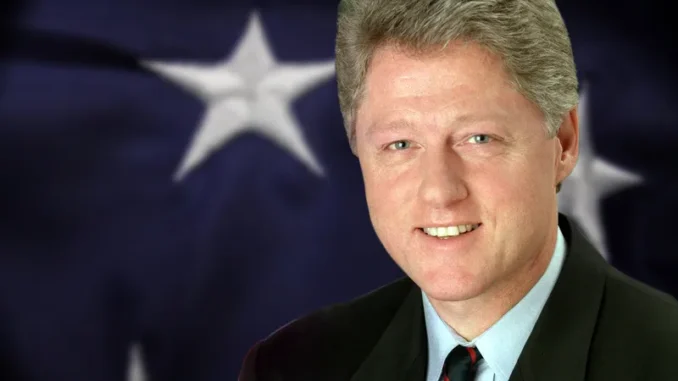
William Jefferson Clinton served as the 42nd President of the United States from January 1993 to January 2001, presiding over the longest period of peacetime economic expansion in American history and navigating one of the most turbulent political episodes a sitting president has ever faced.
Born in the small town of Hope, Arkansas, Clinton rose through a combination of extraordinary intellectual ability, political instinct, and personal charisma to the highest office in the land, only to see his second term consumed by the Monica Lewinsky scandal and an impeachment process that, while ultimately unsuccessful, defined his legacy as much as his policy achievements.
Since leaving office, Clinton has rebuilt his reputation through philanthropy, writing, and continued public engagement, becoming one of the most financially successful and globally active former presidents in American history.
| William Jefferson Clinton (born William Jefferson Blythe III) | |
|---|---|
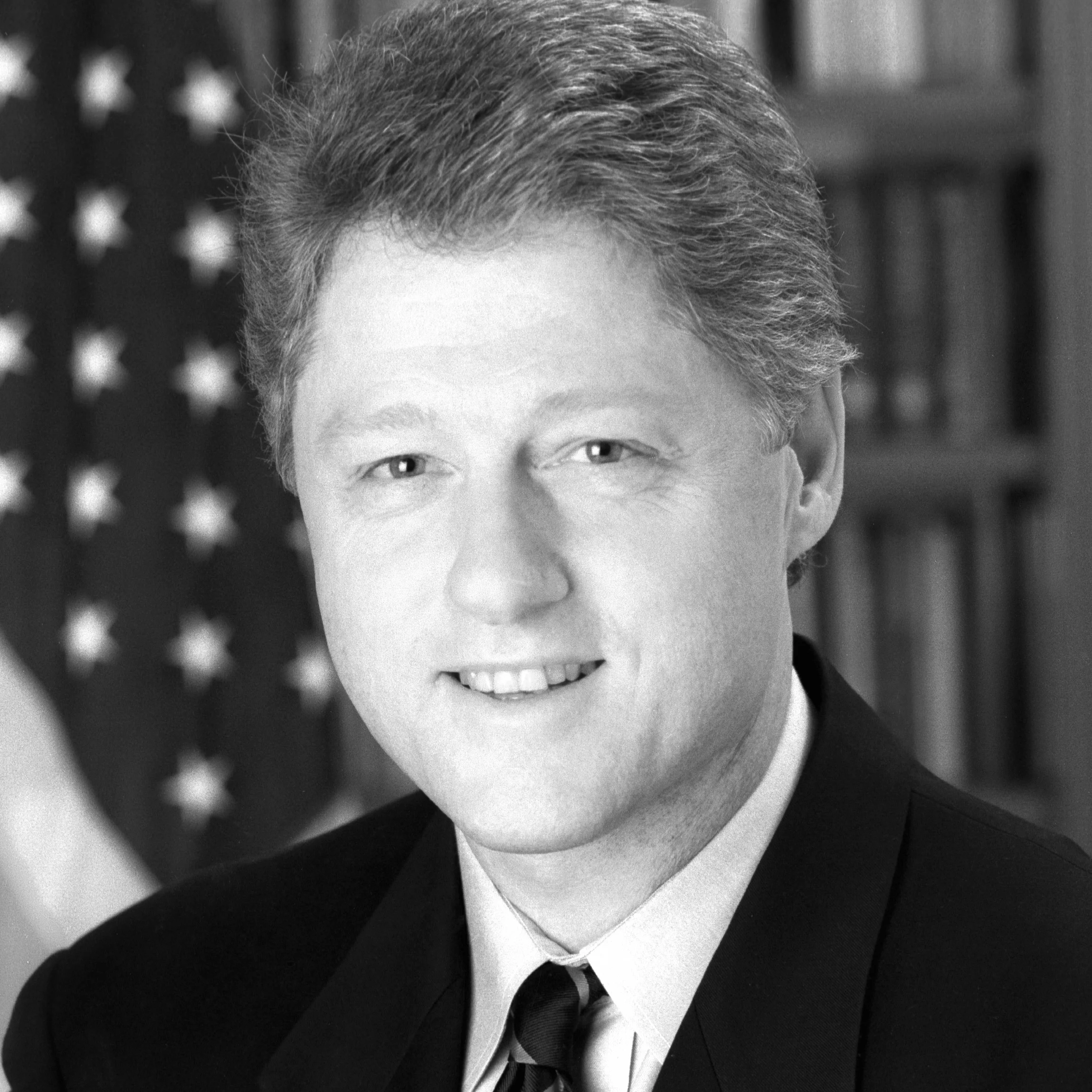 William Jefferson Clinton (born William Jefferson Blythe III): History · Bio · Photo
|
|
| Wiki Facts & About Data | |
| Full Name: | William Jefferson Clinton (born William Jefferson Blythe III) |
| Born: | August 19, 1946 |
| Age: | 79 years old |
| Birthplace: | Hope, Arkansas, USA |
| Nationality: | American |
| Occupation: | Politician, Author, Public Speaker, Philanthropist |
| Spouse: | Hillary Rodham Clinton (married October 11, 1975) |
| Children: | Chelsea Clinton (born 1980) |
| Relationship: | Married |
| Net Worth: | $120 million |
Early Life
William Jefferson Blythe III was born on August 19, 1946, in Hope, Arkansas, to Virginia Dell Cassidy and William Jefferson Blythe Jr., a travelling salesman who died in a car accident three months before his son was born, never knowing he was about to become a father. Virginia later married Roger Clinton Sr., a car dealer from Hot Springs, Arkansas, and young William adopted his stepfather’s surname, becoming William Jefferson Clinton. The relationship with his stepfather was complicated; Roger Clinton was an alcoholic whose volatile behaviour required young Bill to serve at times as a mediating presence between his stepfather and his mother.
Despite a difficult home environment, Clinton demonstrated from an early age the intellectual gifts and social magnetism that would define his political career. He was an outstanding student, a gifted musician (playing the tenor saxophone), and a natural leader. At 16, he travelled to Washington D.C. as a delegate for Boys Nation, a programme that brings outstanding high school students to the capital, and shook hands with President John F. Kennedy in the White House Rose Garden, a moment that Clinton has often cited as the catalyst for his decision to pursue a life in public service.
Education
Clinton attended Georgetown University in Washington D.C., graduating in 1968 with a Bachelor of Science in Foreign Service. He won a prestigious Rhodes Scholarship and spent two years at the University of Oxford in England, where he studied at University College but did not complete a degree. He then enrolled at Yale Law School, graduating in 1973 with his Juris Doctor degree. At Yale, he met Hillary Rodham, who would become his wife and lifelong political partner. Clinton’s educational background, Georgetown, Oxford, Yale, was exceptional and reflected his driving ambition from his earliest years.
Career
Early Political Career
After graduating from Yale Law School, Clinton returned to Arkansas and joined the faculty of the University of Arkansas School of Law. His political career began almost immediately. He ran unsuccessfully for a seat in the U.S. House of Representatives in 1974, losing to the incumbent Republican. In 1976, he was elected Attorney General of Arkansas, and in 1978, at age 32, he was elected Governor of Arkansas, the second-youngest governor in American history at the time. He lost his bid for re-election in 1980, serving only one term, before winning back the governorship in 1982 and going on to serve until 1992. His tenure as Governor established him as a centrist Democrat with a talent for bridging ideological divides.
The Presidency (1993–2001)
Clinton defeated incumbent President George H.W. Bush in the 1992 presidential election with a campaign focused on economic revival, “It’s the economy, stupid” became his campaign’s defining internal slogan. Running as a “New Democrat” aligned with the centrist Third Way political philosophy, he won 370 electoral votes and carried 32 states. Clinton was re-elected in 1996, defeating Republican Bob Dole.
During his presidency, the United States experienced the longest sustained peacetime economic expansion in its history, characterised by budget surpluses (ending decades of deficit spending), falling unemployment, and rising incomes. Key legislative achievements included the signing of the North American Free Trade Agreement (NAFTA) in 1993, the Violent Crime Control and Law Enforcement Act (1994), welfare reform legislation (1996), and the Family and Medical Leave Act. His proposed healthcare reform, the Health Security Act, developed under a task force led by Hillary Clinton, failed to pass Congress, a significant political setback.
Clinton’s foreign policy was shaped by post-Cold War realities: he oversaw NATO’s military intervention in the former Yugoslavia (including the Kosovo War), the Oslo Accords peace process in the Middle East, American engagement in Somalia, Haiti, and Rwanda, and efforts to confront the growing threat of al-Qaeda, efforts that critics later argued were insufficient to prevent the September 11, 2001 attacks that occurred after he left office.
The central crisis of Clinton’s second term was the Monica Lewinsky scandal. Clinton had engaged in a sexual relationship with Lewinsky, a White House intern, in 1995 and 1996. When the relationship became the subject of investigation by Independent Counsel Kenneth Starr, Clinton denied the relationship under oath in a civil lawsuit, a denial he later admitted was false. The House of Representatives voted to impeach Clinton in December 1998 on charges of perjury and obstruction of justice, making him only the second president in American history to be impeached. The Senate voted to acquit him on both articles in February 1999, and he completed his second term. The scandal damaged his personal reputation irreparably in some quarters while leaving his policy legacy largely intact.
Post-Presidential Career
Since leaving the White House in January 2001, Clinton has been one of the most active former presidents in American history. He founded the William J. Clinton Foundation (now the Clinton Foundation), a non-profit organisation addressing global health, economic development, and climate change in developing countries. He has earned extraordinary sums through speaking engagements, reportedly charging up to $500,000 per speech, and through book deals. His memoir “My Life” (2004) was published with a $15 million advance, the largest non-fiction book advance in history at the time, and became an international bestseller. He has co-authored a series of political thriller novels with James Patterson, including “The President Is Missing” (2018), “The President’s Daughter” (2021), and “The First Gentleman” (2025). He and Hillary Clinton together have earned more than $250 million from speaking engagements and book advances since leaving the White House.
Awards and Nominations
- Honorary Doctor of Law degrees from multiple universities including Georgetown University
- Honorary Fellow of University College, Oxford
- Kosovo named Bill Clinton Boulevard and erected a statue of him in Pristina in recognition of his role in the Kosovo War
- Presidential Medal of Freedom — has awarded the honour to others during and after his presidency
- Schools and public buildings named in his honour in multiple countries
Social Media
- Twitter/X: @BillClinton
- Facebook: Bill Clinton (Official Page)
- Instagram: @billclinton
Personal Life
Bill Clinton married Hillary Rodham on October 11, 1975, in Fayetteville, Arkansas. The couple have one daughter, Chelsea Clinton (born 1980), who is married to Marc Mezvinsky and has three children of her own. The Clinton marriage has withstood the extraordinary public pressures of political life and the personal devastation of the Lewinsky scandal, which Hillary Clinton has addressed candidly in her own memoir “Living History.” The two have remained together and continue to work in parallel on political and philanthropic causes, though they maintain distinct public careers. Bill Clinton has faced additional allegations of sexual misconduct from other women over the years, allegations he has denied.
Clinton underwent quadruple bypass heart surgery in 2004 and has been open about his subsequent commitment to a plant-based diet and healthier lifestyle. He has credited the dietary change with significantly improving his health. He is also a grandfather, a role he has spoken about with evident warmth. He remains an active presence in Democratic Party politics, though his influence has evolved as the party has changed around him.
Net Worth
Bill Clinton’s net worth, combined with that of Hillary Clinton, is estimated at approximately $120 million as of 2025. This wealth was built almost entirely after leaving the White House, the Clintons were effectively in debt when they departed in 2001 due to legal fees accumulated during the Lewinsky investigation. Primary income streams include speaking fees (Clinton has earned over $100 million in speaking engagements alone), book advances and royalties, investments, and a $200,000 annual presidential pension. The Clinton Foundation, which operates separately, is a non-profit organisation and does not contribute to personal net worth.
Political Achievements and Offices Held
- Attorney General of Arkansas (1977–1979)
- Governor of Arkansas, first term (1979–1981)
- Governor of Arkansas, second through fifth term (1983–1992)
- 42nd President of the United States (January 20, 1993 – January 20, 2001)
- Founder, Clinton Foundation (2001–present)
- UN Special Envoy to Haiti (2009–2013)
Conclusion
Bill Clinton’s place in American history is uniquely complicated, a figure of extraordinary political talent and achievement who was also brought low by personal failures that became a national spectacle.
He governed during a period of genuine prosperity and oversaw significant policy accomplishments. He also lied under oath and survived an impeachment process that consumed the final years of his presidency.
Since leaving office, he has built a remarkable post-presidential legacy through the Clinton Foundation, his writing, and his continued engagement with global issues.
His story is one of the most fully human in American political history, a man of towering gifts and real flaws, whose legacy continues to evolve with time.
Related People


Leave a Reply