
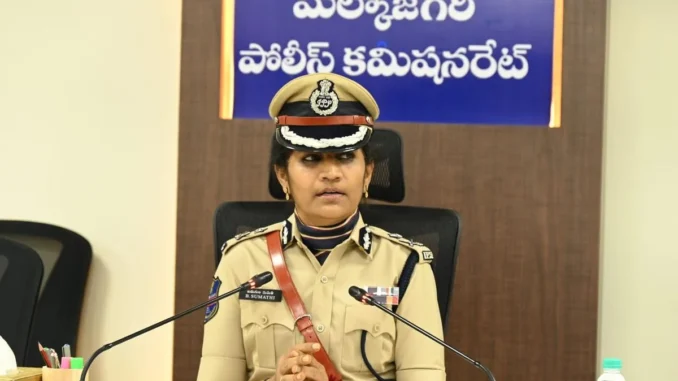
In the annals of Telangana’s law enforcement history, very few names carry as much weight, admiration, and quiet authority as B Sumathi.
A career police officer of over two decades, she has risen through the ranks of the Indian Police Service not through spectacle or controversy, but through disciplined policing, strategic intelligence work, compassionate community engagement, and an unwavering commitment to what she describes as the “human face of policing.”
From her roots in a village in Jogulamba Gadwal district to the historic appointment as the first woman Commissioner of Police of Malkajgiri one of the most populous and rapidly urbanizing police commissionerates in Telangana her journey stands as a powerful testament to perseverance, public service, and purposeful leadership.
Whether she was introducing the groundbreaking Village Police Officer scheme in Medak district, setting up the Chethna counselling centre for crime victims in Hyderabad, overseeing the surrender of nearly 600 Maoist leaders and cadres as head of the Special Intelligence Branch, or championing AI-driven policing tools in Malkajgiri, Sumathi has consistently demonstrated that effective policing is as much about empathy and innovation as it is about enforcement and authority.
| Badugula Sumathi | |
|---|---|
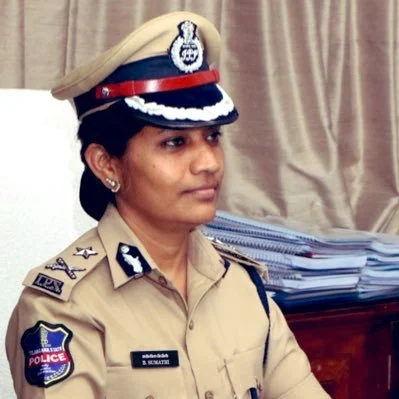 Badugula Sumathi: History · Bio · Photo
|
|
| Wiki Facts & About Data | |
| Full Name: | Badugula Sumathi |
| Stage Name: | B Sumathi / Sumathi IPS / SDM |
| Birthplace: | Kalugotla Village, Jogulamba Gadwal District, Telangana |
| State of Origin: | Telangana, India |
| Nationality: | Indian |
| Occupation: | Indian Police Service Officer |
| Religion: | Hinduism |
| Parents: | Late Badugula Tirupati Reddy (Former Sarpanch) |
Early Life
Badugula Sumathi was born and raised in Kalugotla village, located in the Jogulamba Gadwal district of Telangana, in the southern region of India. Her roots are deeply rural and deeply meaningful she comes from a family with a tradition of public service and community leadership.
Her father, the late Badugula Tirupati Reddy, served as the sarpanch (elected village head) of the village for ten years, a role that placed him at the centre of local governance, dispute resolution, and community welfare.
Growing up watching her father engage with the challenges and responsibilities of local administration gave young Sumathi an early and visceral understanding of the relationship between authority and the common people a relationship built on trust, accountability, and presence.
It was not her father, however, but her grandmother who is credited with first planting the seed of a career in policing in Sumathi’s mind. Her grandmother dreamed of seeing the family represented in the police service, and according to those close to Sumathi, this dream became a guiding aspiration that she carried through her academic years and into her competitive examination preparation.
Growing up in rural Telangana in the 1970s and 1980s, Sumathi would have witnessed firsthand the social challenges of her region communal tensions, feudal disputes, the lingering influence of caste-based hierarchies, and the limited public services available to women and marginalized communities.
These early experiences are widely believed to have informed her later emphasis on community-facing, empathetic policing an approach that would define her career at every level of service.
Education
Sumathi completed her schooling in the Jogulamba Gadwal area before pursuing undergraduate studies in the sciences. She earned a Bachelor of Science in Agriculture (B.Sc. Agriculture) from Acharya N. G. Ranga Agricultural University, one of Telangana’s premier agricultural science institutions.
Her choice of an agricultural science background was reflective of the rural milieu in which she grew up, and it gave her a practical, grounded perspective that she would later bring to her postings in rural districts.
After completing her degree, Sumathi pursued the competitive examinations for recruitment into the Andhra Pradesh State Police Service (SPS). She cleared the recruitment examination and was selected as a Deputy Superintendent of Police (DySP) in the 2001 batch of the State Police Service.
Her success was historic: she became the first woman to hold the post of DySP in the undivided state of Andhra Pradesh at just 25 years of age a landmark achievement that immediately distinguished her as a trailblazer in a profession historically dominated by men.
Through her exceptional performance as a DySP and in subsequent roles, Sumathi was promoted to the Indian Police Service (IPS) in 2006, under the State Police Service promotion quota IPS identity number 20062658, with an official IPS joining date of December 19, 2011.
Career
Early Career: DySP and the Historic First
Sumathi’s first posting as DySP was in Warangal, then in the undivided state of Andhra Pradesh. Even at this early stage of her career, she distinguished herself through her methodical approach to community policing and her willingness to engage with the most vulnerable members of society.
Her appointment as the first woman DySP in undivided Andhra Pradesh was widely noted in the media and within police circles, setting a precedent for female officers in the state’s law enforcement hierarchy.
Her early postings across various districts in Andhra Pradesh gave her a broad exposure to the diverse challenges of policing in a large and complex state from urban crime in district headquarters to the deep-rooted social issues of rural areas, including Naxal influence, inter-caste conflicts, and crimes against women and children.
The Maoist Peace Talks Contribution (2004)
One of the most significant early chapters of Sumathi’s career was her involvement in the 2004 Maoist peace talks in Andhra Pradesh a landmark diplomatic and security exercise in which the state government and Left-wing extremist leadership agreed to hold formal negotiations.
As a serving officer with ground-level intelligence experience, Sumathi played a role in the broader security and intelligence framework surrounding these talks. The experience gave her an early and formative exposure to the complexity of dealing with Left-wing extremism (LWE), a challenge that would return to define some of the most consequential work of her later career.
Superintendent of Police Posting Medak: The Village Police Officer Initiative
Among the most celebrated achievements of Sumathi’s field career was her tenure as a senior officer in Medak district, where she introduced a transformative community policing model known as the “Village Police Officer” plan. Recognising that in rural areas, the distance between ordinary citizens and the nearest police station was a fundamental obstacle to reporting crime and seeking help, Sumathi devised a system in which every single village in Medak would be placed under the direct surveillance of a dedicated constable, who would simultaneously serve as a de facto Station House Officer (SHO) for that village receiving complaints, mediating disputes, and serving as the primary point of contact between residents and the broader police machinery.
The initiative was not merely a tactical policing tool but a cultural transformation it brought the police closer to the people in the most literal possible sense. The plan was so successful and so widely praised that it was subsequently implemented across the entire state of Telangana, a testament to Sumathi’s capacity for institutional thinking and scalable innovation.
The Chethna Counselling Centre Hyderabad
Upon her transfer to Hyderabad, Sumathi was posted as Deputy Commissioner of Police (DCP), North Zone, where she took charge with a clear and publicly stated mandate: that criminals would not rest in peace in her jurisdiction. Her approach to urban policing combined aggressive enforcement with compassionate victim support.
Among her most significant initiatives in Hyderabad was the establishment of Chethna a dedicated distress counselling centre designed to provide psychological support and practical assistance to victims of crime, particularly women and children who had experienced sexual violence, domestic abuse, and other serious offences. The centre was one of the first of its kind within the Telangana police framework and received significant recognition from both the state government and civil society organisations. Sumathi also introduced counselling centres in the North Zone more broadly, embedding mental health and victim support into the standard operating procedures of her division.
The Chethna initiative won a national-level award, further cementing Sumathi’s reputation as a forward-thinking, people-centred police leader.
Promotion to DIG CID Women Protection Cell
As her career progressed, Sumathi was promoted to the rank of Deputy Inspector General of Police (DIG). A significant posting at this level was her role as DIG of the Crime Investigation Department (CID), Women Protection Cell a posting that placed her at the intersection of investigative policing and the protection of women’s rights. In this capacity, she oversaw investigations into crimes against women, trafficking, domestic violence, and related offences across the state, working in close coordination with prosecutors, NGOs, and social welfare agencies.
Her promotion to Inspector General of Police (IGP) came in 2020, as reflected in official government records, marking her ascension to the senior command tier of the IPS hierarchy in Telangana.
IGP Special Intelligence Branch (SIB): The Maoist Surrender
The most nationally prominent chapter of Sumathi’s career came during her tenure as Inspector General of Police, Special Intelligence Branch (SIB), Telangana a posting she held from February 24, 2024. As the head of the SIB, Sumathi was responsible for overseeing Telangana’s state intelligence operations, including the critically sensitive domain of Left-wing extremism and Maoist counter-operations.
Under her leadership and meticulous stewardship of long-drawn negotiation processes, Telangana achieved a historic milestone in February 2026: the surrender of top Maoist commander Thippiri Tirupati alias Devuji a key Central Committee member of the banned Communist Party of India (Maoist) and a politburo member along with another central committee member, Malla Raji Reddy, and two other senior Maoist cadre. The surrender took place in the presence of Telangana DGP B Shivadhar Reddy, while Sumathi sat on the dais as the quiet but central architect of the entire process.
By the time of the Devuji surrender, Sumathi had overseen the return of 591 Maoist leaders and cadres to the mainstream through the Telangana Police’s rehabilitation and surrender framework over a period of approximately two years one of the most significant achievements in India’s decades-long effort to address Left-wing extremism through negotiation and persuasion rather than purely military means. She was also noted for executing undercover intelligence operations during her earlier counter-intelligence work, though the specific details of such operations remain classified.
First Woman Commissioner of Police Malkajgiri (2026)
On May 1, 2026, Sumathi achieved another historic milestone when she was appointed as the first woman Commissioner of Police of Malkajgiri, one of the largest and fastest-growing urban police commissionerates in Telangana. The Malkajgiri Commissionerate covers a vast area of greater Hyderabad’s periphery and encompasses a large, diverse, and rapidly urbanizing population.
Upon assuming charge, Sumathi outlined a bold vision for her tenure at Malkajgiri: technology-driven, citizen-centric policing anchored in transparency, accountability, and responsiveness. She announced a major push toward AI-driven policing tools, with particular emphasis on TG QUEST an advanced crime detection and prevention system. While acknowledging that Malkajgiri is relatively peaceful compared to some other commissionerates, she emphasised that maintaining law and order without compromise would remain central to her leadership.
Awards & Honours
National Award for the Chethna Counselling Centre Sumathi’s Chethna distress counselling initiative in Hyderabad earned national recognition for its innovative approach to victim support within a police framework.
Recognition for the Village Police Officer Plan Her pioneering community policing initiative in Medak was lauded at the state level and subsequently adopted across Telangana, representing one of the most impactful policing innovations in the state’s history.
State Police Service to IPS Promotion (2006) Her promotion from the State Police Service to the Indian Police Service was itself an institutional recognition of her exceptional performance over the first years of her career.
Historic First Recognition First Woman DySP, Undivided Andhra Pradesh Widely noted across police, government, and media circles as a pioneering achievement for women in Indian law enforcement.
Historic First Recognition First Woman Commissioner of Police, Malkajgiri A landmark appointment that made national headlines and established her as one of the senior-most and most consequential women in Telangana’s police history.
Recognition for Maoist Surrender Operations (2026) Her stewardship of the surrender of 591 Maoist cadres, including top Central Committee member Devuji, was widely praised by the Government of Telangana, the DGP, and national security analysts as one of the most significant counter-extremism achievements in the state’s recent history.
Social Media
IPS B Sumathi maintains an active and engaged presence on social media, using her platforms primarily to communicate with citizens, share updates on policing initiatives, and promote the human and community-facing aspects of law enforcement consistent with her philosophy of the “human face of policing.”
Twitter/X: Sumathi is active on Twitter/X under the handle @SumathiIPS, where she has accumulated approximately 27,300 followers. Her Twitter bio reads: “IPS officer, IGP Telangana / Believes in Human face of Policing / Balancing act Be Simple & Sincere / Hyderabad, India.” She joined the platform in May 2020 and regularly shares updates on policing, citizen engagement, and motivational content.
Instagram: She is active on Instagram under the handle @sumathiips, where she has amassed over 54,000 followers, with more than 447 posts. Her Instagram page offers a mix of professional updates, community engagement moments, and glimpses of her work across various postings in Telangana.
Facebook: Sumathi maintains an official Facebook page under the name Sumathi Badugula, with over 31,600 followers. Her Facebook page is used to share police updates, citizen service initiatives, and news about Telangana Police’s performance and achievements. She recently shared news of Telangana Police’s top national ranking in the India Justice Report 2025, celebrating the achievement with her followers.
Personal Life
Sumathi is known for maintaining a deeply private personal life, consistent with the professional discretion expected of senior intelligence and law enforcement officers. She has not made her marital status, spouse, or family details a subject of public discussion, and biographical sources contain minimal information about her personal relationships or domestic life.
What is publicly known is that her family background is rooted in Kalugotla village in Jogulamba Gadwal, and that the influence of her father the late Badugula Tirupati Reddy, who served as village sarpanch and her grandmother’s dream of seeing the family serve in policing were central to shaping her career choices. The loss of her father is a part of her family history, and she has spoken in interviews about the values of simplicity, sincerity, and public service that her background instilled in her.
As a woman who broke barriers at every stage of a career that spans more than two decades, Sumathi has spoken candidly about navigating the male-dominated world of Indian policing. She has described her guiding philosophy as a balancing act: “Be Simple and Sincere” a maxim that appears in her social media profiles and that she has cited in interviews as the core of her approach to both leadership and life.
She has spoken about the importance of the “human face of policing” the belief that police effectiveness is built on citizen trust, and that trust is built through empathy, transparency, and genuine service. This philosophy has informed every major initiative of her career, from the Village Police Officer scheme to the Chethna counselling centres to her AI-driven policing agenda in Malkajgiri.
Net Worth
As an Indian Police Service officer at the Inspector General level (Pay Level 14 as of February 2024), IPS B Sumathi draws a salary and benefits as determined by the 7th Pay Commission norms applicable to senior IPS officers. At the IGP/DIG level, IPS officers typically receive a basic pay in the range of ₹1,44,200 to ₹2,18,200 per month, in addition to allowances including house rent allowance (HRA), travel allowance, medical benefits, and other government perquisites.
Her net worth, accumulated entirely through government service, is estimated in the range of ₹2 crore to ₹4 crore consistent with the financial profile of a career IPS officer of her seniority and service length. She has no known private business interests. As a public servant, her financial disclosures are subject to government regulations and periodic asset declarations required of all IPS officers.
FAQs
Who is IPS B Sumathi?
IPS B Sumathi (full name Badugula Sumathi) is a senior Indian Police Service officer of the Telangana cadre, currently serving as the first woman Commissioner of Police of Malkajgiri. She is known for her groundbreaking policing initiatives, her role in overseeing the historic surrender of top Maoist leaders in Telangana, and her philosophy of the “human face of policing.”
What batch is IPS B Sumathi?
B Sumathi was recruited as a DySP in the 2001 batch of the Andhra Pradesh State Police Service and was subsequently promoted to the Indian Police Service (IPS) in 2006. Her official IPS joining date is December 19, 2011.
What is B Sumathi’s current posting?
As of May 1, 2026, IPS B Sumathi is serving as the Commissioner of Police of Malkajgiri, Telangana making her the first woman to hold this position. Prior to this, she served as IGP, Special Intelligence Branch (SIB), Telangana from February 24, 2024.
Where is B Sumathi from?
B Sumathi was born and raised in Kalugotla village, Jogulamba Gadwal district, Telangana. She hails from a family rooted in public service, with her late father having served as village sarpanch for ten years.
What is the Village Police Officer plan by Sumathi?
The Village Police Officer plan was a community policing initiative introduced by B Sumathi during her posting in Medak district. Under this scheme, every village in the district was placed under the surveillance of a dedicated constable who also served as a de facto station house officer, receiving citizen complaints and maintaining law and order at the grassroots level. The initiative was so successful it was subsequently implemented across Telangana state.
What is the Chethna centre?
Chethna is a distress counselling centre introduced by B Sumathi during her tenure as DCP North Zone in Hyderabad. It was designed to provide psychological support and practical assistance to victims of crime particularly women and children who had experienced sexual violence or domestic abuse. The initiative won a national award for policing innovation.
What role did Sumathi play in the Maoist surrender?
As head of the Special Intelligence Branch (SIB) of Telangana Police, Sumathi was the silent architect of the historic February 2026 surrender of top Maoist commander Devuji (Central Committee member) and other senior cadres before the state DGP. Over approximately two years in her SIB role, she oversaw the surrender and rehabilitation of 591 Maoist leaders and cadres.
What is B Sumathi’s educational qualification?
B Sumathi holds a Bachelor of Science in Agriculture (B.Sc. Agriculture) from Acharya N. G. Ranga Agricultural University in Telangana.
Conclusion
IPS B Sumathi’s biography is a study in quiet, sustained excellence the kind of leadership that does not seek the spotlight but is consistently found at the centre of the most consequential moments. From the narrow lanes of a Jogulamba Gadwal village to the Commissioner’s office in Malkajgiri, her journey has been one of unbroken purpose, marked by a series of firsts that have permanently expanded what women in Indian policing can achieve.
She introduced a policing model that is now used across an entire state. She built counselling centres that gave victims a safe place to be heard. She supervised the peaceful return of nearly 600 individuals from armed insurgency to mainstream society. She championed AI-driven policing tools before most of her peers had recognised their potential. And through all of it, she has maintained the philosophy that her sarpanch father and dreaming grandmother would have recognised: that the power of the state, when wielded with sincerity and simplicity, must always serve the people it protects.
As the first woman Commissioner of Police of Malkajgiri, Sumathi has not merely broken a glass ceiling. She has demonstrated, beyond any reasonable doubt, that the most effective policing is human policing and that the best police officers are, at their core, public servants in the fullest and most honourable sense of that term.
Related People







Leave a Reply