
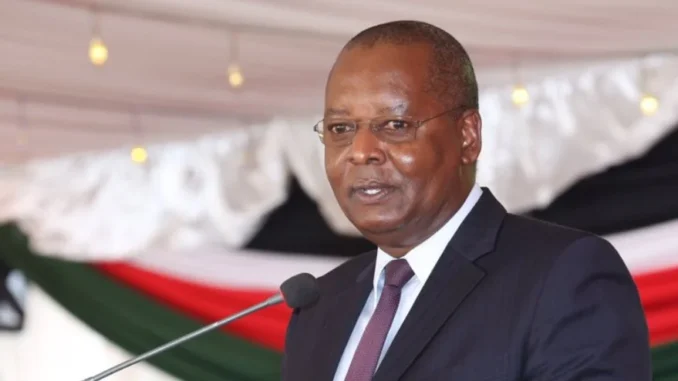
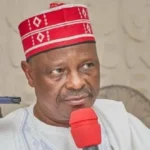
Amos Muhinga Kimunya is one of Kenya’s most recognisable and resilient political figures. A trained accountant who rose to become one of the most powerful ministers in President Mwai Kibaki’s government, Kimunya has navigated a career full of remarkable highs and near-catastrophic lows.
He served as Kenya’s Minister of Lands and Settlement, Minister of Finance, and Minister of Trade, and later returned to public life as the Majority Leader of the National Assembly under the Jubilee Party.
Famously nicknamed the man who declared “I would rather die than resign” only to resign days later Kimunya’s story is a testament to the turbulent, unpredictable nature of Kenyan politics and the rare ability to bounce back from disgrace into relevance.
| Amos Muhinga Kimunya | |
|---|---|
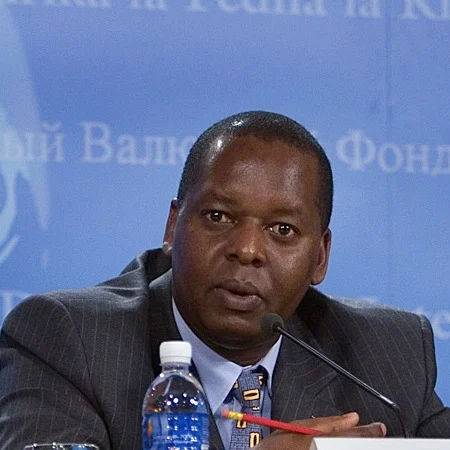 Amos Muhinga Kimunya: History · Bio · Photo
|
|
| Wiki Facts & About Data | |
| Full Name: | Amos Muhinga Kimunya |
| Born: | March 6, 1962 |
| Age: | 64 years old |
| Birthplace: | Kiambu, Kenya |
| Nationality: | Kenyan |
| Occupation: | Politician, Accountant, Academic |
| Religion: | Christianity |
| Parents: | Late Mzee Samuel Kimunya Gikang'a (father); Maria Muthoni Kimunya (mother) |
| Spouse: | Lucy Muhinga Kimunya (deceased, January 30, 2024); previously Sabina Chege |
| Children: | 7 children |
| Net Worth: | Estimated between $1 million and $5 million USD |
Early Life
Amos Muhinga Kimunya was born on March 6, 1962, in Kiambu, a county in the Central Region of Kenya, to Mzee Samuel Kimunya Gikang’a and Maria Muthoni Kimunya.
Around the time of his birth, his family relocated to the newly constituted Nyandarua District a highland farming area in what is now Nyandarua County and it is there that he grew up and developed his roots. Nyandarua would later become the constituency from which he would build his entire political career.
His father, Mzee Samuel Kimunya Gikang’a, lived a long life and passed away in July 2011 at the age of 86 at Nairobi Hospital. His mother, Maria Muthoni Kimunya, survived his father.
Growing up in a highland farming community shaped Kimunya’s understanding of rural poverty and agricultural economics a worldview that would later influence some of his most notable policy decisions and personal initiatives, including an attempt to support potato farmers in the Kipipiri area through an agricultural company.
Kimunya grew up in an era when Kenya was still a young independent nation, and public service was seen as one of the most prestigious career paths a young Kenyan could choose.
He demonstrated academic ability from an early age and progressed through the Kenyan educational system with distinction, eventually making it to the University of Nairobi one of Kenya’s most competitive institutions.
Education
Kimunya began his formal education at Kabati Primary School. He then proceeded to Njabini Boys High School in Nyandarua, where he completed his O-Level examinations in the 1980s. Njabini Boys is located in the heart of the Aberdare highlands and is one of the notable secondary schools in Nyandarua County.
After completing high school, Kimunya enrolled at the University of Nairobi, where he graduated in 1986 with a Bachelor of Commerce (Accounting Option) degree. The University of Nairobi later recognised him as a Distinguished Alumnus.
He subsequently sat for the professional accountancy examinations, completing them in just two sittings, and was registered as a Certified Public Accountant (CPA-K) in October 1987. He also holds the qualification of Certified Public Secretary (CPS-K).
Demonstrating a lifelong commitment to self-improvement particularly during the period when he was out of politics Kimunya pursued further academic qualifications.
In 2014, he received a Global Executive Master of Business Administration (GEMBA) from the United States International University (USIU-Africa) in Nairobi. He went further and in 2019 graduated with a PhD in Business Administration from USIU-Africa, becoming one of the few Kenyan politicians to hold a doctoral degree.
His academic journey during this period was, by his own admission, partly inspired by his 2013 election defeat, which he described as a “blessing in disguise” that gave him time to pursue academic and personal fulfilment.
He also studied at Strathmore School of Accountancy and has been listed as a member of the World Economic Forum, reflecting his standing as a respected figure in finance and governance circles.
Career
Early Professional Career: Accounting and Consultancy (1986–2002)
Following his graduation from the University of Nairobi and his registration as a Certified Public Accountant, Kimunya launched a distinguished career in the private sector.
From 1986 to 1993, he worked at Care Stanyer Gitau and Company, a private accounting firm, rising quickly through the ranks to the position of Senior Manager. This stint gave him deep expertise in financial management, auditing, and corporate governance.
In 1997, he founded Finmans Consultancy in Nairobi, a financial consulting firm. In 1998, the firm merged with Matrix to form Matrix Development Consultants, and Kimunya served as a Director and Consultant for the company from 1998 until 2003, when he transitioned fully into public service.
During this period, he also served on various councils and advisory boards, including as a Council Member and Convener between 1998 and 2001. He was also a club captain of the prestigious Muthaiga Golf Club in Nairobi, one of Kenya’s most exclusive social institutions a role that placed him within the orbit of Kenya’s business and political elite.
Entry into Politics: Minister of Lands and Settlement (2002–2006)
Kimunya’s entry into politics came with the historic 2002 general elections, in which the National Rainbow Coalition (NARC) swept to power, ending decades of KANU dominance. Kimunya stood for the Kipipiri Constituency seat in Nyandarua County and won on the NARC ticket.
The new President, Mwai Kibaki, appointed him as Minister of Lands and Settlement his first cabinet appointment. It was a posting that placed him at the centre of land policy debates in a country where land ownership is one of the most politically charged issues.
Kimunya’s professional background in accountancy and financial management made him stand out in the cabinet, and he quickly became part of Kibaki’s inner circle regarded as one of the few ministers who had direct access to the President. This influence would prove both a source of power and, eventually, a magnet for controversy.
Minister of Finance (2006–2008)
On February 14, 2006, President Kibaki appointed Kimunya as Minister of Finance, following the resignation of the incumbent Minister David Mwiraria, who had been implicated in the Anglo-Leasing Scandal.
The Anglo-Leasing affair involved fictitious contracts for government security projects and cost Kenya billions of shillings. Kimunya stepped into the role as a “clean” technocrat expected to restore confidence in the Treasury.
As Finance Minister, Kimunya oversaw some of the most significant economic transactions in post-Moi Kenya. He was credited with leading President Kibaki’s privatisation programme, which included the landmark sale of a 51% stake in Telkom Kenya to France Telecom.
He also directed Kenya’s largest-ever initial public offering the flotation of telecoms giant Safaricom on the Nairobi Securities Exchange which generated massive public interest and oversubscription. Under Kibaki’s economic team, which Kimunya was a key part of, Kenya experienced a significant economic rebound after the stagnation of the Moi era.
Following the disputed December 2007 elections which plunged Kenya into devastating post-election violence and the subsequent power-sharing agreement between Kibaki and Raila Odinga, Kimunya was retained as Finance Minister in the Grand Coalition Cabinet announced on April 13, 2008. This retention reflected the trust that the Kibaki wing placed in his financial stewardship.
The Grand Regency Hotel Scandal and Resignation (2008)
Kimunya’s tenure as Finance Minister came to a dramatic end in mid-2008 over the controversial sale of the Grand Regency Hotel in Nairobi (now known as Laico Grand Regency Hotel). The hotel had previously been seized by the Central Bank of Kenya as proceeds of the Goldenberg Scandal a massive fraud from the Moi era that had siphoned billions from Kenyan taxpayers. The hotel was allegedly sold to a Libyan investment entity at a price widely believed to be far below its market value, without following proper public procurement procedures.
Parliament erupted in outrage. On July 2, 2008, Kimunya became the subject of a parliamentary vote of no confidence, which passed. In the lead-up to the vote, Kimunya defiantly declared: “I would rather die than resign!” a statement that became one of the most quoted lines in Kenyan political history. However, just days later, on July 8, 2008, he resigned from the cabinet to allow an independent commission to investigate the hotel sale.
The dramatic turnaround from defiant refusal to sudden resignation shocked many observers. However, the story did not end there. On November 25, 2008, an official inquiry cleared Kimunya of any wrongdoing in the hotel sale. Although the commission’s full report was not made public, its conclusion enabled Kimunya’s political rehabilitation. In January 2009, President Kibaki reappointed him to the cabinet as Minister of Trade.
Minister of Trade and Further Challenges (2009–2013)
As Minister of Trade, Kimunya continued to work within the Kibaki administration until the end of its term.
However, his tenure was not without incident. On August 15, 2009, his security guard was shot dead by gangsters while driving in Nairobi. Kimunya was not present at the scene. The incident underscored the security risks faced by senior Kenyan officials.
When the 2013 general elections arrived, Kimunya sought reelection in Kipipiri but suffered a shocking defeat at the hands of Samuel Gichigi, who garnered 16,479 votes against his total. The loss came as a surprise to many, given his profile as a former cabinet minister.
Kimunya himself admitted the defeat was a shock. In an unusual move following his loss, he reportedly wrote a letter to his constituents lamenting that they had not appreciated his development record a move that drew criticism but also reflected the rawness of his defeat.
The Comeback and National Assembly Majority Leadership (2017–2022)
True to his reputation as a political survivor, Kimunya spent his time out of office productively pursuing his MBA and later his PhD, completing the Foothills School project in Nyandarua, and playing golf at Muthaiga Club. He described the 2013 loss as a “blessing in disguise” that reshaped his outlook on life and knowledge.
In 2017, Kimunya made his political comeback, reclaiming the Kipipiri seat on a Jubilee Party ticket. His return to Parliament in the 12th Parliament was notably quieter and more measured than his earlier tenures colleagues described him as calm, focused, and less prone to the political theatre that had earlier defined him.
His composure and loyalty to President Uhuru Kenyatta paid dividends. In June 2020, when President Kenyatta moved to rein in the National Assembly and remove allies of Deputy President William Ruto from leadership positions, Kimunya was chosen to replace the outspoken Aden Duale as Majority Leader of the National Assembly.
The appointment took just 25 minutes at a Jubilee Parliamentary Group meeting chaired by President Kenyatta. As Majority Leader, Kimunya became the government’s chief whip in the lower house, tasked with shepherding the President’s legislative agenda through Parliament.
He served as Majority Leader until the 2022 general elections, in which he contested for the Kipipiri seat under the Jubilee Party within the Azimio La Umoja One Kenya Coalition. The elections proved disastrous for the Jubilee-Azimio alliance in the Mount Kenya region, swept by the United Democratic Alliance (UDA) wave. Kimunya was defeated by Wanjiku Muhia of UDA, conceding defeat graciously and acknowledging the will of the voters.
Post-Parliament: Legal Battles, Academia, and Acquittal (2022–2026)
After leaving Parliament, Kimunya found himself embroiled in a long-running legal battle that traced back to decisions he had made as Minister of Lands and Settlement in 2003.
He had been prosecuted for allegedly fraudulently acquiring a 25-acre piece of land in Kipipiri valued at approximately Ksh 60 million, through a company called Midlands Limited. Kimunya consistently maintained that his involvement with the land was intended to help poor, small-scale potato farmers in Nyandarua County earn better incomes.
The case dragged on for 12 years, through multiple trials and retrials. In a ruling delivered at the Milimani Anti-Corruption Court on May 6, 2026, the magistrate acquitted Kimunya of all charges, finding that the prosecution had not presented sufficient evidence to establish that he had fraudulently disposed of the land or improperly influenced its allocation.
The court also noted that Midlands Limited appeared to have been established as a public-oriented initiative benefiting farmers. On being acquitted, a clearly emotional Kimunya declared: “I have been vindicated. I suffered because I helped the poor farmers of Nyandarua earn more from their potato farming. I suffered for 12 years despite doing nothing wrong.”
Poignantly, Kimunya added that he wished his wife Lucy who had been his main source of moral support through the ordeal had lived to see his vindication. Lucy had passed away on January 30, 2024, while Kimunya was still being tried.
Following his acquittal, Kimunya indicated he intends to move away from politics entirely and pursue a career in academia, believing that mentoring and educating young people would have a more direct and lasting impact on society.
Awards & Recognition
- University of Nairobi Distinguished Alumnus – Recognised by his alma mater for his contributions to public service and finance in Kenya.
- World Economic Forum Member – Listed as a member of the World Economic Forum, reflecting his standing in global governance and finance discussions.
- Credited with Kenya’s Economic Turnaround (Post-2002) – Widely acknowledged as part of the Kibaki economic team that reversed the stagnation of the Moi era, overseeing significant GDP growth, the Safaricom IPO, and the Telkom Kenya privatisation.
Social Media
Amos Kimunya has maintained a presence on social media, particularly on X (formerly Twitter) and Facebook, through which he has shared personal statements on major life events including the passing of his wife in January 2024 and his feelings about his legal battles.
His accounts are not among the most active of Kenyan politicians, but they provide a window into his personal reflections.
During his time as National Assembly Majority Leader, his official statements and press interactions were frequently covered by Kenyan mainstream media including the Daily Nation, The Standard, Tuko.co.ke, and Kenyans.co.ke.
He does not currently maintain highly active public social media profiles with large followings comparable to younger Kenyan politicians, preferring a more reserved public presence.
Personal Life
Amos Kimunya’s personal life has been the subject of some public interest, particularly regarding his marriages. He was previously married to Sabina Chege, the popular media personality and politician who later became the Muranga County Women’s Representative.
Reports indicate that Sabina and Kimunya sired two children together before the relationship ended reportedly during a period when Kimunya was going through significant professional and personal difficulties after his cabinet resignation. Sabina Chege later remarried and built her own distinguished political career.
Kimunya subsequently married Lucy Muhinga Kimunya, whom he described as the greatest pillar of his personal and political life. Lucy stood by him through the highs and lows of his career, including the Grand Regency Hotel scandal, the 2013 election defeat, and the 12-year legal battles that followed.
He credited her with contributing immensely to his personal growth and rise in the political sphere. In a tribute after her death, he wrote: “She was a key pillar in my personal and political life; she contributed immensely to making our society greener through various initiatives and support of the youth and women.”
Tragically, Lucy Kimunya passed away on January 30, 2024, while receiving care at Nairobi Hospital. Kimunya was still undergoing his land-grabbing trial at the time. Her death before his acquittal in May 2026 was one of the most painful aspects of the entire ordeal, as Kimunya lamented publicly that he wished she had lived to see his vindication.
Kimunya is a father of seven children. He is known to be a keen golfer and was once a club captain at the prestigious Muthaiga Golf Club in Nairobi. His post-2013 years spent studying, playing golf, and overseeing community projects are often cited by Kimunya himself as some of the most fulfilling of his life, suggesting a man who found peace in pursuing knowledge and personal goals away from the political arena.
Controversies
Beyond the Grand Regency Hotel scandal and the land case, Kimunya’s career also attracted attention in June 2021, when he was confronted and heckled by an angry crowd during the Kiambaa by-election. Voters at the Kimuga polling station challenged his presence there, claiming he was neither a registered voter in that area nor an authorised agent. Kimunya maintained he was present as a Jubilee Party agent, and police had to intervene to manage the situation.
Net Worth
Amos Kimunya’s estimated net worth is believed to be between $1 million and $5 million USD.
His wealth has been built through a combination of his private-sector career in accountancy and financial consultancy prior to entering politics, his income as a Member of Parliament and Cabinet Minister over multiple terms, and his various business and directorship interests.
As a senior Kenyan MP, his parliamentary salary and allowances alone amounted to a gross monthly income of approximately Ksh 1.378 million during his years in the National Assembly.
His primary sources of income have included his career as an accountant and financial consultant, parliamentary emoluments, and business interests. He is known to lead a relatively modest lifestyle compared to some of his peers, and has channelled personal resources into community projects including the Foothills School in Nyandarua.
Following his 2026 acquittal, he has signalled an intent to transition into academia, which suggests his future income will likely come from educational and consultancy activities.
Frequently Asked Questions (FAQs)
Who is Amos Kimunya?
Amos Muhinga Kimunya is a Kenyan politician and accountant born on March 6, 1962. He served as Minister of Lands and Settlement, Minister of Finance (2006–2008), and Minister of Trade under President Mwai Kibaki, and later as the National Assembly Majority Leader under Jubilee Party from 2020 to 2022. He is the former MP for Kipipiri Constituency, Nyandarua County.
Why did Amos Kimunya resign as Finance Minister?
Kimunya resigned as Finance Minister on July 8, 2008, following a parliamentary vote of no confidence over his alleged role in the controversial sale of the Grand Regency Hotel in Nairobi to a Libyan entity at a price widely considered below market value. He resigned to allow an independent investigation, was later cleared of wrongdoing, and was reappointed as Minister of Trade in January 2009.
What is Amos Kimunya famous for saying?
Kimunya is famous for declaring “I would rather die than resign!” during the Grand Regency Hotel scandal in 2008 only to resign just a few days later, making the statement one of the most ironic in Kenyan political history.
What is Amos Kimunya’s educational qualification?
Kimunya holds a Bachelor of Commerce (Accounting) from the University of Nairobi, a Global Executive MBA from USIU-Africa (2014), and a PhD in Business Administration from USIU-Africa (2019). He is also a Certified Public Accountant (CPA-K) and a Certified Public Secretary (CPS-K).
Who was Amos Kimunya’s wife?
Kimunya was previously in a relationship with politician and media personality Sabina Chege, with whom he sired two children. He later married Lucy Muhinga Kimunya, who was his wife for many years and a key pillar of his personal and political life. Lucy passed away on January 30, 2024, at Nairobi Hospital.
Did Amos Kimunya win the 2022 election?
No. In the August 2022 general elections, Kimunya, who was then the National Assembly Majority Leader, was defeated in the Kipipiri parliamentary race by Wanjiku Muhia of the United Democratic Alliance (UDA). He conceded defeat graciously.
What happened with Amos Kimunya’s land case in 2026?
On May 6, 2026, the Milimani Anti-Corruption Court acquitted Kimunya of all charges relating to alleged fraudulent acquisition of a 25-acre piece of land in Kipipiri. The magistrate ruled that the prosecution had failed to provide sufficient evidence to establish his guilt. Kimunya expressed deep emotion at his vindication, saying he wished his late wife Lucy had lived to witness the ruling.
How many terms did Amos Kimunya serve as MP?
Kimunya served three terms as Member of Parliament for Kipipiri Constituency from 2002 to 2013, and again from 2017 to 2022. He lost the seat in 2013 to Samuel Gichigi and in 2022 to Wanjiku Muhia.
Conclusion
The biography of Amos Muhinga Kimunya is, in many ways, a microcosm of Kenya’s post-independence political story full of promise, punctuated by scandal, and ultimately defined by resilience.
From a young accountant in highland Nyandarua to a Finance Minister presiding over some of the biggest financial transactions in Kenyan history, and from the humiliation of a no-confidence vote to the dignity of a PhD graduation and a final judicial vindication, Kimunya’s life encapsulates the extraordinary unpredictability of public service in East Africa.
His legacy will likely be defined by two things: the economic achievements he was part of during the Kibaki administration including the Safaricom IPO and the post-2002 economic renaissance and the human cost of political life, movingly illustrated by the twelve years of legal battles he endured while his wife, his greatest support, slowly declined and ultimately passed away before seeing his name cleared.
With politics behind him and academia ahead, Amos Kimunya’s final chapter appears to be one of quiet purpose building the next generation of Kenyans, armed with the wisdom of a life richly, and turbulently, lived.
Related People






Leave a Reply