
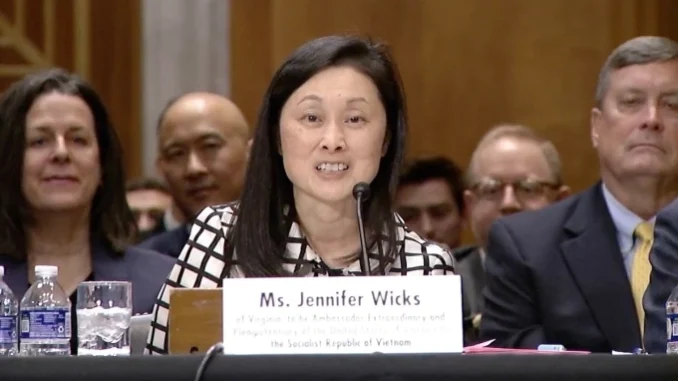
Jennifer Wicks McNamara is a name that will occupy a permanent and historic place in the annals of American diplomatic history.
On May 18, 2026, the United States Senate confirmed her as the Ambassador Extraordinary and Plenipotentiary of the United States of America to the Socialist Republic of Vietnam making her the first woman ever to serve as U.S. Ambassador to Vietnam in the half-century since the two nations normalised relations.
A Midwest girl from Minnesota with nearly 31 years of public service, she rose through the ranks of the U.S. Army overseas, the corridors of the State Department, and the high-stakes environment of the White House to become one of the most senior and respected civil servants in American foreign policy.
Her appointment comes at a moment of extraordinary complexity in the U.S.–Vietnam relationship, defined by a $144 billion trade imbalance, escalating tariff disputes, and a strategic competition with China that gives Vietnam an outsized importance in the Indo-Pacific.
Jennifer Wicks McNamara steps into Hanoi not as a ceremonial figurehead but as a seasoned institutional operator entrusted with one of the most consequential bilateral relationships in American foreign policy.
| Jennifer Wicks McNamara | |
|---|---|
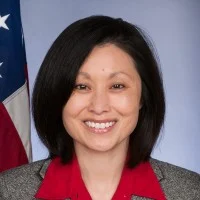 Jennifer Wicks McNamara: History · Bio · Photo
|
|
| Wiki Facts & About Data | |
| Full Name: | Jennifer Wicks McNamara |
| Birthplace: | Minnesota, USA (exact city not publicly disclosed) |
| Nationality: | American |
| Occupation: | Career Diplomat, Senior Civil Servant, U.S. Ambassador |
| Parents: | Gary Wicks (father) and Elizabeth Wicks (mother) — both public school teachers in Minnesota |
| Spouse: | George McNamara |
| Children: | One daughter, Kim (based in Scotland) |
Early Life
Jennifer Wicks was born and raised in Minnesota, the heart of the American Midwest. She grew up in what she has described as a household shaped by the values of hard work and public service values instilled by her parents, Gary and Elizabeth Wicks, who were both public school teachers.
In her confirmation hearing statement before the U.S. Senate Committee on Foreign Relations on December 11, 2025, she said simply: “I am a Midwest girl at heart – growing up in Minnesota with public school teacher parents who instilled in me the values of hard work and public service.”
This background middle-class, Midwestern, rooted in civic duty rather than political ambition or inherited privilege is central to understanding the professional path Jennifer Wicks chose. Unlike many high-profile diplomatic figures who come from wealthy coastal families, elite political circles, or Ivy League pipelines, she built her career the old-fashioned way: by starting at the bottom of the government bureaucracy overseas and working her way up over three decades through a combination of competence, discretion, and genuine institutional expertise.
The specifics of her early childhood, schooling in Minnesota, and undergraduate education have not been publicly disclosed. What is known is that she launched her professional life with the U.S. Army a choice that spoke to her public service orientation and her willingness to serve where she was needed, including abroad.
Education
Jennifer Wicks McNamara holds two prestigious postgraduate degrees that form the academic backbone of her diplomatic and national security career.
She earned a Master of Public Administration (MPA) from The American University in Washington, D.C., in 2003 the same year she joined the State Department. American University’s School of Public Affairs is one of the leading public policy and administration programmes in the United States, particularly for students pursuing careers in federal government, international organisations, and policy analysis.
The MPA equipped her with a rigorous grounding in public sector management, policy implementation, and organisational leadership skills she would apply directly throughout her State Department career.
She subsequently completed a Master of Science in National Security Strategy from the National War College at Fort Lesley J. McNair in Washington, D.C., in 2008. The National War College is one of the most selective and prestigious national security institutions in the United States a joint military and civilian graduate institution that prepares senior government and military officials for the highest levels of strategic leadership.
Admission to the War College is by nomination and is typically reserved for mid-to-senior career professionals in the military, intelligence community, foreign service, and civil service who are identified as future senior leaders.
Her graduation from the National War College in 2008 marked a significant formal recognition of her trajectory within the national security establishment.
Career
U.S. Army Service Seoul, Hawaii, and Virginia (Mid-1990s to 2003)
Jennifer Wicks began her United States government career with the U.S. Army at Yongsan Garrison in Seoul, South Korea a major U.S. military installation in the South Korean capital that served as the headquarters of U.S. Forces Korea.
This overseas posting at the outset of her career gave her an early and formative introduction to the realities of U.S. military presence in the Indo-Pacific, the operational complexities of forward deployment, and the day-to-day functioning of American government operations abroad.
After Seoul, she moved through a series of leadership and management roles with the Army in Hawaii and Virginia, building a foundation in federal administration, human resources, logistics, and institutional management before making the transition to the State Department.
This early Army experience particularly the overseas posting in South Korea gave her a ground-level understanding of U.S. strategic interests in Asia that would inform her diplomatic work decades later. She accumulated nearly a decade of U.S. Army service before joining the State Department in 2003.
U.S. Department of State (2003–Present)
Jennifer Wicks joined the U.S. Department of State in 2003, the same year she completed her Master of Public Administration at American University.
Her State Department career unfolded across a series of increasingly senior positions in administration, management, legislative affairs, and foreign assistance developing her into one of the most versatile and experienced institutional operators in the Department’s civil service ranks.
Her key State Department positions prior to her current role include:
- Special Assistant to the Assistant Secretary of State for Administration an early State Department role in which she supported high-level administrative functions and internal policy development at the Bureau of Administration, one of the Department’s largest and most operationally critical bureaus.
- Senior Advisor for Legislative and Public Affairs to the Under Secretary of State for Management a strategically important position in which she advised one of the State Department’s most powerful undersecretaries on how to align departmental operations with Congressional priorities, manage relationships with Capitol Hill, and communicate management initiatives to external stakeholders. This role gave her deep exposure to the intersection of foreign policy and domestic political dynamics.
- Chief of Staff, Office of U.S. Foreign Assistance Resources (F Bureau) the State Department and USAID coordinating office for all U.S. foreign assistance programmes worldwide. As Chief of Staff, she managed resources critical to U.S. foreign aid delivery a role requiring mastery of both policy substance and institutional coordination at the highest levels of international development bureaucracy.
Director of the Office of Presidential Appointments (November 2012 – 2026)
The defining chapter of Jennifer Wicks McNamara’s State Department career has been her remarkable tenure as Director of the Office of Presidential Appointments a high-profile, high-stakes position she has held since November 2012, serving continuously across four different presidential administrations: Obama, Trump (first term), Biden, and Trump (second term). This extraordinary continuity across administrations of both parties speaks powerfully to her professional credibility, institutional value, and political neutrality as a civil servant.
The Office of Presidential Appointments is responsible for identifying, vetting, processing, and shepherding candidates for the approximately 1,000 Senate-confirmed senior positions at the State Department including ambassadorships, undersecretary positions, and assistant secretary roles.
As Director, Wicks McNamara has been the institutional guide for hundreds of presidential nominees navigating the complex and often treacherous waters of Senate confirmation including the background investigation process, ethics disclosures, Senate Foreign Relations Committee hearings, and floor votes. The deep irony not lost on observers is that she has now completed the same process she spent over a decade managing on behalf of others.
In her role as Director, she also led the State Department’s work on presidential transition planning a sensitive and logistically complex responsibility that involves preparing for the orderly transfer of power between administrations at the world’s most important diplomatic institution.
She additionally led a significant institutional reform initiative: the modernisation of the State Department’s diplomatic title policy to more accurately reflect the evolving diplomatic environment globally a project that required navigating both internal bureaucratic resistance and the sensitivities of foreign governments.
In routine engagement with senior officials at the White House and the State Department, and through her stewardship of one of the institution’s most politically sensitive administrative functions, Wicks McNamara built a reputation as an “innovative and strategic leader” a description used in her official State Department Certificate of Demonstrated Competence submitted to the Senate for her ambassadorial nomination.
Nomination and Confirmation as U.S. Ambassador to Vietnam (2025–2026)
President Donald Trump first nominated Jennifer Wicks McNamara to serve as U.S. Ambassador to the Socialist Republic of Vietnam on October 2, 2025. The nomination was submitted to the Senate as PN585-10 of the 119th Congress.
However, on October 20, 2025, the nomination was unexpectedly withdrawn a procedural development that reflected the political turbulence of the period, including the Trump administration’s unusual mass recall of career ambassadors worldwide that unsettled the State Department that autumn.
Trump re-nominated Wicks McNamara on a second occasion, and the nomination was submitted again. Separately, the previous U.S. Ambassador to Vietnam, Marc Knapper a career diplomat who had championed deepening U.S.–Vietnam ties was abruptly recalled from his post before Christmas 2025, concluding his tenure on January 18, 2026.
His departure left the ambassadorship in Hanoi vacant at a particularly critical moment, as Vietnam’s goods trade surplus with the United States had surpassed even that of China in certain quarters of 2025, reaching a staggering $144.2 billion for the January–October 2025 period.
On December 11, 2025, Jennifer Wicks McNamara appeared before the Senate Committee on Foreign Relations for her confirmation hearing the very committee and process she had shepherded hundreds of nominees through during her 13-year tenure as Director of Presidential Appointments. She was joined at the hearing by her husband George and close friends; her parents Gary and Elizabeth watched from Minnesota, and her daughter Kim followed the proceedings remotely from Scotland.
In her opening statement, she declared: “I am a Midwest girl at heart growing up in Minnesota with public school teacher parents who instilled in me the values of hard work and public service.” She described Vietnam as “one of our most important partners in the region” and stated that “a strong, independent, and resilient Vietnam is in the United States’ interest.”
She praised the U.S.–Vietnam Comprehensive Strategic Partnership elevated to that status in 2023 and committed to advancing cooperation across defence and security, trade and investment, and people-to-people ties. She acknowledged Vietnam’s human rights record as a matter of ongoing concern, pledging to urge the Vietnamese government to respect freedoms of expression, peaceful assembly, association, and religion.
She also reaffirmed her commitment to Vietnam’s critical support for U.S. war legacy programmes, including the decades-long effort to repatriate the remains of more than 1,000 American service members still missing from the Vietnam War.
On the trade question the issue dominating the bilateral agenda she adopted a notably firm posture: “The current trade relationship is imbalanced,” she told the committee, pledging to “promote equitable market access for U.S. goods and services, including technology, energy, and agricultural products.” Analysts described this as reflecting the administration’s “America First” trade doctrine, treating tariffs as instruments of diplomatic leverage.
Some foreign policy experts, including Hunter Marston of the Center for Strategic and International Studies (CSIS), warned that a singular focus on the trade deficit risked eroding the trust underpinning the Comprehensive Strategic Partnership one of the most significant diplomatic achievements in recent Southeast Asian policy. Ambassador Brian McFeeters of the U.S.-ASEAN Business Council, however, expressed confidence in her, describing her as “a very senior and respected official within the State Department.”
On May 18, 2026, the United States Senate confirmed Jennifer Wicks McNamara as U.S. Ambassador to Vietnam as part of a package of 49 nominations approved in a single recorded vote of 46 in favour and 43 against (with 11 senators not voting).
The confirmation made her the first woman ever chosen to lead the American embassy in Hanoi. The post had been vacant since Marc Knapper’s departure in January 2026 a gap of four months that underscored the urgency of filling the position at one of the most diplomatically active U.S. missions in Asia.
Policy Priorities as Ambassador
Jennifer Wicks McNamara enters the U.S. Embassy in Hanoi with a well-defined set of priorities shaped by both the Trump administration’s foreign policy agenda and the structural realities of the U.S.–Vietnam relationship:
- Trade and investment rebalancing: Addressing the $144 billion U.S.–Vietnam trade imbalance, pressing for equitable market access for American goods and services (technology, energy, agriculture), and engaging with the contested question of Vietnam’s “non-market economy” designation by the U.S. Department of Commerce.
- Transshipment enforcement: Managing Washington’s concerns about the transshipment of Chinese goods through Vietnam to avoid U.S. tariffs on China a politically and economically sensitive issue that could reshape Vietnam’s manufacturing and export model.
- Defence and security cooperation: Deepening the security dimensions of the Comprehensive Strategic Partnership, including naval cooperation, maritime security in the South China Sea, and intelligence-sharing arrangements that align with U.S. strategic competition with China.
- War legacy programmes: Supporting the continuation of Vietnam’s critical assistance in repatriating the remains of missing U.S. service members a long-standing bilateral commitment with deep emotional significance for American veterans’ families.
- Human rights: Urging the Vietnamese government to respect freedoms of expression, peaceful assembly, association, and religious belief a perennial tension in the bilateral relationship that requires careful diplomacy to raise without destabilising the broader partnership.
- People-to-people ties: Supporting the growth of tourism, educational exchanges, and the deeper integration of Vietnam’s substantial diaspora community in the United States the fourth-largest Asian American population into the bilateral relationship.
Personal Life
Jennifer Wicks McNamara is married to George McNamara, who accompanied her to her Senate confirmation hearing on December 11, 2025. Very little additional information about George McNamara has been made publicly available, consistent with the family’s preference for privacy.
The couple have one daughter, Kim, who was based in Scotland at the time of her mother’s confirmation hearing and followed the proceedings remotely. No further details about Kim’s life or career have been publicly disclosed.
Jennifer’s parents, Gary and Elizabeth Wicks, remain in Minnesota and watched the confirmation hearing from home a moving detail that connects her moment of historic professional achievement to the small-town Midwestern household and the public school teachers who shaped her values.
Her family background unpretentious, civic-minded, hardworking is in many ways the most revealing thing about her as a person and a public servant.
In terms of personal style, Wicks McNamara is known within the State Department as measured, composed, and institutional in her approach a civil servant in the truest and best sense of the term. Having served under four presidents of opposing parties without losing the trust of any of them, she has cultivated a reputation for professionalism over partisanship and competence over ideology. These qualities are precisely what made her attractive to the Trump administration as an ambassador a safe pair of hands for one of Washington’s most strategically important bilateral relationships.
Historic Significance
Jennifer Wicks McNamara’s confirmation as U.S. Ambassador to Vietnam carries a significance that extends beyond her individual career. The United States and Vietnam established diplomatic relations in 1995 just twenty years after the end of a war that cost more than 58,000 American lives and millions of Vietnamese.
The relationship has been one of the most remarkable diplomatic transformations of the post-Cold War era, progressing from former enemies to Comprehensive Strategic Partners in less than three decades.
Throughout that journey, every U.S. Ambassador to Vietnam has been male. McNamara is the first woman to hold the position.
Her appointment at this particular inflection point when the bilateral relationship faces its most significant structural economic tensions even as it reaches its highest strategic importance adds further historical weight to what is already a landmark posting.
Social Media and Public Profile
Jennifer Wicks McNamara does not maintain a significant personal social media presence, consistent with her career identity as a civil servant rather than a public political figure.
Official communications from the U.S. Embassy in Hanoi and the State Department’s public affairs channels will be the primary vehicles for her public engagement as ambassador. She can be expected to be active on official State Department and Embassy platforms including:
- U.S. Embassy Hanoi official website: vn.usembassy.gov
- U.S. Embassy Hanoi on Facebook and Twitter/X the primary public-facing social media channels for official embassy communications
- U.S. Department of State official channels for broader policy statements and press releases
FAQs
Who is Jennifer Wicks McNamara?
Jennifer Wicks McNamara is an American career diplomat and civil servant who was confirmed by the U.S. Senate on May 18, 2026, as U.S. Ambassador to the Socialist Republic of Vietnam. She is the first woman to serve in this role. She previously served as Director of the Office of Presidential Appointments at the U.S. Department of State for over 13 years across four presidential administrations.
When was Jennifer Wicks McNamara confirmed as Ambassador to Vietnam?
She was confirmed by the U.S. Senate on May 18, 2026, as part of a package of 49 nominations approved by a recorded vote of 46 in favour and 43 against. The confirmation made her the first female U.S. Ambassador to Vietnam.
Who nominated Jennifer Wicks McNamara?
She was nominated by President Donald Trump. He first nominated her on October 2, 2025, though that nomination was briefly withdrawn on October 20, 2025, before she was re-nominated. She appeared before the Senate Foreign Relations Committee on December 11, 2025.
What is Jennifer Wicks McNamara’s educational background?
She holds a Master of Public Administration from The American University (2003) and a Master of Science in National Security Strategy from the National War College (2008).
What is the Office of Presidential Appointments?
The Office of Presidential Appointments at the State Department oversees the identification, vetting, and Senate confirmation process for approximately 1,000 senior State Department positions that require presidential nomination and Senate confirmation, including ambassadorships. Wicks McNamara directed this office for over 13 years across four administrations.
Where did Jennifer Wicks McNamara begin her career?
She began her U.S. government career with the U.S. Army at Yongsan Garrison in Seoul, South Korea, and subsequently held leadership and management roles with the Army in Hawaii and Virginia before joining the State Department in 2003.
What are Jennifer Wicks McNamara’s priorities as Ambassador to Vietnam?
Her stated priorities include addressing the $144 billion U.S.–Vietnam trade imbalance, promoting equitable market access for U.S. goods, managing transshipment enforcement issues, deepening defence and security cooperation, supporting war legacy programmes (repatriation of missing U.S. soldiers’ remains), advocating for human rights, and strengthening people-to-people ties.
Is Jennifer Wicks McNamara from Minnesota?
Yes. She grew up in Minnesota, the daughter of two public school teachers, Gary and Elizabeth Wicks. She described herself in her confirmation hearing as “a Midwest girl at heart.”
Who is Jennifer Wicks McNamara’s husband?
Her husband is George McNamara, who accompanied her to her Senate confirmation hearing in December 2025. They have one daughter, Kim, who was living in Scotland at the time of the hearing.
What is the significance of Jennifer Wicks McNamara’s appointment?
Her appointment marks the first time in the history of U.S.–Vietnam diplomatic relations since they were established in 1995 that a woman has served as U.S. Ambassador to Vietnam. She also takes office at a critical moment in the bilateral relationship, defined by a record trade imbalance exceeding $144 billion and significant strategic competition involving China in the Indo-Pacific.
Conclusion
Jennifer Wicks McNamara’s biography is, in many ways, a portrait of the American civil service at its best: a public school teacher’s daughter from Minnesota who chose not wealth or fame but service; who spent three decades building expertise quietly and thoroughly across the U.S. Army and the State Department; who guided a thousand other nominees through the very process she would eventually complete herself; and who now steps into one of the most consequential diplomatic postings in the Indo-Pacific at one of the most consequential moments in U.S.–Vietnam relations.
Her historic confirmation as the first female U.S. Ambassador to Vietnam on May 18, 2026, is not incidental to her story it is a measure of what sustained, principled, non-partisan public service can achieve. The work ahead of her in Hanoi is formidable: a $144 billion trade imbalance to address, a Comprehensive Strategic Partnership to deepen, human rights concerns to raise, and a relationship with a former adversary now an indispensable partner to steward through one of the most turbulent periods in global geopolitics. If her career to date is any guide, Jennifer Wicks McNamara is exactly the kind of person the United States sends when the stakes are highest and the margin for error is smallest.
Related People








Leave a Reply