
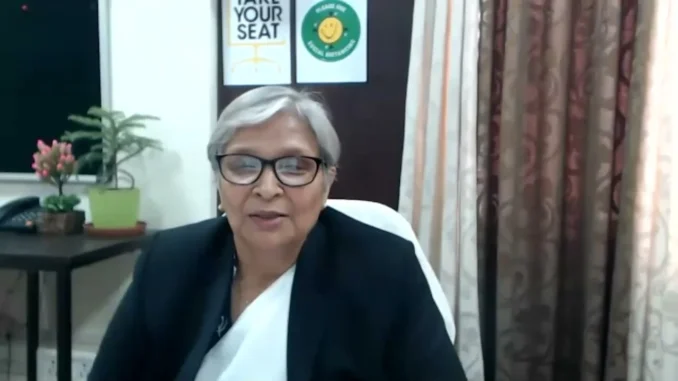
Giribala Singh is a retired Indian judicial officer from Madhya Pradesh who served as a district court judge and subsequently as Chairperson of the District Consumer Disputes Redressal Commission in Bhopal.
She became a subject of intense national public scrutiny in May 2025 when her daughter-in-law, 33-year-old former Miss Pune Twisha Sharma, was found dead under mysterious circumstances at Giribala Singh’s residence in the Katara Hills area of Bhopal.
The case quickly escalated into one of the most talked-about legal and social controversies in India in 2025, drawing comparisons to other high-profile dowry harassment and custodial death cases and triggering a CBI investigation that eventually led to her arrest after her bail was revoked.
Profile
| Full Name | Giribala Singh |
| Nationality | Indian |
| Occupation | Retired District Court Judge; Former Chairperson, District Consumer Disputes Redressal Commission, Bhopal |
| State | Madhya Pradesh |
Early Life
Detailed biographical information about Giribala Singh’s early life, birthplace, and family background is not extensively available in public records, as her prominence prior to 2025 was largely within the closed circuits of the Madhya Pradesh judiciary and the district-level consumer protection system.
What is known is that she pursued a career in law and the judiciary and rose through the ranks to serve as a district court judge, a position of significant authority and public trust within the Indian judicial system.
Education
Giribala Singh’s educational qualifications would have included the standard legal training required for judicial appointments in India, including an LLB (Bachelor of Laws) degree.
Her appointment as a district court judge would have required her to go through the rigorous selection and evaluation process administered by the relevant State Public Service Commission and High Court. Specific details of her educational institutions are not in the public domain.
Career
Giribala Singh built her career within the Madhya Pradesh state judiciary, serving as a district court judge across multiple years.
Her judicial career gave her a professional reputation within the state’s legal community. Following her retirement from the district bench, she was appointed as the Chairperson of the District Consumer Disputes Redressal Commission in Bhopal, a quasi-judicial body that handles consumer complaints and is presided over by retired judicial officers. This role placed her in a position of continued authority and public responsibility even after her formal retirement from the bench.
Her professional standing was called into serious question in May 2025 when the death of her daughter-in-law Twisha Sharma at her Bhopal home triggered a wide-ranging investigation. Twisha Sharma, a 33-year-old former model and marketing professional who had previously won the title of Miss Pune, was found dead on the terrace of Giribala Singh’s residence in Katara Hills, Bhopal, on May 12, 2025, and was declared dead in the early hours of May 13. The circumstances of her death were immediately disputed by Twisha’s natal family, who alleged dowry harassment, mental cruelty, and suspicious circumstances surrounding her death. Giribala Singh, as Twisha’s mother-in-law, was placed at the centre of these allegations.
The Madhya Pradesh government subsequently initiated an internal inquiry into Giribala Singh’s conduct and fitness to continue serving as Chairperson of the Consumer Forum. The State Food, Civil Supplies, and Consumer Protection Department wrote to relevant officials seeking action against her. The Central Bureau of Investigation (CBI) became involved in the probe, and following legal proceedings that included the revocation of her bail by the Madhya Pradesh High Court, Giribala Singh was arrested by the CBI in connection with the dowry death investigation.
Social Media & Public Presence
Giribala Singh does not maintain a notable public social media presence.
Her public visibility has been entirely through the lens of the Twisha Sharma death case and the subsequent legal proceedings, media coverage of which has been extensive across national Indian news platforms including DNA India, The Statesman, NDTV, and various Bhopal-based outlets.
Personal Life
Giribala Singh’s personal life entered the spotlight involuntarily through the Twisha Sharma case. She is the mother-in-law of the late Twisha Sharma, who married her son.
According to reports, Twisha’s family alleged that she suffered dowry harassment and mental cruelty within the matrimonial home, and that Giribala Singh as the head of the household bore significant responsibility for this.
Giribala Singh and her family denied these allegations. The case represents one of the most prominent instances in recent Indian public discourse of a retired judicial officer facing criminal accusations, a fact that added enormous societal weight to the proceedings and drew commentary from legal experts about the accountability of former members of the judiciary.
Conclusion
Giribala Singh’s story is a stark and sobering reminder that professional status, even a decades-long career as a judge, does not insulate individuals from the consequences of alleged crimes within the domestic sphere.
The Twisha Sharma case has shone a painful light on the ongoing challenges of dowry harassment and domestic violence in India, and Giribala Singh’s position at the centre of it has made the case a watershed moment in public discourse about accountability, privilege, and the justice system.
As of mid-2025, the case remains the subject of active CBI investigation and judicial proceedings, and its full resolution will be closely watched by legal observers and the public across India.
Related People









Leave a Reply