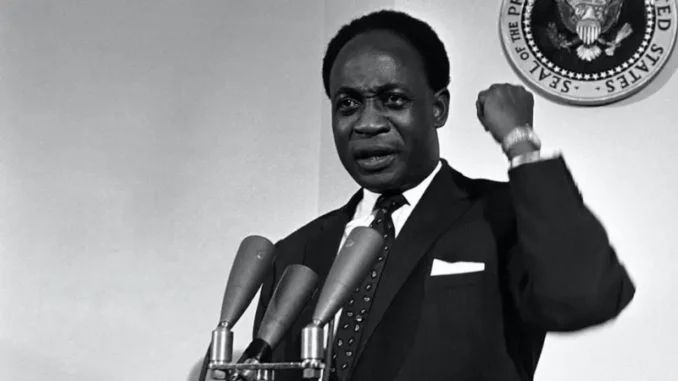
Francis Kwame Nkrumah was one of the most consequential political figures of the twentieth century, the Ghanaian revolutionary, political philosopher, and statesman who in 1957 led the Gold Coast to independence from Britain as the first black African colony to achieve self-rule in the post-war era, renaming the nation Ghana.
As Ghana’s first Prime Minister and later its first President, he championed African unity, built major infrastructure, advanced education, and articulated the philosophy of Pan-Africanism in ways that shaped the entire African liberation movement.
His eventual overthrow in a military coup, his exile, and his death in Romania gave his legacy a bittersweet complexity, that of a genuine visionary undone by his own authoritarianism, that historians continue to debate more than 50 years after his death.
| Francis Nwia Kofi Kwame Nkrumah | |
|---|---|
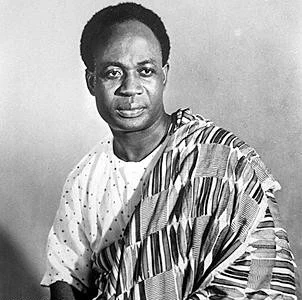 Francis Nwia Kofi Kwame Nkrumah: History · Bio · Photo
|
|
| Wiki Facts & About Data | |
| Full Name: | Francis Nwia Kofi Kwame Nkrumah |
| Born: | September 21, 1909 |
| Age: | (aged 62) |
| Death: | April 27, 1972 (aged 62) |
| Birthplace: | Nkroful, Nzema Land, Gold Coast (now Ghana) |
| Nationality: | Ghanaian |
| Occupation: | Politician, Revolutionary, Philosopher, Author |
| Religion: | Catholicism (baptised); secular humanist in later life |
| Parents: | Opanyin Kofi Nkrumah (father, goldsmith); Nyaniba (mother) |
| Spouse: | Fathia Rizk Nkrumah (married 1957; died 2007) |
| Children: | 3 (Gamal, Samia, Sekou) |
Early Life
Kwame Nkrumah was born on September 21, 1909, in the village of Nkroful, in the Nzema region of south-western Gold Coast. His father, Kofi Nkrumah, was a goldsmith and his mother, Nyaniba, was his father’s third wife in a polygamous household.
He was baptised into the Roman Catholic Church at birth. Growing up in the colonial Gold Coast, he was exposed from an early age to the humiliation and contradiction of British imperial governance, a system that extracted wealth from African labour while offering African people no substantive participation in their own governance. He attended the Roman Catholic junior school in Half Assini, where his exceptional academic ability was quickly noticed.
He was subsequently sent to the Government Training College in Accra (later Achimota College) in 1926, where he trained as a teacher and graduated in 1930.
Education
After teaching for several years in the Gold Coast, Nkrumah departed for the United States in 1935, a journey that transformed his intellectual and political formation. He attended Lincoln University in Pennsylvania, one of America’s historically Black universities, from 1935 to 1939, graduating with a Bachelor of Arts degree.
He remained at Lincoln as a lecturer in political science, while simultaneously pursuing graduate studies at the University of Pennsylvania, where he earned two master’s degrees, one in education and one in philosophy, by 1943.
Nkrumah also completed his Bachelor of Sacred Theology degree from Lincoln University’s theology school. He spent twelve years abroad in total, during which he absorbed the intellectual influences of Marcus Garvey’s Pan-Africanist nationalism, W.E.B. Du Bois’ social philosophy, and Leninist organisational theory, a synthesis that would define his political ideology for the rest of his life.
He subsequently studied law in London in 1945, where he organised with West African student groups and became deeply involved in the global Pan-African movement.
Career
Return to the Gold Coast and the CPP (1947–1952)
Nkrumah returned to the Gold Coast in 1947 to serve as General Secretary of the United Gold Coast Convention (UGCC), a conservative nationalist party led by J.B. Danquah.
He quickly became the party’s most dynamic popular organiser, mobilising market women, urban workers, and ex-servicemen through his “Positive Action” campaign of non-violent civil disobedience, general strikes, and boycotts of colonial businesses.
His radicalism generated a split with the UGCC’s conservative leadership, and in 1949 he broke away to found the Convention People’s Party (CPP), a mass-based organisation whose slogan “Self-Government Now” expressed the urgency of his politics.
In 1950, the British colonial authorities arrested Nkrumah for sedition and imprisoned him. While in prison, the CPP swept the February 1951 general elections by a landslide. The Governor of the Gold Coast, Sir Charles Arden-Clarke, released Nkrumah from prison and invited him to form a government, a remarkable reversal that validated the power of mass political organisation. In 1952 he was formally designated Prime Minister of the Gold Coast.
Independence and First Years of Leadership (1957–1962)
On March 6, 1957, the Gold Coast became the first black African colony to achieve independence from Britain, and was renamed Ghana, after the ancient West African empire. Nkrumah spoke to an estimated crowd of tens of thousands with the famous declaration: “Ghana, your beloved country, is free forever.”
He served simultaneously as Prime Minister and the driving force behind a newly independent state that attracted immense international attention as a model for African liberation movements across the continent.
He hosted the All-African Peoples’ Conference in Accra in 1958, bringing together independence leaders from across the continent, and played a leading role in founding the Organisation of African Unity (OAU) in 1963. In 1962, he was awarded the Lenin Peace Prize by the Soviet Union.
He declared Ghana a republic in 1960 and became its first President, receiving the Lenin Peace Prize in the same year and deepening Ghana’s ties with the Eastern Bloc while maintaining formal non-alignment.
He oversaw the construction of the Akosombo Dam, one of the largest hydroelectric projects in the world at the time of its completion, and implemented free primary education across Ghana.
Authoritarianism and the Coup (1962–1966)
As the 1960s progressed, Nkrumah’s governance became increasingly authoritarian. He detained political opponents without trial under the Preventive Detention Act, declared Ghana a one-party state under the CPP, and in 1964 engineered a constitutional amendment making himself President for Life.
His economic policies, ambitious investments in industrialisation and infrastructure, generated significant debt, and Ghana’s economy deteriorated from one of the strongest in Africa to one of the weakest.
On February 24, 1966, while Nkrumah was on a visit to Hanoi to mediate in the Vietnam War, the Ghana Armed Forces and Police overthrew his government in a coup. He never returned to Ghana.
He settled in Conakry, Guinea, where President Sékou Touré made him honorary co-president, a gesture of Pan-African solidarity that offered him political continuity without real power.
Exile and Death (1966–1972)
During his years in exile in Guinea, Nkrumah continued writing prolifically, producing several of his most important political texts.
He died on April 27, 1972, in Bucharest, Romania, where he had been seeking treatment for prostate cancer. He was 62 years old.
His remains were initially buried in Guinea before being transferred to a mausoleum in his birth village of Nkroful in Ghana, and later to a state mausoleum and memorial park constructed in his honour in Accra.
Awards and Honours
- 1962 — Lenin Peace Prize — Soviet Union
- 1963 — Co-founder, Organisation of African Unity (OAU)
- 2000 — Named “Africa’s Man of the Millennium” by listeners of the BBC World Service
- Ghana’s Kwame Nkrumah Memorial Day observed annually on September 21
Personal Life
Nkrumah married Fathia Rizk, an Egyptian woman of Coptic Christian heritage, in 1957, the year of Ghanaian independence.
The marriage was celebrated both as a personal union and as a symbol of African continental solidarity. The couple had three children: Gamal, Samia, and Sekou Nkrumah. Fathia Nkrumah died in Cairo in 2007.
Nkrumah was baptised a Catholic but his mature intellectual life was shaped by secular humanism, Marxism, and his own philosophy of Consciencism, a blend of traditional African values, Islam, and Euro-Christian influences synthesised in the service of African liberation.
Major Works
- Towards Colonial Freedom (1945)
- Ghana: The Autobiography of Kwame Nkrumah (1957)
- I Speak of Freedom (1961)
- Africa Must Unite (1963)
- Consciencism (1964)
- Neo-Colonialism: The Last Stage of Imperialism (1965)
- Class Struggle in Africa (1970)
- Revolutionary Path (1973, posthumous)
Conclusion
Kwame Nkrumah’s legacy is one of the most debated in modern African history precisely because it resists simple verdict. He freed a nation. He inspired a continent. He built infrastructure and educational systems that outlasted him. He also imprisoned his opponents, strangled democratic competition, and left Ghana’s economy in ruins. What endures most powerfully is not the flawed leader but the idea, that African people could govern themselves, that they had the right and the capacity to determine their own destiny. That idea, first tested in Ghana’s independence, ignited independence movements across the entire African continent within a decade. Kwame Nkrumah did not just lead Ghana: he lit a fire that burned from Cairo to Cape Town.
Related People
Leave a Reply