
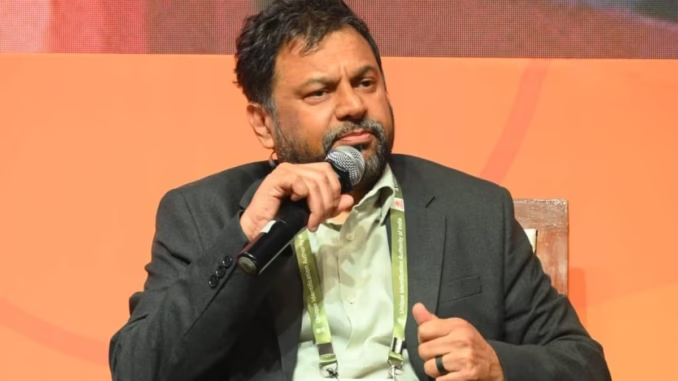
Brijesh Singh is a 1996 batch Indian Police Service (IPS) officer of the Maharashtra cadre who has established himself as one of India’s most distinctive and innovative senior officers, simultaneously a cybercrime pioneer, a published thriller author, a technology policy thought leader, and a public intellectual on AI and digital governance.
As the founding head of Maharashtra Cyber, the state’s dedicated cybersecurity unit, he built India’s most advanced state cybercrime infrastructure, set up 48 state-of-the-art district cyber labs, and oversaw the sanction of 43 dedicated cyber police stations, a first for any Indian state.
He became the first IPS officer ever appointed as Principal Secretary to the Chief Minister of Maharashtra, a post traditionally held exclusively by IAS officers, a recognition of his extraordinary cross-domain expertise.
Profile
| Full Name | Brijesh Singh |
| Service | Indian Police Service (IPS) |
| Batch | 1996 |
| Cadre | Maharashtra |
| Nationality | Indian |
| Education | B.E. (Mining Engineering); M.A. (Psychology); M.A. (Public Administration); Diploma in Computer Forensics; PGD in Foreign Trade |
| Current Posting | Director General, Information and Public Relations (DGIPR), Maharashtra Government |
Early Life and Education
Specific details about Brijesh Singh’s birthplace and early life are not widely documented in publicly available sources.
What is confirmed through multiple authoritative records is that he holds an extraordinary and diverse set of academic qualifications: a Bachelor of Engineering in Mining, a Master of Arts in Psychology, a Master of Arts in Public Administration, a Diploma in Computer Forensics, and a Postgraduate Diploma in Foreign Trade.
This multi-disciplinary academic foundation, spanning engineering, social sciences, law enforcement technology, and international trade, is highly unusual for an IPS officer and directly informs the breadth and depth of his professional portfolio.
Career
Early IPS Career (1996–2010)
Brijesh Singh joined the Maharashtra IPS cadre in 1996 and served across a range of field and departmental postings in his early career, including as Inspector General (IG) of the Criminal Investigation Department (CID), where he implemented the prestigious Crime and Criminal Tracking Network and System (CCTNS) for Maharashtra Police, connecting all 1,100 police stations in the state to a state-of-the-art technology platform. This pioneering digital infrastructure project became a reference point for police technology implementation in India.
Founding Maharashtra Cyber (2016–2022)
The most consequential chapter of Brijesh Singh’s career began when the Maharashtra government created a dedicated cybercrime division and appointed him as its first Special Inspector General, simultaneously making him the first person to hold this newly created post and the first IPS officer to serve as the government’s Chief Information Security Officer (CISO).
Under his leadership, he implemented the MH Cyber Project, established CERT-MH (Maharashtra’s Computer Emergency Response Team), and built Predictive Policing capabilities.
He oversaw the establishment of 48 district-level cyber labs, making Maharashtra the first state in India to create such comprehensive cyber infrastructure. The Maharashtra Cyber Digital Crime Unit (MCDCU), led by him, successfully took down over 400 pirate websites and received recognition from the World Intellectual Property Organization.
When the government changed and the MVA (Maha Vikas Aghadi) came to power under Uddhav Thackeray, Singh was transferred to Additional DGP, Home Guard. After the Eknath Shinde-led Mahayuti government returned to power, he was appointed Principal Secretary to the Chief Minister, the first IPS officer ever to hold this post, marking a historic departure from the convention of appointing only IAS officers to the position.
His most recent confirmed posting is as Director General, Information and Public Relations (DGIPR) of the Maharashtra Government.
Author and Public Intellectual
Brijesh Singh’s intellectual output extends far beyond law enforcement. He is the author of the thriller novel Quantum Siege, published by Penguin Books, and the critically engaged non-fiction work Dangerous Minds of India.
He is an Adjunct Distinguished Fellow in Cybersecurity Studies at Gateway House, a leading Indian foreign policy think tank. He is a co-chair of the AI Index at Stanford University, a member of the OECD’s working group on AI classification and definitions, and a member of the National AI Advisory Committee (NAIAC) of India.
He has testified before the United States Congress on AI governance and appeared on multiple national and international media platforms as an expert on cybersecurity, AI policy, and law enforcement technology. He is an advocate of open-source intelligence (OSINT) and an active proponent of coding skills within law enforcement.
Awards and Honours
- 2016 — DG’s Insignia Award
- International recognition for MCDCU and AMBIS projects from the World Intellectual Property Organization
- Multiple national awards for cybercrime infrastructure development
Personal Life
Specific details about Brijesh Singh’s family and personal life are not publicly available.
He is known for combining his law enforcement responsibilities with prolific intellectual output, describing himself in interviews as an officer who identifies more with his identity as a writer and researcher than with the conventional image of a police officer.
Net Worth
No verified personal net worth figure is available.
His income is derived from his IPS remuneration at his current rank and supplemented by royalties from his published books and his academic and advisory engagements.
Conclusion
Brijesh Singh is one of the most intellectually remarkable IPS officers of his generation, a man who took the technical complexity of cybercrime seriously when most of his peers had barely encountered the concept, built from scratch an infrastructure that became a national model, published novels and non-fiction that demonstrated a literary sensibility, and earned a place at the table of global AI governance conversations.
His story is proof that the Indian Police Service, at its best, can produce individuals who are simultaneously practitioners, theorists, and artists, and that the combination is more powerful than any of them alone.
Related People








Leave a Reply