
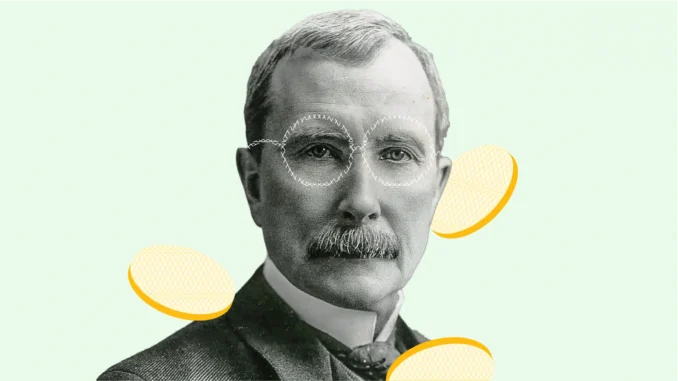
John Davison Rockefeller was an American industrialist, philanthropist, and devout Baptist who founded the Standard Oil Company in 1870 and built it into the most dominant industrial monopoly in American history, controlling approximately 90 percent of all U.S. oil refining by the early 1880s.
He is widely regarded as the wealthiest American who ever lived: at his peak in 1913, his personal fortune of $900 million represented approximately 3 percent of total U.S. GDP, a proportion that by comparable modern measures would make him richer than any person alive today.
The Supreme Court ordered Standard Oil broken up in 1911 under the Sherman Antitrust Act, creating dozens of successor companies, among them ExxonMobil, Chevron, and BP’s American predecessor, whose stock increases after the breakup actually made Rockefeller even wealthier.
His philanthropic giving during his lifetime totaled over $500 million, establishing the University of Chicago, Rockefeller University, the Rockefeller Foundation, and numerous other institutions that continue to shape American science, medicine, and education. He died in 1937 at the age of 97, just short of his stated ambition to live to 100.
| John Davison Rockefeller | |
|---|---|
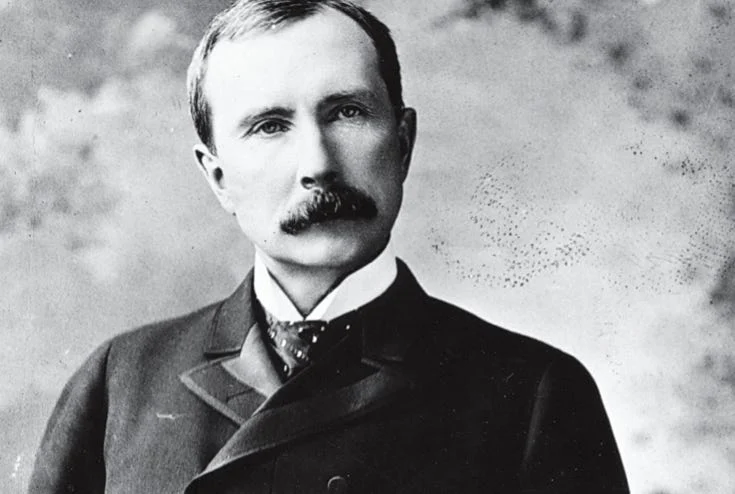 John Davison Rockefeller: History · Bio · Photo
|
|
| Wiki Facts & About Data | |
| Full Name: | John Davison Rockefeller |
| Stage Name: | John D. Rockefeller |
| Born: | July 8, 1839 |
| Age: | 97 |
| Death: | May 23, 1937 |
| Birthplace: | Richford, New York, USA |
| Nationality: | American |
| Occupation: | Industrialist, Oil Magnate, Philanthropist |
| Religion: | Baptist (devout) |
| Parents: | William Avery "Big Bill" Rockefeller (Father, traveling salesman and con man); Eliza Davison Rockefeller (Mother, housewife) |
| Siblings: | Five siblings including William Rockefeller Jr. (brother, co-founder of Standard Oil) |
| Spouse: | Laura Celestia "Cettie" Spelman Rockefeller (m. September 8, 1864 — d. March 12, 1915) |
| Children: | Five: Bessie (Elizabeth), Alice (died in infancy), Alta, Edith, and John D. Rockefeller Jr. |
| Net Worth: | Peak: approximately $900 million (1913) — approximately $435 billion in 2025 GDP-equivalent terms; approximately $29.7 billion in inflation-adjusted terms |
Early Life
John Davison Rockefeller was born on July 8, 1839, in Richford, Tioga County, New York, on a modest farm. He was the second of six children. His father, William Avery Rockefeller, known as “Big Bill”, was a traveling salesman, confidence man, and amateur physician who sold dubious patent medicines purporting to cure cancer and other diseases. Big Bill was frequently absent from home for extended periods, maintained a secret second family under the name “Dr. William Levingston,” and was eventually identified by newspapers as a bigamist. Despite (or perhaps because of) this unstable paternal influence, Rockefeller developed an extreme personal discipline, frugality, and dedication to his Baptist faith from early childhood. His mother, Eliza, was a stern and devoutly religious woman who enforced strict household discipline and was the primary moral influence on her children’s upbringing.
The family moved repeatedly during Rockefeller’s childhood, to Moravia, New York; then Owego; then in 1853, to the Cleveland, Ohio area. Rockefeller attended Owego Academy and later Central High School in Cleveland. At 16, he took a business course at Folsom Mercantile College, a ten-week program in bookkeeping and commercial arithmetic, and immediately found work as an assistant bookkeeper at the commission firm of Hewitt and Tuttle in Cleveland. He considered September 26, 1855, the day he began that job, such a significant date that he celebrated it as “Job Day” for the rest of his life. He was industrious, meticulous, and deeply frugal; from his first earnings, he tithed 10 percent to his church, a practice he maintained until his death.
Education
John D. Rockefeller attended Owego Academy in Owego, New York; Central High School in Cleveland, Ohio (did not graduate); and completed a ten-week commercial bookkeeping course at Folsom Mercantile College in Cleveland in 1855. He had no further formal education. His business knowledge was developed through practical experience beginning at age 16.
Career
In 1859, with $1,000 in savings and a $1,000 loan from his father, 19-year-old Rockefeller formed a commission business partnership with Maurice Clark. That same year, Edwin Drake drilled the first commercial oil well in Titusville, Pennsylvania, igniting the American petroleum industry. Cleveland quickly became a major oil-refining center. In 1863, Rockefeller and Clark entered the oil-refining business, constructing a refinery. In 1865, the partners disagreed on management and decided to sell the refinery to the highest bidder among themselves; Rockefeller bid $72,500 and won, immediately selling his other business interests to focus entirely on oil. He partnered with Samuel Andrews and then Henry M. Flagler, who contributed the crucial insight that negotiating bulk shipping contracts with railroads in exchange for guaranteed volume could produce preferential rates that would undercut every competitor.
In 1870, Rockefeller and his associates incorporated the Standard Oil Company of Ohio. Over the next twelve years, through a combination of superior efficiency, relentless cost-cutting, secret railroad rebates, aggressive buyout offers, and, when necessary, coercive pricing designed to drive competitors to bankruptcy, Standard Oil absorbed or eliminated nearly all of its competition. By 1879, Standard controlled approximately 90 percent of all oil pipelines and 90 percent of all oil refining in the United States. In 1882, Rockefeller and his associates established the Standard Oil Trust, the first major American industrial trust, placing the stocks of Standard’s affiliates in dozens of states under the control of a board of nine trustees with Rockefeller at the head. The Trust became simultaneously the model for industrial monopoly organization and a flashpoint for the emerging antitrust movement. Journalist Ida Tarbell’s meticulous 19-part exposé, The History of the Standard Oil Company (published in McClure’s Magazine, 1902–1904; book 1904), documented the company’s predatory practices and galvanized public and political opposition.
In 1896, Rockefeller effectively retired from active management, though he remained titular president until 1911. In June 1911, the U.S. Supreme Court ruled unanimously that Standard Oil violated the Sherman Antitrust Act and ordered it broken into 34 independent companies. The breakup paradoxically increased Rockefeller’s personal wealth: as the largest shareholder in each successor company, the aggregate value of his holdings, which included what would become ExxonMobil, Chevron, Amoco, and others, soared as each company’s stock rose independently. By 1913, his personal wealth reached approximately $900 million, representing roughly 3 percent of total U.S. GDP that year, the equivalent in relative terms to approximately $435 billion in 2025. He is widely considered the wealthiest private individual in modern history in proportional terms.
From the mid-1890s, Rockefeller devoted himself primarily to philanthropy, guided by his son John D. Rockefeller Jr. and by his philanthropic advisor Frederick T. Gates. His giving established: the University of Chicago (with an initial gift of $600,000 in 1890 and total lifetime contributions of $35 million); the Rockefeller Institute for Medical Research in New York (now Rockefeller University, founded 1901); the General Education Board (1902), which transformed American public education; the Rockefeller Sanitary Commission (1909), which eradicated hookworm disease across the American South; and the Rockefeller Foundation (1913), which has since distributed billions of dollars in public health, science, and educational grants globally. Total lifetime charitable giving exceeded $500 million.
Personal Life
Rockefeller married Laura Celestia “Cettie” Spelman on September 8, 1864. Cettie’s father, Harvey Spelman, was a prosperous Ohio merchant, abolitionist, and active participant in the Underground Railroad. The couple had five children, four of whom survived to adulthood: Bessie, Alta, Edith, and John D. Rockefeller Jr. Cettie was a deeply devoted companion and collaborator until her death in 1915. Laura Spelman Rockefeller College at the University of Chicago and Spelman College (the historically Black women’s college in Atlanta, Georgia) were both named in her honor. Rockefeller was devoutly Baptist throughout his life, attending church services even in old age, and believed that his wealth was a gift entrusted to him by God with the responsibility of using it wisely for human benefit. In his 50s, he suffered a physical and emotional breakdown, losing all his hair to alopecia from the stress of his business battles. He recovered and lived to 97, spending his final decades at his estates in Pocantico Hills, New York (Kykuit), and Ormond Beach, Florida, playing golf and entertaining. He died in his sleep at his Ormond Beach home on May 23, 1937.
Net Worth
At the time of his death, John D. Rockefeller’s remaining fortune, largely held in family trusts, was estimated at $1.4 billion, representing approximately 1.5 percent of U.S. GDP at the time. By proportional GDP comparison in 2025 dollars, this equates to approximately $435 billion, making him the wealthiest private individual in modern recorded history by that measure. By raw inflation-adjusted purchasing power, his 1913 peak fortune is equivalent to approximately $29.7 billion in 2025, which, while less than the fortunes of contemporary tech billionaires, still represents an extraordinary accumulation of personal wealth. He donated over $500 million during his lifetime, the largest philanthropy of any private individual in American history to that point.
Institutions Founded
- Standard Oil Company (1870; dissolved by Supreme Court 1911)
- University of Chicago (1890)
- Rockefeller Institute for Medical Research / Rockefeller University (1901)
- General Education Board (1902)
- Rockefeller Sanitary Commission (1909)
- Rockefeller Foundation (1913)
Conclusion
John D. Rockefeller is simultaneously one of the most admired and most condemned figures in American economic history, a man whose organizational genius created the modern American corporate structure and whose aggressive business practices reshaped what competition and monopoly meant in an industrial economy. He was a ruthless competitor who built his empire through tactics that courts ultimately declared illegal, and a genuinely devout Christian who gave away more money during his lifetime than any American before him. The debate over his legacy, whether he was primarily a creator of wealth, an exploiter of competitors and workers, or a philanthropist of historic generosity, has never been fully resolved, because all three characterizations are simultaneously accurate. The institutions he established continue to shape American science, education, and public health more than 85 years after his death.
Related People






Leave a Reply