
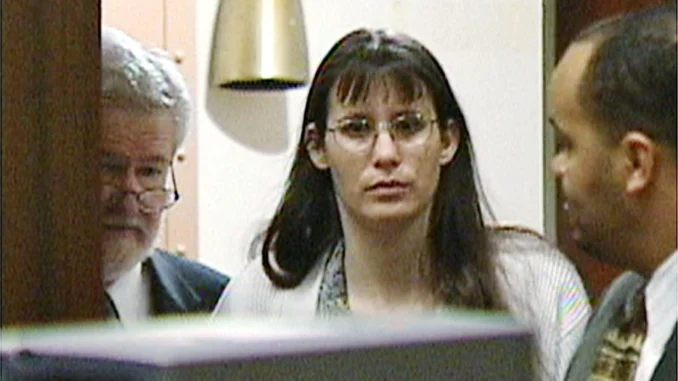
Andrea Yates is an American woman from Houston, Texas, who on June 20, 2001, drowned her five young children in the bathtub of the family home.
The case became one of the most widely reported and debated criminal proceedings in modern American history, not only because of the horrific nature of the crime, but because of the profound questions it raised about postpartum mental illness, the definition of legal insanity, the adequacy of the mental health system, and the fairness of the criminal justice process.
Found guilty of capital murder at her first trial in 2002, Yates had her conviction overturned on appeal in 2005 following the discovery of false expert testimony, and at a retrial in 2006, a jury found her not guilty by reason of insanity. She has remained in a state psychiatric facility in Texas ever since.
Profile
| Full Name | Andrea Pia Yates (born Andrea Pia Kennedy) |
| Date of Birth | July 2, 1964 |
| Birthplace | Houston, Texas, USA |
| Nationality | American |
| Occupation | Former registered nurse |
| Spouse | Russell “Rusty” Yates (married April 17, 1993; divorced 2004) |
| Children | Noah (born 1994), John (born 1995), Paul (born 1997), Luke (born February 1999), Mary (born November 2000), all deceased |
| Relationship Status | Divorced |
Early Life
Andrea Pia Kennedy was born on July 2, 1964, in Houston, Texas, into a Roman Catholic family. By all accounts, she had a happy and stable childhood. She was an academically exceptional student, graduating from Milby High School as class valedictorian, and was known for her athletic ability, regularly jogging and swimming. Friends and teachers described her as conscientious, kind, and driven. After high school, she pursued a career in nursing and worked as a registered nurse at the University of Texas MD Anderson Cancer Center, where she cared for cancer patients in a demanding, emotionally taxing environment.
Nothing in Andrea Kennedy’s early life suggested the psychiatric crisis that would later engulf her. She was, by all external measures, a high-achieving, compassionate individual who gave considerable care and attention to the people around her.
Education
Andrea Yates graduated from Milby High School as class valedictorian and subsequently trained as a registered nurse, a qualification she used professionally at MD Anderson Cancer Center in Houston before leaving the workforce after the birth of her children.
Marriage, Family, and Mental Health History
Andrea married Russell “Rusty” Yates, a NASA computer engineer, on April 17, 1993. The couple’s first child, Noah, was born in February 1994, followed by John in 1995, Paul in 1997, and Luke in February 1999. Shortly after Luke’s birth, Andrea Yates experienced a severe mental health crisis. In 1999, she attempted suicide twice and was hospitalised, where she was diagnosed with postpartum depression and psychosis. Psychiatrists and treating physicians explicitly advised the couple against having additional children, warning that doing so would carry serious risks given her mental health history.
Despite this advice, Andrea became pregnant again, and in November 2000, she gave birth to a daughter, Mary. Months after Mary’s birth, Andrea suffered another severe breakdown and required hospitalisation. She was placed on antipsychotic medication, but reports indicate the medication was reduced or discontinued in the weeks preceding the tragedy. On June 18, 2001, her treating psychiatrist, Dr. Mohammed Saeed, had a session with her and determined she was not psychotic, a judgment that would later be widely questioned. Two days later, on June 20, 2001, while her husband was at work, Andrea Yates drowned her five children one by one in the bathtub of the family’s Clear Lake, Texas home: John, Paul, Luke, and Mary were each drowned, and when Noah, aged seven, discovered a sibling’s body and ran, Andrea chased him, dragged him to the bathtub, and drowned him alongside his dead sister. She then called police, saying “It’s time,” and contacted her husband, telling him “the children” had been hurt.
The Criminal Trials
Andrea Yates was indicted on two counts of capital murder and pleaded not guilty by reason of insanity. Her first trial began on February 18, 2002. She did not take the stand. Defence attorneys argued that she was in a psychotic state and had believed, due to her mental illness, that she was saving her children from Satan. Prosecutors countered that under Texas law, she could only be found not guilty by reason of insanity if her condition had prevented her from knowing that what she was doing was wrong, and that the evidence suggested she did know her actions were wrong.
On March 12, 2002, after deliberating for fewer than four hours, a jury found Yates guilty of two counts of capital murder for the deaths of Noah, John, and Mary (she was not tried separately for the deaths of Paul and Luke). She was sentenced to life in prison with the possibility of parole after 40 years. The verdict was deeply divisive, with many mental health advocates arguing that Yates was a woman who needed treatment, not imprisonment.
In January 2005, the Texas Court of Appeals overturned the conviction on the grounds of false testimony. During the original trial, prosecution expert witness Dr. Park Dietz, a forensic psychiatrist, had testified that Yates had been influenced by an episode of the television crime drama “Law and Order” in which a mother who drowned her children was found innocent. However, no such episode had ever aired. This fabricated piece of testimony had potentially influenced the jury, and the court found the error sufficient to warrant a new trial.
At Yates’s retrial in 2006, a jury found her not guilty by reason of insanity on July 26, 2006. She was committed to the North Texas State Hospital and later transferred to Kerrville State Hospital in Kerrville, Texas, where she has remained under psychiatric care. Rusty Yates divorced her during her original incarceration in 2004 and later remarried. Andrea Yates has repeatedly and voluntarily waived her annual review hearings that could potentially allow for her conditional release, indicating she does not wish to leave the psychiatric facility at this time.
Personal Life
Before her mental health crisis, Andrea Yates was described as a devoted mother and wife. She had left her nursing career to homeschool her children and take care of them full-time, a decision driven in part by the influence of Michael Woroniecki, an itinerant evangelical preacher whose extreme religious teachings, which included warnings about the sinfulness of mothers and the damnation of their children, have been examined by researchers and journalists as a possible contributing factor to the ideological context of her psychosis. Woroniecki denied any responsibility for the tragedy.
Andrea Yates has been described by those who have interacted with her during her time in psychiatric care as quiet, remorseful, and cooperative with her treatment. She has reportedly expressed profound grief over the deaths of her children. She has never publicly spoken at length about the events of June 20, 2001.
Net Worth
No verified net worth figure is currently available for Andrea Yates. She has been institutionalised since 2001 and has not been employed or engaged in income-generating activities during this period.
Legacy and Impact
- The Andrea Yates case brought national and international attention to postpartum psychosis as a serious and potentially devastating psychiatric condition
- It sparked significant debate about the legal definition of insanity and whether current standards adequately account for severe mental illness
- The case led to increased public education about postpartum depression and psychosis, and prompted advocates to push for better screening and treatment protocols for new mothers
- Several organisations working on maternal mental health have cited the Yates case as a catalyst for policy reform and public awareness campaigns
Conclusion
The Andrea Yates case remains one of the most harrowing and morally complex criminal cases in recent American history. It is not a story that lends itself to simple conclusions.
At its centre is a woman who, by every reliable clinical account, was suffering from severe psychotic illness at the time she committed an act of unspeakable violence against her own children, children she reportedly believed she was saving from eternal damnation.
The case exposed deep fault lines in the American legal and mental health systems, raised fundamental questions about how society treats severely mentally ill individuals, and forced a long-overdue national conversation about postpartum psychosis.
The tragedy of June 20, 2001 claimed six lives: five children, and in a very real sense, the life Andrea Yates had known before her illness took hold.
Related People







Leave a Reply