
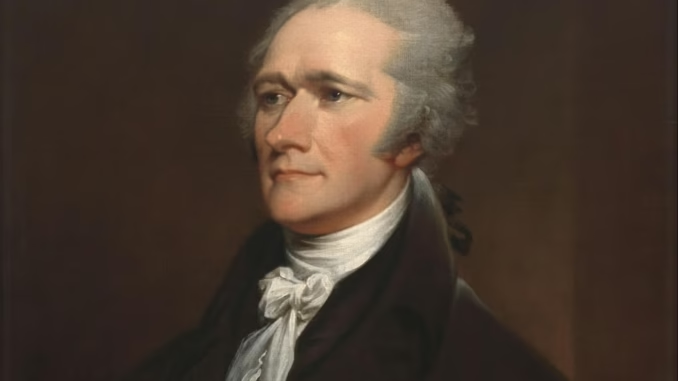
Alexander Hamilton was one of the most consequential Founding Fathers of the United States, an immigrant from the Caribbean who rose through sheer intellect and ambition to shape the political, economic, and constitutional foundations of a new republic.
As the first Secretary of the Treasury, chief co-author of the Federalist Papers, architect of the national banking system, and one of the driving forces behind the ratification of the United States Constitution, Hamilton’s fingerprints are on virtually every structural element of American governance.
His extraordinary life, from an impoverished, illegitimate childhood in the West Indies to the corridors of power in the new nation’s capital, was cut short on July 12, 1804, when he died from a gunshot wound suffered in a duel with Vice President Aaron Burr.
More than two centuries later, Hamilton remains one of the most studied, debated, and celebrated figures in American history.
Profile
| Full Name | Alexander Hamilton |
| Date of Birth | January 11, 1755 or 1757 (disputed) |
| Date of Death | July 12, 1804 |
| Age at Death | Approximately 47–49 |
| Birthplace | Charlestown, Nevis, British West Indies (now Saint Kitts and Nevis) |
| Nationality | American |
| Occupation | Statesman, Lawyer, Military Officer, Economist, Political Theorist |
| Spouse | Elizabeth Schuyler Hamilton (married December 14, 1780) |
| Children | 8 (Philip, Angelica, Alexander Jr., James Alexander, John Church, William Stephen, Eliza, Philip II) |
Early Life
Alexander Hamilton was born out of wedlock on the Caribbean island of Nevis, part of the British West Indies, to James Hamilton, a Scottish trader, and Rachel Faucette Lavien, a woman of French Huguenot descent. His exact birth year remains disputed by historians, with some sources citing 1755 and others 1757. His parents were not married, as his mother’s first husband, a Danish merchant named Johann Michael Lavien, had refused to grant her a divorce. The social stigma of illegitimacy would follow Hamilton throughout his early years, though it ultimately failed to define the man he became.
Hamilton’s childhood was marked by hardship. His father abandoned the family around 1765, leaving Rachel to support her two sons alone. His mother died of a fever in 1768, when Hamilton was approximately 11 or 13 years old, and he and his brother James became wards of their mother’s relatives. To survive, Hamilton went to work as a clerk for a trading firm on the island of St. Croix, where he demonstrated prodigious intellectual gifts that caught the attention of local merchants and community leaders. A letter he wrote describing a devastating hurricane in 1772 was published in a local newspaper and so impressed readers that a group of prominent citizens raised funds to send the young man to the American colonies for a proper education.
Education
Hamilton arrived in the American colonies around 1772 and initially studied at a preparatory school in Elizabethtown, New Jersey, before enrolling at King’s College in New York City, the institution now known as Columbia University. He proved to be an extraordinarily capable student with a voracious appetite for learning. He studied law, politics, economics, and military science with remarkable speed. His studies were interrupted by the outbreak of the American Revolutionary War, during which he left college to join the Continental Army. He would later serve as a trustee of Kings College (later Columbia University).
Career
Hamilton’s career can be divided into three remarkable phases: military service, legal and political philosophy, and statesmanship. During the Revolutionary War, he served as an artillery captain before catching the attention of General George Washington, who appointed him as his aide-de-camp in 1777. In this role, Hamilton functioned as Washington’s chief of staff, handling correspondence, drafting key documents, and serving as a trusted advisor. He eventually secured a battlefield command and led a critical charge at the Battle of Yorktown in 1781, the final major military engagement of the war.
After the war, Hamilton studied law and established a successful legal practice in New York. He was one of the delegates to the Constitutional Convention in Philadelphia in 1787, where he argued forcefully for a strong central government modelled along British lines. Though not all of his specific proposals were adopted, his broader vision of a powerful federal government prevailed. Along with James Madison and John Jay, Hamilton wrote the Federalist Papers, a collection of 85 essays published in 1787 and 1788 arguing for the ratification of the new Constitution. Hamilton authored 51 of the 85 essays, making him the single largest contributor to one of the most influential political texts in American history.
When George Washington was inaugurated as the first President of the United States in 1789, he appointed Hamilton as the nation’s first Secretary of the Treasury, a post Hamilton held until 1795. In this role, Hamilton built the financial architecture of the new republic almost from scratch. He advocated for the federal assumption of state debts incurred during the Revolutionary War, established the First Bank of the United States (chartered in 1791 and modelled on the Bank of England), created the U.S. Mint, laid the foundation for the Coast Guard, and developed a system of tariffs and taxes to fund the federal government. His financial vision, though bitterly opposed by Thomas Jefferson and James Madison, succeeded in fuelling economic growth and establishing credit for the new nation.
Hamilton was a co-founder of one of America’s first political parties, the Federalists, and remained deeply active in politics after leaving the Treasury. When Aaron Burr and Thomas Jefferson were tied in electoral votes in the presidential election of 1800 due to a flaw in the Electoral College system, Hamilton actively supported Jefferson, despite their ideological differences, because of his profound distrust of Burr. This intervention, combined with Hamilton’s later opposition to Burr’s candidacy for Governor of New York in 1804, inflamed a long-simmering enmity between the two men. After a letter describing Hamilton’s “despicable” opinion of Burr was published in an Albany newspaper, Burr challenged Hamilton to a duel.
The duel took place on the morning of July 11, 1804, at Weehawken, New Jersey. Hamilton was shot in the right side by Burr, suffering a wound that proved mortal. He was carried across the Hudson River to the Greenwich Village home of a friend, where he died the following afternoon, July 12, 1804, surrounded by family and friends. Aaron Burr, though indicted for murder in New York and New Jersey, was never prosecuted and completed his term as Vice President, though his political career was effectively destroyed. Hamilton was buried at Trinity Churchyard in lower Manhattan, where his grave can still be visited today. His face appears on the United States ten-dollar bill.
Political Achievements and Offices Held
- Aide-de-Camp to General George Washington (1777–1781)
- Delegate to the Continental Congress (1782–1783)
- Delegate to the Constitutional Convention, Philadelphia (1787)
- Co-author of The Federalist Papers (1787–1788), authored 51 of 85 essays
- First Secretary of the Treasury of the United States (1789–1795)
- Founded the First Bank of the United States (1791)
- Founded the Bank of New York (1784)
- Co-founder of the Federalist Party
- Inspector General of the Army and Major General during the Quasi-War (1798–1800)
Personal Life
Hamilton married Elizabeth Schuyler, known as Eliza, on December 14, 1780. She was the daughter of Philip Schuyler, a prominent New York general, senator, and landowner. Together they had eight children. Their eldest son, Philip Hamilton, was killed in a duel in 1801 at the age of 19, a loss that devastated the family. Hamilton’s own personal life was not without scandal; in the 1790s, he carried on an affair with a married woman named Maria Reynolds, whose husband subsequently blackmailed him. When political opponents implied the payments to Reynolds were related to financial corruption in the Treasury, Hamilton made the extraordinary decision to publish a detailed public confession of the affair, known as the Reynolds Pamphlet, in order to defend his financial integrity at the cost of his personal reputation. His wife Eliza, who survived him by fifty years, spent much of her widowhood preserving his legacy and founding one of New York City’s first private orphanages, the Orphan Asylum Society, in 1806.
Net Worth
As a historical figure from the 18th century, no verified net worth figure exists in modern terms. Hamilton died leaving his family in considerable debt, partly due to the legal costs associated with his public and private affairs. His wife was left to manage the family finances and care for their children with significant financial difficulty in the years immediately following his death.
Major Works and Contributions
- The Federalist Papers (co-authored with James Madison and John Jay, 1787–1788)
- Report on Public Credit (1790), laid out Hamilton’s plan for federal assumption of state debt
- Report on a National Bank (1790), led to the chartering of the First Bank of the United States
- Report on Manufactures (1791), argued for federal support of American industry through tariffs and subsidies
- The Reynolds Pamphlet (1797), public confession of extramarital affair to protect his financial reputation
Conclusion
Alexander Hamilton’s life was one of the most extraordinary in American history, a story of a self-made immigrant who, through intellect, ambition, and sheer force of will, helped shape the political and economic foundations of a new nation. His vision for a strong federal government, a national bank, and an industrial economy was not universally popular in his time, but it proved prescient: much of the structure he put in place in the 1790s endures to this day. Hamilton remains on the $10 bill, his face a permanent fixture of the nation he helped build. His story, finally given the popular audience it deserved through Lin-Manuel Miranda’s 2015 Broadway musical, continues to resonate because it is, at its core, a story about what is possible when talent, determination, and opportunity converge, even against the most daunting of odds.
Related People







Leave a Reply