
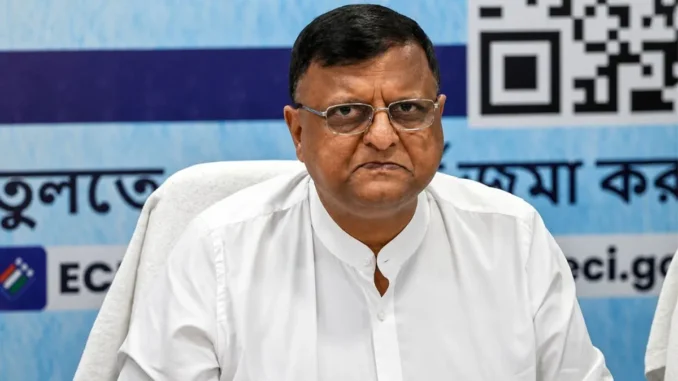
IAS officer Manoj Kumar Agarwal, who oversaw the recently concluded West Bengal polls that brought the BJP to power in the state for the first time ever, was appointed Chief Secretary on Monday, two days after the new government assumed office.
The appointment of Manoj Kumar Agarwal as West Bengal’s Chief Secretary on 11 May 2026 just two days after the swearing-in of the state’s first-ever BJP government under Chief Minister Suvendu Adhikari is one of the most politically loaded senior bureaucratic appointments in recent Indian administrative history.
An IIT Kanpur-educated engineer who joined the IAS in 1990, spent 36 years across district administration, state departments, central deputation, and electoral management, and served as Chief Electoral Officer during the most consequential West Bengal Assembly election in fifteen years Agarwal is a man whose career has been defined by his willingness to operate with firmness and procedural discipline in the most politically charged environments.
His colleagues in the CEO’s office describe him as a bureaucrat of extremely cool temperament with the ability of handling difficult situations with professional ease and impeccable transparency. This was precisely why every suggestion of Agarwal regarding SIR and polling was accepted by the Election Commission of India’s top brass in New Delhi without almost any question asked.
He is in the truest sense of the phrase, the right man at the right moment a seasoned administrator placed at the helm of West Bengal’s bureaucracy at the exact moment when the state’s governance undergoes its most profound transformation in over a decade.
Profile
| Full Name | Manoj Kumar Agarwal |
| Born | 8 July 1966 |
| Age | 59 Years Old |
| Home State / Origin | Uttar Pradesh |
| Nationality | Indian |
| Occupation | Indian Administrative Service (IAS) Officer |
| IAS Batch | 1990 |
| Cadre | West Bengal |
| Recruitment Type | Direct Recruit (DR) via UPSC Civil Services Examination |
| IAS Identity Number | 01WB034400 |
| Educational Qualification | B.Tech in Mechanical Engineering, IIT Kanpur |
| School | La Martiniere College, Lucknow |
| Wife | Rooma Agarwal |
| Current Posting | Chief Secretary, Government of West Bengal (from 11 May 2026) |
| Expected Retirement | 31 July 2026 |
| Other Role | President, West Bengal State IAS Association |
Early Life
Born on July 8, 1966, Manoj Kumar Agarwal originally belongs to Uttar Pradesh. He was born into a family with the educational values and aspirational culture that characterise many middle-class professional households in Uttar Pradesh’s major cities.
The family’s decision to send the young Manoj to La Martiniere College in Lucknow one of India’s most prestigious and historically significant missionary schools reflects the importance they placed on educational excellence and the kind of broad, values-based formation that the best Indian schools have historically provided.
Growing up in Lucknow the capital of Uttar Pradesh, a city known for its Nawabi cultural refinement, its linguistic elegance, and its long tradition of professional and administrative achievement gave Agarwal an early education in the art of navigating complex institutional environments with composure and dignity.
These are qualities that would serve him well across a career spent in one of India’s most politically volatile and administratively demanding states.
Education
He completed his schooling at the prestigious La Martiniere College in Lucknow before pursuing higher studies at the Indian Institute of Technology (IIT) Kanpur. He earned a B.Tech degree in Mechanical Engineering from IIT Kanpur and later joined the Indian Administrative Service through the UPSC Civil Services Examination.
La Martiniere College, Lucknow founded in the 19th century by the French general Claude Martin is one of India’s oldest and most distinguished English-medium schools, known for producing generations of distinguished alumni across medicine, law, the civil services, and the armed forces. Its alumni community is among the most tightly knit in Indian educational history, and attendance at La Martiniere is widely recognised as a mark of educational distinction.
From La Martiniere, Agarwal proceeded to the Indian Institute of Technology (IIT) Kanpur one of the five original IITs established in the early years of Indian independence, and consistently ranked among India’s premier engineering and research institutions.
His B.Tech in Mechanical Engineering from IIT Kanpur gave him a rigorous quantitative and analytical training the kind of systematic, problem-solving intellectual framework that, when applied to the challenges of public administration, produces administrators who bring engineering discipline to governance problems.
It is no coincidence that the most celebrated IAS officers from IIT backgrounds are often praised for their precision, their data-driven approach to administration, and their willingness to confront complex institutional problems with structured, methodical solutions.
His decision to appear for the UPSC Civil Services Examination after completing his engineering degree forgoing the engineering career that most IIT graduates pursue reflects the kind of public service orientation that draws India’s most talented young professionals into the IAS in each generation.
Over a distinguished administrative career spanning more than three decades, Agarwal has handled 27 different assignments across state and central government departments.
Career
Early Career District Administration, West Bengal (1990–2003)
Agarwal began his administrative career in 1990 as a trainee officer, with early postings as Additional District Magistrate in Bardhaman, SDO in Bardhaman, ADM in Purulia, and CEO in Jalpaiguri through the 1990s.
His early career postings placed him across some of West Bengal’s most geographically and administratively varied districts from the industrially significant Bardhaman belt in the Burdwan region to the tea garden district of Jalpaiguri in north Bengal and the tribal district of Purulia in the state’s western margins.
Each of these postings required a different administrative intelligence: Bardhaman demanded an understanding of industrial relations and urban governance; Jalpaiguri required sensitivity to the specific challenges of tea plantation communities and north Bengal’s ethnic diversity; and Purulia demanded knowledge of tribal development, land rights, and the particular vulnerabilities of scheduled tribe communities in western Bengal.
He served as District Magistrate in North Dinajpur from 1999 to 2001, and later in Bardhaman from 2001 to 2003.
His two consecutive District Magistrate postings in North Dinajpur (1999–2001) and Bardhaman (2001–2003) were among the most formative experiences of his senior career. North Dinajpur is a border district sharing a long and sensitive international border with Bangladesh, with the governance challenges of a predominantly agricultural, relatively underdeveloped district with significant minority population dynamics.
He served as District Magistrate of Uttar Dinajpur, where he reportedly developed close ties with late Congress leader Priya Ranjan Dasmunsi. Bardhaman was one of West Bengal’s most populous, most industrialised, and most politically organised districts managing it as DM required both administrative competence and political dexterity of a high order.
Central Deputation Personal Secretary to Union Minister Priya Ranjan Dasmunsi
Apart from his state-level responsibilities, Agarwal also served on central deputation in New Delhi, including as Personal Secretary to former Union Minister Priya Ranjan Dasmunsi during his tenure as Union Information and Broadcasting Minister, as well as in assignments linked to the Delhi Development Authority (DDA).
His role as Personal Secretary to a Union Cabinet Minister gave him an invaluable perspective on the workings of the central government the interplay between the political executive and the administrative machinery, the management of a Cabinet ministry’s daily operations, and the cultivation of the national-level professional networks that prove useful to state cadre officers throughout their careers.
Priya Ranjan Dasmunsi was one of West Bengal’s most prominent and nationally influential Congress politicians a five-time Member of Parliament from Raiganj, a former Union Minister of State for External Affairs and later Union Minister for Information and Broadcasting, and a key figure in the Congress party’s Bengal political strategy.
Agarwal’s personal secretary role under Dasmunsi placed him at the intersection of national media policy and Bengal Congress politics during an important period of Indian political history.
Principal Secretary Food and Supplies Department (2017–2018)
His senior-level postings included Principal Secretary and Commissioner in the Food and Supplies Department from 2017 to 2020. The Food and Supplies Department is one of West Bengal’s most operationally significant portfolios responsible for the state’s public distribution system (PDS), which provides subsidised food grains to tens of millions of Below Poverty Line families across the state.
Managing this department requires strict oversight of a supply chain involving state procurement agencies, district-level warehousing, ration shop dealers, and beneficiary management systems and is a portfolio where corruption and leakage have historically been serious concerns.
Agarwal is described in bureaucratic circles as an officer who was transferred out of the Food and Supplies Secretary role in 2018 after ordering an FIR over alleged irregularities in the public distribution system.
The minister then in charge of that department, Jyotipriyo Mallick, was subsequently arrested by the Enforcement Directorate in October 2023 in a money laundering case linked to an alleged multi-crore ration distribution scam.
The retrospective significance of this detail is extraordinary: an IAS officer was transferred out of a department after raising an FIR about irregularities, and the minister responsible for those irregularities was arrested by the ED five years later.
For those who defend Agarwal’s professional integrity, this sequence of events is among the most compelling evidence of his willingness to follow due process even at personal professional cost.
Principal Secretary Fire and Emergency Services
His career also included serving as Principal Secretary in Fire and Emergency Services a department responsible for fire prevention, emergency response, and the management of West Bengal’s fire and rescue services infrastructure.
This posting gave him additional crisis management expertise that complemented his later work in electoral management and his role overseeing emergency situations as CEO.
Additional Chief Secretary Forest Department
He served as Additional Chief Secretary in the Forest Department one of West Bengal’s more complex and multi-dimensional portfolios, covering forest conservation, wildlife management, timber and non-timber forest produce, tribal rights in forest areas, and the administration of the state’s extensive Sundarbans delta ecosystem.
The ACS Forest posting gave him senior-level exposure to environmental governance and the specific challenges of managing a state with both ecologically sensitive protected areas and large forest-dependent tribal populations.
Additional Chief Secretary Disaster Management and Civil Defence
He also served as Additional Chief Secretary in Disaster Management and Civil Defence building on the disaster preparedness and emergency response expertise that West Bengal’s geography demands of its most senior administrators, given the state’s exposure to annual cyclones, floods, and the specific vulnerabilities of the Sundarbans delta and the flood-prone districts of north Bengal.
Chief Electoral Officer (CEO) West Bengal (March 2025 – May 2026)
The most consequential and publicly visible phase of Manoj Kumar Agarwal’s career was his tenure as Chief Electoral Officer of West Bengal from March 2025 to May 2026 a period that encompassed the entire run-up to and conduct of the historic 2026 West Bengal Assembly elections.
IAS Agarwal was appointed as West Bengal’s Chief Electoral Officer in March 2025. His appointment had drawn attention after the Election Commission rejected the state government’s initial shortlist and sought a revised panel of officers nearing retirement after the 2026 Assembly elections. According to senior bureaucratic sources, the Election Commission preferred an officer who would remain insulated from political pressure while overseeing the crucial Assembly polls.
The flashpoint of his tenure was the Special Intensive Revision (SIR) of electoral rolls, a process Agarwal oversaw until its completion on February 28, 2026. On paper, the exercise is meant to clean up voter lists. In practice, it has turned into a political flashpoint.
This was the first such revision in Bengal in nearly two decades, and its scale added only to the tension. As CEO, Agarwal supervised the Special Intensive Revision of electoral rolls a politically sensitive exercise that reportedly led to the removal of nearly 91 lakh voter names from electoral lists.
Agarwal has pushed back, saying that disputed cases were referred to judicial authorities only after electoral officers failed to resolve them despite hearings.
His colleagues in the CEO’s office describe him as a bureaucrat of extremely cool temperament with the ability of handling difficult situations with professional ease and impeccable transparency. Every suggestion of Agarwal regarding SIR and polling was accepted by the ECI’s top brass in New Delhi without almost any question asked.
The 2026 West Bengal Assembly elections held in two phases on 23 and 29 April 2026 were conducted with an unprecedented 92.93% voter turnout, a relatively peaceful polling process in contrast to West Bengal’s long history of electoral violence, and an outcome that produced the BJP’s historic 206-seat majority.
Agarwal is considered as the principal “musketeer” of “The Three Musketeers” for making the recently concluded Assembly elections remarkable, from various viewpoints, such as the peaceful polling in contrast to the state’s history of electoral violence and an unprecedented voting percentage, with the other two musketeers being poll observer Subrata Gupta and special police observer N.K.
Chief Secretary West Bengal (11 May 2026 – Present)
In a major administrative reshuffle following the formation of the new BJP government in West Bengal under Chief Minister Suvendu Adhikari, senior IAS officer Manoj Kumar Agarwal has been appointed as the new Chief Secretary of the state. The appointment was officially announced on May 11, 2026.
According to a report, while several officers from his batch, including Vivek Kumar, Hridesh Mohan, and Vivek Bharadwaj, remain in service, “Agarwal has emerged as the frontrunner for the top bureaucratic post owing to his performance in handling key responsibilities over the years.”
The BJP said: “Unlike former CM Mamata Banerjee, who had subverted the bureaucracy by blatantly flouting the rules governing the IAS by superseding dozens of officers, the BJP Government of West Bengal has appointed the senior most IAS officer working in the state, Shri Manoj Agarwal, as the Chief Secretary of West Bengal in keeping with its promise to restore the dignity of the laws of the land.”
With retirement scheduled for July 31, 2026, Manoj Agarwal is expected to serve a brief but politically significant tenure as Chief Secretary during a crucial transition phase in West Bengal politics. His Chief Secretaryship spanning barely two and a half months before his mandatory retirement will be measured primarily by how effectively he helps the incoming BJP government establish its administrative machinery, initiates the institutional transition from TMC to BJP governance, and manages the enormous administrative challenges of post-election West Bengal.
Controversies
CBI Disproportionate Assets Case (2009–2018)
Agarwal’s record is complicated by a past CBI investigation into a disproportionate assets case. In a 2010 written reply to the Rajya Sabha, then Union Minister Prithviraj Chavan included Agarwal’s name in a list of IAS officers under investigation.
The CBI, examining assets acquired between 1990 and 2008, alleged he had accumulated wealth 116 percent beyond his known income. The charge sheet also named his wife, Rooma, and father-in-law, M.P. Garg, with allegations of nearly 30 bank accounts linked to the case. A special CBI court summoned Agarwal, his wife, and father-in-law in October 2015.
In 2013, the CBI filed a chargesheet alleging that Agarwal and his wife possessed disproportionate assets worth Rs 1.46 crore. However, he was acquitted by a Delhi court in 2018. His acquittal by the Delhi court in 2018 formally cleared him of all criminal liability in the case. The case was subsequently dismissed, though, as The Print noted, the investigation remains a documented part of his official record. During his tenure as CEO, the TMC revived references to the case as part of its political campaign against him though the acquittal makes its legal relevance minimal.
SIR Controversy and TMC Bias Allegations (2025–2026)
IAS Agarwal’s tenure as CEO became politically contentious, especially during the voter list revision exercise. Former Chief Minister Mamata Banerjee and the Trinamool Congress repeatedly criticised him, accusing him of bias and favouring the BJP. The TMC even lodged a formal complaint before the Election Commission alleging “partisan conduct.”
The ruling party alleged misuse of power by Agarwal to influence voters. This came at a time when Agarwal was visiting different areas to take feedback about the SIR process. The TMC alleged that Agarwal was only visiting certain areas where BJP cadre was present and was accompanied by local BJP leaders. The TMC termed Agarwal’s moves as a “clear violation of protocols.”
Agarwal consistently defended his conduct, and the Election Commission of India which had specifically chosen him for the CEO role precisely because of its confidence in his neutrality and procedural integrity stood by his handling of the SIR exercise throughout. The BJP’s defence of his appointment as Chief Secretary explicitly positioned him as a counter-narrative to the TMC’s characterisation: the BJP strongly defended the appointment, stating that Manoj Agarwal was the senior-most IAS officer serving in the state and his selection reflected the government’s commitment to restoring bureaucratic integrity.
Transfer from Food and Supplies Post (2018)
Agarwal is described in bureaucratic circles as an officer who was transferred out of the Food and Supplies Secretary role in 2018 after ordering an FIR over alleged irregularities in the public distribution system. While this transfer was a setback at the time, the subsequent 2023 arrest of the minister involved in those irregularities has been widely cited by his defenders as retrospective vindication of his professional judgment and his willingness to act on evidence of wrongdoing regardless of the political consequences.
Social Media
Manoj Kumar Agarwal does not maintain a publicly known personal social media presence. Consistent with the professional culture of senior IAS officers who prefer to communicate through official channels and institutional platforms, his digital footprint is minimal.
Official information about his career and postings is available through the Government of West Bengal’s PAR Department posting lists, the DoPT IAS Civil List (identity number 01WB034400), and India’s leading bureaucracy news portals.
His role as President of the West Bengal State IAS Association has occasionally generated coverage in bureaucracy news sources.
Personal Life
The charge sheet named his wife, Rooma Rooma Agarwal who was also named in the CBI disproportionate assets case. As noted, the case was ultimately dismissed and he was acquitted by a Delhi court in 2018.
Details about his children, family background, and personal interests are not publicly available. He is described by colleagues as a composed, procedure-focused administrator who keeps his personal life strictly separate from his professional identity.
He currently also serves as President of the West Bengal State IAS Association reflecting the professional respect of his peer group within the state’s IAS cadre. The IAS Association presidency is not an elected position in the political sense, but reflects the institutional stature of the officer who holds it within the civil service community.
Colleagues describe Agarwal as a firm administrator who prefers to stick to procedure, even in difficult situations. Officials who have worked alongside him describe him as a bureaucrat of extremely cool temperament with the ability of handling difficult situations with professional ease and impeccable transparency.
These two descriptions procedural firmness and cool-headed transparency capture the professional identity of a man whose career has consistently been defined by his willingness to follow institutional rules even when doing so creates political friction.
Salary and Service Details
As a 1990 batch IAS officer of the West Bengal cadre in the Apex Scale, Manoj Kumar Agarwal’s salary as Chief Secretary is governed by the 7th Pay Commission Pay Matrix at the Apex Scale (Level 17), carrying a fixed pay of ₹2,25,000 per month supplemented by Dearness Allowance, HRA, and all position-specific entitlements associated with the Chief Secretary’s office including official accommodation, official vehicle with security, secretariat support staff, and government hospitality arrangements.
His expected retirement date is 31 July 2026 based on his date of birth of 8 July 1966 and the IAS mandatory retirement age of 60.
With retirement scheduled for July 31, 2026, Manoj Agarwal is expected to serve a brief but politically significant tenure as Chief Secretary during a crucial transition phase in West Bengal politics. His Chief Secretaryship will therefore last approximately two and a half months from 11 May 2026 to 31 July 2026 before a successor is appointed.
Frequently Asked Questions (FAQs)
Who is Manoj Kumar Agarwal IAS?
Manoj Kumar Agarwal is a 1990 batch IAS officer of the West Bengal cadre who was appointed Chief Secretary of West Bengal on 11 May 2026 by the newly formed BJP government under Chief Minister Suvendu Adhikari. He previously served as the Chief Electoral Officer (CEO) of West Bengal from March 2025, overseeing the 2026 Assembly elections. He is an alumnus of IIT Kanpur (B.Tech, Mechanical Engineering) and La Martiniere College, Lucknow.
When was Manoj Kumar Agarwal born?
He was born on 8 July 1966.
What is Manoj Kumar Agarwal’s educational background?
He attended La Martiniere College in Lucknow for his schooling and holds a B.Tech in Mechanical Engineering from the Indian Institute of Technology (IIT) Kanpur one of India’s premier engineering institutions. He subsequently cleared the UPSC Civil Services Examination and joined the IAS in 1990.
What is the SIR controversy involving Manoj Kumar Agarwal?
As West Bengal’s Chief Electoral Officer, Agarwal oversaw the Special Intensive Revision (SIR) of electoral rolls completed on 28 February 2026. The exercise resulted in approximately 91 lakh names being removed from voter lists, which the TMC alleged was biased against its voters. The party lodged a formal complaint with the Election Commission accusing Agarwal of partisan conduct in favour of the BJP. The Election Commission stood by his handling of the exercise throughout.
What was the CBI case against Manoj Kumar Agarwal?
In 2009, the CBI began investigating allegations that Agarwal had accumulated disproportionate assets worth ₹1.46 crore 116% beyond his known income. A chargesheet was filed in 2013, also naming his wife Rooma and father-in-law M.P. Garg, with allegations involving nearly 30 bank accounts. He was acquitted by a Delhi court in 2018, and the case was dismissed. The TMC revived references to it during the 2026 election period but his acquittal makes it legally resolved.
When was Manoj Kumar Agarwal appointed Chief Secretary?
He was appointed Chief Secretary of West Bengal on 11 May 2026, two days after the swearing-in of Chief Minister Suvendu Adhikari’s BJP government. He succeeded Dushyant Nariala, who was transferred to New Delhi as Principal Resident Commissioner.
When does Manoj Kumar Agarwal retire?
His mandatory retirement date is 31 July 2026, based on his date of birth of 8 July 1966 and the IAS retirement age of 60. His Chief Secretaryship is therefore expected to last approximately two and a half months.
What other roles has Manoj Kumar Agarwal held?
He has held 27 documented assignments across his career, including District Magistrate of North Dinajpur (1999–2001) and Bardhaman (2001–2003), Personal Secretary to Union Minister Priya Ranjan Dasmunsi, Principal Secretary of Food and Supplies, Principal Secretary of Fire and Emergency Services, Additional Chief Secretary of the Forest Department, Additional Chief Secretary of Disaster Management and Civil Defence, and President of the West Bengal State IAS Association.
Is Manoj Kumar Agarwal married?
Yes. His wife’s name is Rooma Agarwal. They were both named in the now-dismissed CBI disproportionate assets case. Further details about his family are not publicly available.
Why was Manoj Kumar Agarwal’s appointment as Chief Secretary seen as significant?
It was significant for multiple reasons: he moves directly from overseeing the election as CEO to running the state administration as Chief Secretary; he is the senior-most IAS officer in service in West Bengal, with the BJP positioning his appointment as a restoration of seniority norms; and his close association with the Election Commission’s election management framework gives the new BJP government an immediate administrative advantage during a critical post-election governance transition.
Conclusion
Manoj Kumar Agarwal’s biography is the story of an IIT-trained engineer who chose the harder path of public service, spent 36 years navigating the complexities of West Bengal’s governance landscape with the procedural firmness and professional composure that have defined his reputation, and found himself in the final weeks of a distinguished career at the absolute apex of the administrative hierarchy of India’s most politically transformed state.
His career has not been without controversy. The CBI disproportionate assets case, however ultimately resolved, is a documented chapter in his public record. The SIR controversy with its allegations of partisan conduct will remain a subject of political debate long after the 2026 elections have passed into history. But the consistent thread running through his career the FIR against food irregularities that cost him a posting, the EC’s confidence in his handling of the most sensitive electoral process in Bengal in a generation, the cool professionalism that his colleagues cite repeatedly suggests a man whose commitment to institutional procedure has been genuine rather than performative.
In a state and a political moment defined by the most dramatic transfer of power in fifteen years, Manoj Kumar Agarwal’s two and a half months as Chief Secretary will be brief but significant. He will oversee the administrative birth of BJP-governed West Bengal setting in motion the bureaucratic machinery that will carry the new government’s priorities into effect. And when he retires on 31 July 2026, he will leave behind a career that whatever controversies attended it was built on 36 years of consequential, consistent, and ultimately creditable public service.
Related People






Leave a Reply