
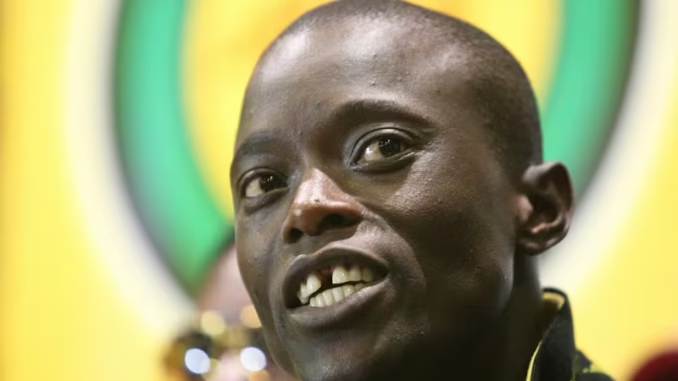
Who Was Sindiso Magaqa?
Sindiso Magaqa was a South African ANC politician from KwaZulu-Natal who served as the Secretary General of the ANC Youth League (ANCYL) from June 2011 to April 2012. He was a passionate advocate for economic transformation, youth empowerment, and integrity in public service.
Before his national prominence, he was a grassroots organiser and student activist in Umzimkhulu, and after his national career, he served as a ward councillor and executive committee member of the Umzimkhulu Local Municipality where he bravely raised the alarm about serious corruption in municipal spending.
He was shot in an apparent assassination attempt on 13 July 2017, alongside two other councillors, and succumbed to his injuries nearly two months later on 4 September 2017 at the Inkosi Albert Luthuli Hospital in Durban.
He was 35 years old. His killing was widely attributed to his anti-corruption activism within the municipality and broader ANC factional politics in KwaZulu-Natal. A student residence at Nelson Mandela University in George has been named in his honour.
| Sindiso Jethro Magaqa | |
|---|---|
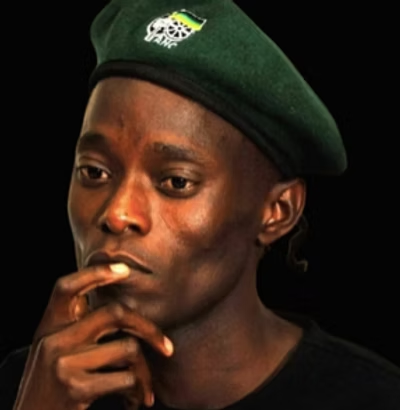 Sindiso Jethro Magaqa: History · Bio · Photo
|
|
| Wiki Facts & About Data | |
| Full Name: | Sindiso Jethro Magaqa |
| Stage Name: | "Super" |
| Born: | May 7, 1983 |
| Age: | 43 years old |
| Death: | September 4, 2017 (aged 35) |
| Birthplace: | Ibisi Township, Umzimkhulu (then Eastern Cape; now KwaZulu-Natal), South Africa |
| Nationality: | South African |
| Occupation: | Politician · Student Activist · Ward Councillor · Municipal Project Manager · Anti-Corruption Whistleblower |
| Religion: | Christianity |
| Parents: | Agnes Magaqa (Mother) |
| Siblings: | Dr Lwazi Magaqa (Brother) |
Early Life
Sindiso Jethro Magaqa was born on May 7, 1983, in the township of Ibisi in Umzimkhulu a community located in the southernmost region of what is today KwaZulu-Natal. Umzimkhulu has a complex geographical and administrative history: for much of South Africa’s history, it was part of the Eastern Cape province, before being transferred to KwaZulu-Natal in 2006 as part of a government redetermination of provincial boundaries.
This dual identity rooted in the Eastern Cape’s strong tradition of ANC activism while geographically positioned within KwaZulu-Natal would later come to define many of the political tensions that shaped Sindiso’s career and, ultimately, his fate.
Ibisi, a small and modest township, was a world away from the halls of national power where Sindiso would later make his mark.
Growing up in a community marked by the legacy of apartheid limited economic opportunities, inadequate public services, and a deeply politicised culture of community organisation and resistance Sindiso absorbed the spirit of the liberation movement from an early age. South Africa was in the midst of a historic political transition during his childhood. Nelson Mandela was released from prison in 1990, and the country held its first democratic elections in April 1994, when Sindiso was just ten years old. The euphoria and transformative energy of that moment left an indelible impression on a generation of young South Africans, of whom Sindiso was one.
His political awakening was almost immediate and remarkably precocious. He joined the Congress of South African Students (COSAS) the ANC-aligned student organisation while he was still in primary school, demonstrating an unusual and passionate commitment to political organisation at an extraordinarily young age. This early entry into structured political activism set the tone for everything that was to follow.
He attended Ibisi High School in Umzimkhulu, where he quickly became a dominant figure in student politics. He rose to become the leader of the school branch of the Congress of South African Students, organising his fellow students, articulating demands for better education and greater equality, and developing the communication skills and political instincts that would later serve him on the national stage.
Those who knew him during this period recall a young man who combined intellectual curiosity with an instinctive gift for leadership and an uncompromising sense of justice. He was the kind of person who could calm a room or electrify a crowd with equal ease.
His mother, Agnes Magaqa, has since spoken publicly about the courage her son displayed throughout his life. In a letter read aloud at the Public Interest SA Whistleblowers Awards gala in Johannesburg in October 2025 where the Babita Deokaran Award was posthumously presented to Sindiso’s family Agnes described her son’s life as one devoted entirely to truth, justice, and a better South Africa. Her words captured the essence of who he was: a man who did not fight for himself, but for his nation.
Education
Sindiso Magaqa completed his basic schooling at Ibisi High School in Umzimkhulu, where his academic abilities were evident alongside his political leadership. Following his matriculation, he pursued higher education even as he simultaneously advanced through the ranks of the ANC Youth League.
In tandem with his escalating political career, Sindiso studied Law at the University of South Africa (UNISA) the country’s largest distance-learning institution and one of the most prestigious open universities in Africa. UNISA was an appropriate fit for an activist whose life demanded constant travel, organising, and political engagement: its flexible academic model allowed students to study while remaining fully engaged with their professional and public responsibilities.
His legal studies reflected his deeply held belief that understanding the law was essential to the project of achieving true social justice and economic transformation in post-apartheid South Africa. Though the demands of his political career and, later, the circumstances of his suspension and subsequent return to local-level political work may have complicated the completion of his formal legal qualifications, his grounding in law remained evident in his articulate, structured approach to raising corruption concerns within the Umzimkhulu municipality.
Career
Grassroots Political Beginnings: COSAS and ANCYL in Umzimkhulu
Sindiso Magaqa’s political career began at the very bottom of the organisational ladder exactly where the most transformative leaders so often start. After his school-level activism with COSAS, he formally joined the African National Congress Youth League (ANCYL) in 1997, when he was just fourteen years old. Within a year, in 1998, he was elected branch chairman of the ANCYL in his local branch in Umzimkhulu a remarkable achievement for a teenager, and a clear sign that his peers recognised in him an extraordinary capacity for leadership.
Over the years that followed, Sindiso steadily climbed the organisational ladder of the ANCYL, holding leadership positions at the regional and provincial levels. His work brought him into contact with the full complexity of ANC organisational life the tensions between different factions, the debates about economic policy and transformation, and the challenge of building a movement that could speak to the aspirations of South Africa’s young people in a democratic but still deeply unequal society.
During this period, he also worked as a project manager in the Umzimkhulu Local Municipality a professional role that gave him practical experience in local government and public administration, and that would later inform his determined efforts to hold the municipality accountable for how it spent public money.
Rise to National Prominence: ANCYL Secretary General (2011–2012)
By the late 2000s, Sindiso Magaqa had established himself as one of the most formidable young politicians in the KwaZulu-Natal provincial branch of the ANCYL. His reputation for principled leadership, organisational effectiveness, and passionate advocacy for economic transformation made him an increasingly prominent figure at the national level. After only a year in the KwaZulu-Natal provincial branch, he emerged as the frontrunner to succeed Vuyiswa Tulelo as ANCYL national Secretary General.
As the ANCYL’s leadership elections approached, Magaqa enjoyed overwhelming support the backing of eight of the league’s nine provincial branches. His sole opponent was Ayanda Matiti, the chairperson of the Eastern Cape branch, who drew the support of that province alone. The outcome was never really in doubt.
The ANCYL’s 24th National Conference was held in June 2011 at Gallagher Estate in Midrand. Sindiso Magaqa was elected Secretary General of the ANC Youth League, with Kenetswe Mosenogi as his deputy. He entered the ANCYL Secretariat at the beginning of the second term of Julius Malema as ANCYL President an era marked by extraordinary energy, radical rhetoric, and open conflict with the mainstream ANC leadership.
The Mail & Guardian newspaper regarded Magaqa as a close ally of Malema, and he quickly adopted a similarly confrontational stance toward the ANC establishment. The ANCYL under Malema and Magaqa became the primary vehicle for demanding what they called Economic Freedom in Our Lifetime a radical programme that included the nationalisation of mines and banks, land expropriation without compensation, and a fundamental redistribution of South Africa’s wealth. The programme resonated powerfully with millions of young, economically marginalised South Africans who felt that the post-apartheid economic dispensation had failed them.
The ANCYL under Malema and Magaqa became a major force in the radicalization of South African youth politics. Their challenge to the Zuma administration’s economic orthodoxy attracted enormous attention and galvanised a generation of young activists. However, it also drew the ire of the ANC’s National Executive Committee (NEC), which grew increasingly alarmed by the provocative public statements emanating from the ANCYL leadership.
Disciplinary Action and Suspension (2011–2013)
The decisive turning point in Sindiso’s national political career came in August 2011, when he published an ANCYL statement that was sharply critical of Malusi Gigaba, the incumbent Minister of Public Enterprises. The statement was characteristically direct and uncompromising, reflecting the ANCYL’s combative political style. The ANC’s National Executive Committee, however, viewed it as a serious breach of party discipline, and disciplinary proceedings were initiated against the entire top leadership of the ANCYL.
Sindiso appeared before the ANC’s National Disciplinary Committee at Luthuli House on 30 August 2011. On 10 November 2011, the committee chaired by Derek Hanekom found him guilty of misconduct for his public attacks on Minister Gigaba. He was ordered to apologise publicly to Gigaba and his ANC membership was suspended.
Through a complicated internal appeals process, his sentence was reviewed twice first by the National Disciplinary Committee, which increased it to a three-year suspension, and then twice by Cyril Ramaphosa’s National Disciplinary Committee of Appeals. At the conclusion of the process in April 2012, Ramaphosa’s committee settled on a one-year suspension from the ANC. The suspension effectively ended his tenure as ANCYL Secretary General, and while his suspension concluded in April 2013, the broader ANC Youth League leadership corps including Malema had by then been disbanded.
Julius Malema was expelled from the ANC at the same time that Magaqa was suspended. Malema subsequently founded the Economic Freedom Fighters (EFF). Malema later claimed that Magaqa had considered joining the EFF, but when his suspension ended, Sindiso publicly reaffirmed his commitment to remaining within the ANC, declaring that he would continue to fight for economic freedom under the ANC banner. He expressed the belief that the party could still be won over to a radical economic programme, and he called publicly on the ANC to readmit Malema.
The years following his suspension were difficult ones. For a period, Sindiso was effectively in the political wilderness without a formal leadership position and, for a time, without a clear source of income. He eventually secured employment as a youth affairs manager at the Umzimkhulu Local Municipality, returning to his roots and channelling his energies into local governance and community development.
Return to Local Politics: Ward Councillor (2016–2017)
In the August 2016 local elections, Sindiso Magaqa was elected to represent the ANC as a ward councillor in Umzimkhulu Local Municipality. He also served on the municipality’s executive committee. His return to elected public service was widely welcomed by community members who respected his track record of principled advocacy, and he threw himself into the work of local governance with characteristic dedication and passion.
However, what Sindiso found in the corridors of Umzimkhulu’s municipal administration horrified him. He began raising serious concerns with the municipality’s executive committee about what he described as gross financial mismanagement in particular, a municipal project for the upgrade of the Umzimkhulu Memorial Hall, whose budget had ballooned from R4 million to R37 million without adequate justification or transparent tender processes.
When his internal objections were ignored, Sindiso escalated his concerns through formal channels. He gathered documentary evidence of the alleged corruption and handed it to a trusted contact in the provincial executive, who then passed it to South African Revenue Service Commissioner Tom Moyane, the National Treasury, and the Hawks (South Africa’s elite Directorate for Priority Crime Investigation). This act of principled whistleblowing made him an immediate and dangerous enemy of powerful figures within the municipal and regional ANC structures who had vested interests in ensuring the corruption remained concealed.
In the months that followed, tensions in the Harry Gwala region of KwaZulu-Natal of which Umzimkhulu is a part intensified dramatically. A powerful regional faction wanted Sindiso to stand down from contesting a senior ANC regional position (Secretary of the Harry Gwala region), but he refused to be intimidated. He was lobbied by supporters who urged him to fight for the position. He accepted, and with that decision, the threat to his life escalated to a critical level.
In May 2017, at a Stephen Dlamini memorial lecture delivered by Nkosazana Dlamini-Zuma in Ixopo where she herself warned that ANC factionalism would tear the party apart Sindiso told those present that he feared for his life as tensions in the region continued to rise.
The Assassination (July 13, 2017)
On the evening of 13 July 2017, Sindiso Magaqa was in a car with two fellow local politicians Nonsikelelo Mafa and Jabu Mzizi. The trio were ambushed when they stopped at a general store in some accounts described as a car wash near Sindiso’s home in Ibisi. At least two gunmen opened fire on the vehicle, wielding an R1 rifle and a pistol. The South African Police Service reported that approximately 15 shots were fired into the car. All three occupants were struck and critically wounded. Sindiso, who had been driving, sustained the most severe injuries.
All three victims were rushed to hospital and initially stabilised. Sindiso was airlifted to the Inkosi Albert Luthuli Hospital in Durban, where he received specialist trauma care. In the weeks that followed, reports suggested that he appeared to be recovering, fuelling cautious optimism among his family and supporters. However, after weeks of critical care, Sindiso Magaqa died on 4 September 2017, never regaining the health needed to survive his wounds. He was 35 years old.
His funeral was held on 16 September 2017 in Umzimkhulu. The service drew national political figures, ANC leaders, community members, and activists from across South Africa. He was mourned as a son of the soil whose life had been extinguished far too soon. Family members, however, were not fully convinced by the official account of his death, and some including high-profile politicians close to Sindiso, such as KwaZulu-Natal MEC for Community Safety Mxolisi Kaunda raised suspicions that Sindiso may have been poisoned during his hospitalisation. The Hawks confirmed that the possibility of poisoning was being investigated, though a pathologist was appointed to determine the official cause of death. The official ruling was that he died from the gunshot wounds sustained in July.
The Murder Investigation and Pursuit of Justice
The assassination of Sindiso Magaqa was part of a broader and deeply alarming wave of political killings in KwaZulu-Natal that had begun ahead of the 2016 local elections and intensified as the ANC’s 54th National Conference (held in December 2017 in Johannesburg) approached. He was the fifth councillor in Umzimkhulu alone to be shot in the months leading up to his death. The Moerane Commission a provincial inquiry established to investigate political killings in KwaZulu-Natal heard evidence about Sindiso’s murder, including testimony from his ANC comrade Thabiso Zulu, who had courageously spoken out about the murder despite receiving threats to his own safety.
In 2018, the police’s Political Killings Task Team made its first arrests in connection with the shooting. By March 2019, four men had been charged with common-purpose murder in the Umzimkhulu Magistrate’s Court. The accused included former policeman Sbonelo Myeza, businessman Mbulelo Mpofana, Umzimkhulu municipal manager Zweliphansi Skhosana, and most prominently Mluleki Ndobe, who was at the time the sitting mayor of the Harry Gwala District Municipality.
The charges against Skhosana and Ndobe were subsequently dropped in the early stages of the legal process. Two new accused Mlungisi Ncalane and Sibusiso Ncengwa were brought into the case, and their trial began at the Pietermaritzburg High Court in April 2023. Former mayor Mluleki Ndobe never faced final justice: he died by suicide in 2019 while facing related charges.
A landmark moment in the long quest for justice arrived on 7 July 2025, when Sibusiso Ncengwa was convicted of murder and sentenced to 25 years in prison in the Pietermaritzburg High Court. Ncengwa confessed that he had been part of a group of men who were paid over R500,000 (with R120,000 specifically attributed to the Magaqa killing) to carry out the assassination. He admitted to travelling to Umzimkhulu the day before the shooting to confirm Sindiso’s identity, and to spotting him at the car wash on the day of the murder. He implicated the late Mluleki Ndobe as a mastermind, along with former municipal manager Zweliphansi Skhosana and a senior eThekwini municipality employee, Mdu Ncalane, as key coordinators. The motive, Ncengwa confirmed, was directly connected to Sindiso’s whistleblowing activities and his plans to fully expose the corruption in the municipal tender for the Umzimkhulu Memorial Hall.
Just weeks later, in July 2025, Zweliphansi Skhosana the former Umzimkhulu municipal manager was re-arrested in Malvern, Durban by the Political Killings Task Team, and appeared in the Pietermaritzburg High Court on 6 October 2025 as an accused mastermind of the assassination. The trial of the remaining co-accused Sbonelo Myeza and Mbulelo Mpofana was set down for the period 18 May to 12 June 2026 in the Pietermaritzburg High Court, with the National Prosecuting Authority (NPA) pressing forward with the state’s case against the full network of conspirators.
Legacy and Honours
Sindiso Magaqa’s legacy as a whistleblower, anti-corruption activist, and political martyr has grown steadily in the years since his death. A student residence at Nelson Mandela University in George has been named in his honour, recognising his contributions to youth politics and the struggle for economic justice in South Africa. His name is frequently invoked alongside other South African whistleblowers such as Babita Deokaran who were murdered for their courage in exposing corruption and demanding accountability.
In October 2025, at the Public Interest SA Whistleblowers Awards gala at Melrose Arch in Johannesburg, the organisation presented the prestigious Babita Deokaran Award posthumously to Sindiso’s family, in recognition of his role in exposing corruption and paying the ultimate price for doing so. The decision to honour him was described by organisers as a long-overdue recognition. Former Chief Justice Raymond Zondo, who spoke at the event, used the occasion to call for stronger legal protections for whistleblowers in South Africa acknowledging that the current legislative framework is insufficient and that courageous individuals like Sindiso deserve far greater institutional support and protection.
In July 2025, South Africa’s Parliament also acknowledged the significance of Ncengwa’s sentencing, with the Portfolio Committee on Justice and Constitutional Development issuing a formal statement declaring that the conviction and sentence were a significant moment for the rule of law in South Africa, reinforcing the collective belief that justice must be served regardless of time, influence, or status.
Awards and Posthumous Honours
- Student Residence Named in His Honour Nelson Mandela University, George Campus, South Africa
- Babita Deokaran Award (October 2025) Posthumously presented to his family by Public Interest SA at the Whistleblowers Awards gala, Melrose Arch, Johannesburg, in recognition of his anti-corruption whistleblowing and his ultimate sacrifice
- Recognition by South Africa’s Parliament (July 2025) The Portfolio Committee on Justice and Constitutional Development formally recognised him as “a passionate advocate for youth empowerment and integrity in public service” upon the sentencing of his killer
- Tribute from COSATU (September 2017) The Congress of South African Trade Unions described him as “a loyal and forthright cadre of the movement, who served the ANC with integrity and never wavered in his fight for social justice”
- Blueprint for Free Speech Whistleblowers’ Award Awarded to Thabiso Zulu for testifying about Sindiso’s murder at the Moerane Commission in the face of personal threats, in tribute to the courage Sindiso himself had shown
Social Media and Public Profile
During his lifetime, Sindiso Magaqa was a prominent public figure whose statements and activities were widely covered by South African media outlets including the Mail & Guardian, Sunday Times, Daily Maverick, Times Live, and major broadcast networks.
As a national ANCYL Secretary General, he regularly appeared on television, at press conferences, and in newspaper headlines as one of the most recognisable young political voices in the country.
His social media presence during his lifetime was consistent with his political activism, and he used available platforms to communicate his views and mobilise support. Following his assassination, his memory has been kept alive through tributes shared widely on Twitter/X, Facebook, and other digital platforms.
He is regularly referenced in South African political discourse as an example of the courage and integrity demanded of public servants, and his name has trended nationally on multiple occasions particularly during key moments in the murder trial, including the 2025 sentencing of his killer.
Personal Life
Sindiso Magaqa was known to those who worked alongside him as a man of genuine warmth, calm under pressure, and extraordinary personal courage. Colleagues in the ANCYL described him as a “gentle soul and fearless fighter” a rare combination that made him both beloved and effective as a leader.
Tributes from across the political spectrum at the time of his death described a man who was fundamentally decent, principled, and committed to the well-being of ordinary South Africans.
He was deeply rooted in his home community of Umzimkhulu. Despite his national prominence as ANCYL Secretary General, he chose after his suspension and subsequent return to political life to come home and serve his community at the local level rather than seeking prestigious positions elsewhere. This grounded, community-first orientation was widely admired and spoke to the authenticity of his political convictions.
Despite his youth, he was regarded by senior political figures as possessing a wisdom and composure beyond his years. A tribute by a senior ANC comrade noted that in times of confusion, conflict, and competing views, Sindiso “would always be among the few to calm the noise and ensure sanity prevailed.”
His death was mourned as the loss of someone who possessed exactly the kind of rare moral clarity and steady leadership that South Africa’s democracy needed most.
His mother, Agnes Magaqa, and his brother, Dr Lwazi Magaqa, have remained active in advocating for justice in his case. Dr Lwazi Magaqa has spoken to the press on multiple occasions regarding developments in the murder trial, expressing the family’s determination to see all those responsible including the alleged masterminds brought to full accountability.
His mother Agnes, in her letter read at the 2025 Whistleblowers Awards, described the posthumous recognition as bittersweet an overdue honour that could never bring back a life taken far too soon. She appealed to government and civil society to do more to protect public servants and whistleblowers, and to ensure full accountability for those behind political killings.
Details about Sindiso’s personal romantic life and any children have not been publicly documented or confirmed by his family, reflecting a private dimension that the family has chosen to protect from public scrutiny.
Net Worth
Sindiso Magaqa was not a man of personal wealth. His life was defined by political service and public activism rather than financial accumulation. He worked as a project manager and later a youth affairs manager at Umzimkhulu Local Municipality, earning a public servant’s salary. As a ward councillor, he received the standard remuneration attached to that office.
His former colleagues noted that during the years following his ANCYL suspension, he had limited income until securing his municipal employment.
In a meaningful sense, Sindiso’s real net worth lay not in financial assets but in the currency of public trust, political principle, and the love and respect of his community resources he invested entirely in the service of others and which he ultimately gave his life to protect.
2026 Updates: Trial, MP Arrest, and the Madlanga Commission
As of May 2026, the Sindiso Magaqa murder case is at its most active and explosive point since his killing nine years ago. A series of fast-moving developments has thrust the case back into the national spotlight, generating widespread public debate about political violence, the integrity of South Africa’s justice system, and the protection of whistleblowers.
The Trial of Three Accused: 18 May to 12 June 2026
The most significant legal milestone of 2026 is the long-awaited trial of three men charged with conspiring to murder Sindiso Magaqa. Sbonelo Myeza (former police officer), Mbulelo Mpofana (businessman), and Zweliphansi Stanley Skhosana (former Umzimkhulu municipal manager) are scheduled to face trial at the Pietermaritzburg High Court from 18 May to 12 June 2026. The trio face a formidable array of charges: conspiracy to commit murder, murder, attempted murder, unlawful possession of a prohibited firearm, unlawful possession of a firearm, unlawful possession of ammunition, malicious injury to property, and defeating the administration of justice.
Myeza and Mpofana are currently out on bail, while Skhosana who was re-arrested in July 2025 remains in custody after his bail application was denied. A fourth accused, Mlungisi Ncalane, has been declared mentally unfit to stand trial and is held in a psychiatric facility. For Sindiso’s family and for South Africans who have followed the case, the trial represents the most important reckoning yet with the alleged masterminds behind his killing. The self-confessed hitman Sibusiso Ncengwa already convicted and serving 25 years implicated all three accused in his confession, providing the state with critical testimony about how the murder was planned and funded.
MP Fadiel Adams Arrested: 5 May 2026
Just two weeks before the trial was due to begin, the Magaqa case generated its most dramatic 2026 headline yet. On 5 May 2026, the Political Killings Task Team (PKTT) arrested Fadiel Adams leader of the National Coloured Congress (NCC) and a sitting Member of Parliament at the Parliamentary Village in Pelican Park, Cape Town. Adams faces charges of fraud and defeating or obstructing the course of justice.
National police spokesperson Brigadier Athlenda Mathe confirmed that investigators had discovered Adams allegedly interfered with convicted hitman Sibusiso Ncengwa at a sensitive and advanced stage of the investigation visiting him at Westville Prison both before and after his conviction. The PKTT held a J50 warrant of arrest and had made arrangements through Adams’s legal representative for him to hand himself over at Cape Town Central Police Station on Monday, 4 May 2026. He failed to comply, reportedly assuring police he would surrender the following day. When he did not, officers went directly to the Parliamentary Village and arrested him on the morning of 5 May 2026. He was subsequently escorted to KwaZulu-Natal, where he was held pending his first court appearance.
Adams, who serves on Parliament’s Police Portfolio Committee and has positioned himself as an outspoken critic of corruption within SAPS, offered a starkly different narrative. He claimed that Ncengwa had approached him with a written statement alleging direct police involvement in Magaqa’s killing and was willing to testify to that effect. Adams said he visited the prison to secure that statement after SAPS appeared unwilling to act on the information themselves. He maintained that his actions were those of a conscientious public servant trying to ensure the full truth about the murder emerged. He described the arrest warrant as retaliation, saying he had no faith in SAPS to investigate itself and characterising the situation as “the wolf investigating the wolf.”
Adams’s lawyer, Bruce Hendricks, announced that they would challenge the validity of the J50 warrant of arrest, arguing it was not procedurally sound and that the information contained in it had not been taken under oath. A member of the National Coloured Congress, Hanif Loonat, went further on social media, suggesting that the arrest was an attempt to physically silence Adams before he could expose the alleged network of police complicity: “It’s clear that they want to get Fadiel to Durban to physically deal with him. This is to silence him.”
The Magaqa family reacted to Adams’s arrest with a mixture of distress and demand for answers. Sindiso’s older brother, Dr Lwazi Magaqa, said the family had been “deeply triggered” by the revelation that an MP had accessed the convicted hitman in prison. He called for a full explanation of how Adams obtained permission to visit Ncengwa, and expressed concern that the development could delay the already long-postponed trial. The family has spent nearly nine years demanding full accountability and fears any further disruption to the legal process.
The Madlanga Commission of Inquiry: Explosive Testimony
Running parallel to the criminal trial process, the Madlanga Commission of Inquiry has been hearing evidence about the systemic patterns behind South Africa’s political killings including the Magaqa case. In January 2026, an undercover Crime Intelligence operative, referred to only as Witness E to protect his identity and safety, delivered explosive testimony before the Commission. Witness E stated that two weeks before the July 2017 shooting, he received a phone call from one of the hitmen who was simultaneously a registered SAPS informant explicitly outlining plans to “take out” Magaqa.
This testimony, if corroborated, would confirm long-standing suspicions held by Sindiso’s allies including Thabiso Zulu, who testified before the earlier Moerane Commission that rogue elements within South Africa’s crime intelligence apparatus played a direct role in facilitating the assassination. Earlier investigative reporting had already revealed allegations that a silver-grey Mercedes-Benz used by the hitmen was purchased using a SAPS Secret Service Account, and that the firearms used in the attack were also reportedly procured through official intelligence funding channels under covert operations codenamed Project Blow Out and Project Wave both allegedly aimed at eliminating politicians in a specific ANC faction in KwaZulu-Natal.
The Madlanga Commission’s findings, combined with the upcoming criminal trial, mean that 2026 could finally provide the comprehensive account of the Sindiso Magaqa assassination that his family, his community, and South Africa’s civil society have demanded for years. The full picture involving corrupt municipal officials, ANC factional politics, rogue intelligence operatives, contracted hitmen, and now an MP accused of interfering with the investigation is only now, nearly a decade on, coming into full view.
FAQs About Sindiso Magaqa
Who was Sindiso Magaqa?
Sindiso Magaqa was a South African ANC politician from KwaZulu-Natal. He served as Secretary General of the ANC Youth League (ANCYL) from June 2011 to April 2012 and later as a ward councillor in Umzimkhulu Local Municipality. He was assassinated in 2017 after blowing the whistle on corruption in the municipality.
When was Sindiso Magaqa born?
He was born on May 7, 1983, in the township of Ibisi in Umzimkhulu, South Africa.
How did Sindiso Magaqa die?
He was shot in an apparent assassination attempt on July 13, 2017, when gunmen ambushed his car near a store in Umzimkhulu. He sustained critical gunshot wounds and died nearly two months later on September 4, 2017, at the Inkosi Albert Luthuli Hospital in Durban. He was 35 years old.
Why was Sindiso Magaqa killed?
The self-confessed hitman, Sibusiso Ncengwa, testified that the motive was Magaqa’s whistleblowing activities specifically his efforts to expose a corrupt municipal tender for the Umzimkhulu Memorial Hall, whose budget had ballooned from R4 million to R37 million. He was killed to silence him before he could fully expose the corruption.
Who was convicted of killing Sindiso Magaqa?
Sibusiso Ncengwa was convicted of murder and sentenced to 25 years in prison by the Pietermaritzburg High Court on July 7, 2025. He confessed to being part of a group paid over R500,000 to carry out the assassination. He implicated the late former mayor Mluleki Ndobe and former municipal manager Zweliphansi Skhosana as masterminds.
What was Sindiso Magaqa’s role in the ANC Youth League?
He served as the Secretary General of the ANC Youth League (ANCYL) from June 2011 to April 2012, during the second term of ANCYL President Julius Malema. In this role, he was a central figure in the ANCYL’s campaign for Economic Freedom in Our Lifetime and its open challenge to the mainstream ANC establishment.
Why was Sindiso Magaqa suspended from the ANC?
In November 2011, the ANC’s National Disciplinary Committee found him guilty of misconduct for publishing ANCYL statements that publicly attacked Minister of Public Enterprises Malusi Gigaba. After an internal appeals process, he was handed a one-year suspension from the ANC in April 2012.
What schools did Sindiso Magaqa attend?
He attended Ibisi High School in Umzimkhulu and later studied Law at the University of South Africa (UNISA) through distance learning.
What honours has Sindiso Magaqa received posthumously?
A student residence at Nelson Mandela University in George has been named after him. In October 2025, his family was presented with the Babita Deokaran Award by Public Interest SA at a national Whistleblowers Awards gala in Johannesburg in recognition of his anti-corruption stand.
Is the Sindiso Magaqa murder case still ongoing?
Yes, and it is more active than ever in 2026. The full trial of three accused Sbonelo Myeza, Mbulelo Mpofana, and Zweliphansi Stanley Skhosana is scheduled for 18 May to 12 June 2026 at the Pietermaritzburg High Court. On 5 May 2026, just days before the trial, National Coloured Congress MP Fadiel Adams was arrested for allegedly interfering with the investigation by visiting convicted hitman Sibusiso Ncengwa in prison. The Madlanga Commission of Inquiry has also heard explosive testimony from a Crime Intelligence undercover operative about possible police involvement in the assassination.
Who is Fadiel Adams and why was he arrested in connection with the Magaqa case?
Fadiel Adams is the leader of the National Coloured Congress (NCC) and a sitting Member of Parliament on South Africa’s Police Portfolio Committee. He was arrested on 5 May 2026 by the Political Killings Task Team on charges of fraud and defeating or obstructing the course of justice. Police allege he interfered with the murder investigation by visiting convicted hitman Sibusiso Ncengwa at Westville Prison at a sensitive stage of the investigation. Adams disputes this characterisation, claiming he was acting in the public interest to secure testimony about alleged police involvement in Magaqa’s killing.
Conclusion
Sindiso Jethro Magaqa lived a short life, but one packed with extraordinary courage, principled conviction, and meaningful service to his people. From a young boy organising his school mates under the banner of COSAS in a modest township in Umzimkhulu, to a nationally recognised ANCYL Secretary General championing economic freedom on the biggest political stages in South Africa and ultimately to a humble ward councillor who refused to look the other way in the face of corruption even when his life was clearly in danger Sindiso Magaqa embodied the very best of what a public servant can be.
He was killed not because he was weak, but because he was powerful in the most important way a person can be: morally. He had information that threatened those who had enriched themselves at the expense of the communities they were elected to serve. He had the courage to act on it. And those who feared exposure chose to respond not with accountability but with violence. It is a story that speaks to the unfinished business of South Africa’s democracy the urgent need to protect whistleblowers, dismantle networks of political corruption, and ensure that those who serve the public in good faith do not pay for their integrity with their lives.
In May 2026, nearly nine years after his assassination, the full truth about who ordered Sindiso Magaqa’s murder is finally and dramatically coming into focus. The criminal trial of three alleged masterminds begins on 18 May 2026 at the Pietermaritzburg High Court. A sitting MP has been arrested for allegedly interfering with the investigation. The Madlanga Commission has heard testimony implicating rogue crime intelligence officers in the plot. And a self-confessed hitman’s testimony has named the corrupt municipal officials who allegedly bankrolled the killing.
For his family his mother Agnes, his brother Dr Lwazi, and all who loved him justice has been agonisingly slow. But it is moving. His mother’s words, delivered at the 2025 Whistleblowers Awards and echoing still in 2026, say everything that needs to be said: “Sindiso believed in truth and justice. He did not fight for himself; he fought for the nation.” That is his legacy, and South Africa the nation he gave his life for owes it to him to see it honoured in full.
Related People



Leave a Reply