

Kemi Badenoch is one of the most consequential figures in contemporary British politics, a blunt-spoken, fiercely intelligent, and ideologically self-assured politician who made history on November 2, 2024, when she became the first Black person ever to lead the Conservative Party of the United Kingdom.
Born to Nigerian parents in Wimbledon, London, raised across Lagos, Nigeria, and the United States, and returning to Britain at the age of 16 with £100 in her pocket, Badenoch’s life story is one of remarkable self-making.
From software engineer to financial analyst to Member of Parliament, Cabinet Minister, and now Leader of the Opposition, her journey defies easy political categorisation and has made her simultaneously one of the most admired and most debated politicians of her generation.
| Olukemi Olufunto Adegoke Badenoch (née Adegoke) | |
|---|---|
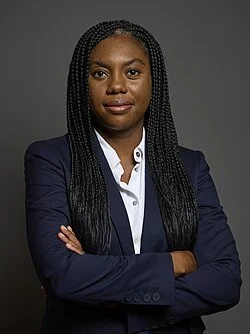 Olukemi Olufunto Adegoke Badenoch (née Adegoke): History · Bio · Photo
|
|
| Wiki Facts & About Data | |
| Full Name: | Olukemi Olufunto Adegoke Badenoch (née Adegoke) |
| Born: | January 2, 1980 |
| Age: | 46 years old |
| Birthplace: | Wimbledon, London, England |
| Nationality: | British |
| Occupation: | Politician; former Software Engineer, Financial Analyst |
| Religion: | Christianity |
| Parents: | Femi Adegoke (Father – Physician, publisher, Yoruba rights activist); Feyi Adubifa (Mother – Professor of Physiology, University of Lagos) |
| Siblings: | One brother; one sister |
| Spouse: | Hamish Badenoch (married 2012; banker at Deutsche Bank; former Conservative councillor) |
| Children: | 3 — two daughters and one son |
| Relationship: | Married |
| Net Worth: | £2 million – £3 million |
Early Life
Olukemi Olufunto Adegoke known to the world as Kemi Badenoch was born on January 2, 1980, at St Teresa’s Maternity Hospital in Wimbledon, south-west London.
Her birth in the United Kingdom was, to some extent, an accident of circumstance: her mother, Feyi Adubifa, had travelled from Nigeria to the UK for medical treatment and gave birth during her stay.
Crucially, this occurred just before the British Nationality Act 1981 abolished automatic birthright citizenship for those born in the UK to non-British parents.
Kemi was therefore born a British citizen by the law as it stood, though her family did not discover she was eligible for a British passport until she was a teenager. Feyi returned to Nigeria with her newborn daughter shortly after the birth.
Kemi is one of three children born to her Nigerian Yoruba parents. Her father, Femi Adegoke, was a general practitioner who later founded a publishing company in Nigeria and became an activist for the rights of the Yoruba people a political identity that would significantly influence his daughter’s own sense of ethnic and cultural belonging.
Her mother, Feyi, was a professor of physiology who held academic positions at the University of Lagos and also lectured in the United States, giving the family a transatlantic dimension from early in Kemi’s childhood.
Kemi grew up primarily in Lagos, Nigeria, where her family lived in the middle-class neighbourhood of Surulere. She attended the private International School of Lagos one of Nigeria’s leading educational institutions.
Yet despite the family’s middle-class social standing, she has been frank in public about the material hardships of everyday Nigerian life in the 1980s and early 1990s: power cuts were routine, doing homework by candlelight was normal, and water from a well was sometimes the only option when tap water stopped flowing. The family experienced periods of real financial hardship as Nigeria’s currency underwent dramatic devaluation during the era of military rule.
She also spent time in the United States as a child, accompanying her mother during lecturing stints, before returning to Lagos. By 1996, when Badenoch was 16, Nigeria’s political and economic situation had deteriorated severely under military rule.
The instability had taken a serious toll on her family’s fortunes, and the decision was made for Kemi to return to the United Kingdom to continue her education. She arrived in London essentially alone a teenager with £100, staying with a friend of her mother’s and would have to work while studying to support herself.
She is notable for being the first cousin once removed of former Nigerian Vice-President Yemi Osinbajo, according to a profile in The Times a familial connection that adds an additional layer of public interest to her story given her complicated and often publicly critical relationship with Nigeria.
Education
Upon arriving in London in 1996, Badenoch studied for her A-Levels at a college in Morden, south London, while simultaneously working at a McDonald’s restaurant an experience she has referenced publicly as emblematic of the determined pragmatism that has defined her life. Her time in south London also helped shape her political convictions: she has recalled being struck by the ideological arrogance of what she described as “snotty, middle-class north Londoners” at her college who held misguided views about how to help people in Africa, an encounter that reinforced her scepticism of left-wing paternalism.
She went on to earn a Master of Engineering degree in Computer Systems Engineering from the University of Sussex a technically demanding qualification that placed her in the relatively small category of female engineers in British academia. The degree gave her the analytical and problem-solving framework that would later inform her approach to both her technology career and her policy thinking in government.
Alongside her early professional career, Badenoch also studied law part-time at Birkbeck, University of London one of the UK’s most distinguished institutions for part-time and mature students earning a Bachelor of Laws (LLB) degree in 2009.
The combination of an engineering master’s degree, a law degree, and substantial professional experience in technology and finance gave her one of the most multidisciplinary educational profiles of any senior British politician of her generation.
Career
Technology and Finance (2003–2010)
Before entering politics, Kemi Badenoch built a career in the technology and financial services sectors. From 2003 to 2006, she worked as a software engineer at Logica, an IT and management consultancy.
She subsequently transitioned into financial services, spending nine years as an analyst working for institutions including the Royal Bank of Scotland and Coutts before her political career fully absorbed her professional attention. It was during her years in financial services that she developed the free-market, pro-business economic outlook that would later define her ministerial identity.
She joined the Conservative Party in 2005, at the age of 25. In 2008, she admitted in an interview that, as a prank a decade earlier, she had briefly hacked the website of a Labour politician a disclosure that received some press coverage but did not derail her political trajectory.
London Assembly and First Parliamentary Bid (2010–2017)
Badenoch’s first attempt to win a seat in the British Parliament came at the 2010 general election, when she contested the Dulwich and West Norwood constituency in London for the Conservatives.
She finished third, behind Labour incumbent Tessa Jowell and the Liberal Democrat candidate. The defeat did not discourage her. She stood for the London Assembly in 2012, finishing fifth on the Conservative list and failing to win a seat. She continued building her profile in Conservative Party circles, serving as a Vice-Chair of the party and participating in the House of Commons Justice Select Committee as a party activist.
In 2015, she gained entry to the London Assembly when incumbent Assembly Member Victoria Borwick was elected as an MP, creating a vacancy that passed down the list to Badenoch.
She retained her Assembly seat in 2016 the same year she publicly declared her support for Brexit in the UK’s EU membership referendum before leaving the Assembly when she won a parliamentary seat in 2017. As a London Assembly Member, she served as the Conservatives’ spokesperson for the economy and sat on the Transport and Policing & Crime Committees.
Member of Parliament Saffron Walden / North West Essex (2017–Present)
At the 2017 general election, Badenoch won the safe Conservative seat of Saffron Walden in East England succeeding the retiring Sir Alan Haselhurst with approximately 62 percent of the vote.
In her maiden speech to the House of Commons, she quoted both Woody Allen and Edmund Burke, and named Winston Churchill, Airey Neave, and Margaret Thatcher as her political heroes a declaration of her ideological position that drew both admiration and criticism. She was re-elected comfortably in 2019. Following boundary changes in 2023, the constituency was renamed North West Essex.
Ministerial Career Under Boris Johnson (2019–2022)
When Boris Johnson became Prime Minister in July 2019, Badenoch was appointed Parliamentary Under-Secretary of State for Children and Families at the Department for Education. In the February 2020 reshuffle, she was appointed Exchequer Secretary to the Treasury and Parliamentary Under-Secretary of State for Equalities roles that placed her at the intersection of fiscal policy and social justice debates, two areas in which she proved both combative and articulate. She also served as Minister of State for Housing and Planning and as Minister of State at the Department for Levelling Up, Housing and Communities under Johnson.
In July 2022, she was among the ministers who resigned from Johnson’s government in protest at his leadership a decision that simultaneously demonstrated political principle and positioned her as a credible candidate in the imminent Conservative leadership contest.
First Leadership Bid (2022)
Following Boris Johnson’s resignation, Badenoch entered the 2022 Conservative leadership race as a relative outsider.
Despite her limited public profile at the time, her campaign generated considerable momentum. She advanced through multiple rounds of MP voting, performing above expectations before being eliminated, with the final contest being decided between Rishi Sunak and Liz Truss.
The race made Badenoch a nationally known figure and firmly established her as a significant presence on the Conservative right.
Cabinet Roles Under Truss and Sunak (2022–2024)
When Liz Truss became Prime Minister in September 2022, she appointed Badenoch Secretary of State for International Trade her first Cabinet-level role. When Rishi Sunak replaced Truss in October 2022, he retained Badenoch in government, adding the role of Minister for Women and Equalities to her portfolio.
In February 2023, following a departmental restructuring, Badenoch became Secretary of State for Business and Trade one of the most senior economic portfolios in the British Cabinet while retaining her equalities brief.
Her time in Cabinet established her reputation as a businesslike and intellectually rigorous minister who took a sceptical view of regulation and diversity-mandated corporate governance.
Conservative Party Leadership 2024 Election and Beyond
The Conservative Party’s catastrophic defeat in the July 2024 general election in which its seat count fell from 372 to 121, the worst result in the party’s 190-year history set the scene for the most consequential leadership contest in a generation. Rishi Sunak resigned as party leader, and on July 28, 2024, Badenoch announced her candidacy.
Her campaign, chaired by former Planning Minister Rachel Maclean, was focused on honest reckoning with the party’s failures, renewal of its intellectual foundations, and holding Keir Starmer’s new Labour government accountable.
Despite being considered a frontrunner from the outset, Badenoch came second in the first and second rounds of MP voting trailing Robert Jenrick before overtaking him in subsequent ballots.
On November 2, 2024, she defeated Robert Jenrick in the final members’ ballot, winning approximately 56 percent of the vote. She thus became the Leader of the Conservative Party and Leader of His Majesty’s Official Opposition and, in doing so, became the first Black person ever to lead the Conservative Party in its nearly two-century history.
Her tenure as opposition leader has been characterised by the same bluntness and ideological confidence that defined her ministerial career. She has called for the Conservative Party to be honest about its failures in government, including on Brexit delivery and immigration control.
In a January 2025 speech, she acknowledged the party had told voters “what they wanted to hear first and then tried to work it out later.” The 2025 local elections in England proved a challenging early test: the Tories lost more than 650 council seats and finished third behind Reform UK and the Liberal Democrats, prompting fresh questions about her leadership strategy.
She reshuffled her shadow cabinet in July 2025 in an effort to improve party unity. However, she has faced no formal leadership challenge, and her supporters argue that rebuilding from the scale of the 2024 defeat is inherently a generational task.
Political Ideology and Key Policy Positions
Badenoch is widely regarded as a politician of the right wing of the Conservative Party. She describes herself as a critic of identity politics and what she terms “woke” ideology opposing the teaching of concepts such as “white privilege” as established fact in schools and arguing that diversity and equality frameworks have become vehicles for political division rather than genuine inclusion. She has been an outspoken critic of what she sees as regulatory overreach by the state and advocates for a “strong but limited government.”
On immigration, she has taken a hardline position, stating that while “numbers matter,” culture matters more and emphasising that those who move to the UK should share British values. She has called for comprehensive immigration reform and pledged, during her 2024 leadership campaign, to develop the most detailed immigration control plan of any political party.
On economic policy, she is a committed free-marketeer and fiscal conservative, shaped intellectually by American economist Thomas Sowell and British philosopher Roger Scruton. She has been publicly sceptical of net zero climate targets, describing the 2050 target as achievable only at unacceptable economic cost. She is a strong supporter of Israel and in May 2025 described the Conservative Party as “the last line of defence for Israel in the UK parliament.”
Awards and Recognitions
Kemi Badenoch has received various recognitions throughout her political career, primarily defined by historic firsts rather than formal award ceremonies. She is the first Black person to lead the Conservative Party a milestone of historic significance in British political life.
She was named among the most influential politicians in the United Kingdom during her years as Secretary of State for Business and Trade and has been consistently listed among the leading figures of the Conservative Party’s intellectual right wing. Her election as Conservative leader in 2024 was reported globally as a landmark in British politics.
Social Media
As Leader of the Opposition, Kemi Badenoch maintains an active and strategically managed presence across social media platforms, using them to communicate policy positions, challenge the Labour government, and connect with a broader public audience.
- Twitter/X: @KemiBadenoch Her most active platform, where she regularly engages in direct political commentary, responds to government policy announcements, and communicates her own leadership positions. She has millions of followers and is known for sharp, unfiltered exchanges on the platform.
- Instagram: Active on Instagram, where she shares personal moments, constituency work, and campaign-related content.
- Facebook: Maintains an official Facebook presence for broader public outreach, particularly in engaging older Conservative supporters.
- Official Website: kemibadenoch.org.uk Her official site covering her constituency work, policy positions, and political updates.
Personal Life
Kemi Badenoch met her husband, Hamish Badenoch, in 2009 through their involvement in Conservative Party activities in south London. The couple married in 2012. Hamish is a senior banker at Deutsche Bank and was a Conservative councillor for Merton Borough Council from 2014 to 2018.
He also contested the Foyle constituency for the Northern Ireland Conservatives during the 2015 general election. He is by design a private figure who maintains a deliberate distance from the political spotlight, providing the steady domestic foundation that Kemi’s intensely demanding political career requires.
Together, they have three children two daughters and one son. Badenoch has spoken publicly and movingly about her family’s personal experience with the NHS: she went into premature labour at twenty weeks with her first daughter and credits emergency NHS surgery with preventing a miscarriage an experience that has shaped her nuanced view of public services, combining genuine personal gratitude with her broader scepticism of state expansion.
She also served as a school governor at St Thomas the Apostle College in Southwark and Jubilee Primary School, and was a board member of Charlton Triangle Homes housing association until 2016.
Regarding her identity, Badenoch has made deliberate and sometimes provocative public statements about her relationship with Nigeria. She identifies primarily as Yoruba rather than Nigerian, drawing a sharp distinction: “I have nothing in common with the people from the north of the country.”
In August 2025, she confirmed she had not renewed her Nigerian passport since the early 2000s and said she no longer identifies as Nigerian a statement that drew sharp criticism from Nigerian Vice-President Kashim Shettima, who accused her of “denigrating her nation of origin.” A spokesman for Badenoch responded that she “is not the PR for Nigeria.” These exchanges have added a complex postcolonial dimension to her already polarising public profile.
Controversies have accompanied her rise. In addition to the identity politics debates, she faced accusations from former staff of difficult workplace conduct, which she denied strongly, describing them as smears and accusing those involved of “covering up their own failures.”
A department spokesperson confirmed there were no formal complaints or investigations. She also attracted attention in 2024 when The Spectator published unflattering comments attributed to a user named “Kemi” from the Naijablog website, which Badenoch condemned as “dirty tricks” from rival campaigns.
Net Worth
Kemi Badenoch’s estimated net worth is approximately £2 million to £3 million (approximately $3–4 million USD as of 2026).
Her wealth reflects a career that preceded politics: nine years in financial services as an analyst, employment in the technology sector as a software engineer, and her years as a senior Cabinet Minister.
As MP for North West Essex, she earns a base parliamentary salary of £91,346 per year, with additional allowances applicable to her role as Leader of the Opposition.
Her husband Hamish, as a senior Deutsche Bank banker, also contributes to a household financial profile consistent with London’s professional class.
Badenoch does not belong to the independently wealthy tier of Conservative politicians, and her personal financial journey from a teenager with £100 in London to a multimillionaire political leader is itself a core narrative of her public story.
Frequently Asked Questions (FAQs)
Who is Kemi Badenoch?
Kemi Badenoch (full name Olukemi Olufunto Adegoke Badenoch) is the Leader of the Conservative Party and Leader of His Majesty’s Official Opposition in the United Kingdom. She is the MP for North West Essex and the first Black person to lead the Conservative Party, having been elected to the leadership on November 2, 2024.
When was Kemi Badenoch born?
She was born on January 2, 1980, in Wimbledon, London, England. She is 46 years old as of 2026.
Is Kemi Badenoch Nigerian?
She was born to Nigerian Yoruba parents and spent much of her childhood in Lagos. However, she has publicly stated that she no longer identifies as Nigerian identifying instead primarily as Yoruba and confirmed in August 2025 that she has not renewed her Nigerian passport since the early 2000s.
What is Kemi Badenoch’s educational background?
She attended the International School of Lagos as a child, studied for her A-Levels in Morden, London, earned a Master of Engineering in Computer Systems Engineering from the University of Sussex, and obtained a Bachelor of Laws (LLB) from Birkbeck, University of London in 2009.
Who is Kemi Badenoch’s husband?
Her husband is Hamish Badenoch, a senior banker at Deutsche Bank and former Conservative councillor for Merton Borough Council. They married in 2012 and have three children two daughters and one son.
What is Kemi Badenoch’s net worth?
Her estimated net worth is between £2 million and £3 million (approximately $3–4 million USD), built from her technology and financial services career, parliamentary salary, and ministerial income.
What is Kemi Badenoch known for politically?
She is known for her outspoken criticism of identity politics and “woke” ideology, her hardline stance on immigration, her free-market economic conservatism, her support for Israel, and for being the first Black person to lead the Conservative Party in its nearly 200-year history.
Has Kemi Badenoch previously run for Conservative Party leader?
Yes. She ran in the 2022 Conservative Party leadership contest following Boris Johnson’s resignation, advancing further than expected before being eliminated. Liz Truss won that contest against Rishi Sunak. She won the 2024 leadership contest by defeating Robert Jenrick in the final member ballot.
What ministerial positions has Kemi Badenoch held?
Her ministerial roles include: Parliamentary Under-Secretary for Children and Families (2019); Exchequer Secretary to the Treasury and Under-Secretary for Equalities (2020–2022); Minister for Housing and Planning (2022); Secretary of State for International Trade (2022, under Liz Truss); Secretary of State for Business and Trade and Minister for Women and Equalities (2022–2024, under Rishi Sunak).
Conclusion
Kemi Badenoch’s biography is one of the most distinctive in modern British political history a story that spans three continents, two nationalities, two professional careers, and a single relentless upward trajectory driven by intelligence, conviction, and an almost combative refusal to be categorised.
She is a Black British woman who leads the party of Thatcher. She is a Nigerian-born politician who publicly disavows Nigerian identity. She is a former engineer who quotes Edmund Burke. She is a beneficiary of the NHS who is sceptical of state expansion. The contradictions, her critics would argue, are the point; her supporters would say they are the proof that she defies political formulas.
The task ahead of her is formidable. The Conservative Party she leads suffered its worst electoral defeat in nearly two centuries, and it now faces existential competition from both Keir Starmer’s centrist Labour government on its left and Nigel Farage’s Reform UK on its right. Rebuilding the Tories’ intellectual foundations, electoral coalition, and public trust will require exactly the kind of brutal honesty about past failure that Badenoch has at least been willing to articulate.
Whether that honesty translates into the political strategy and electoral success the party needs is the defining question of her leadership.
What is beyond question is that Kemi Badenoch once a 16-year-old alone in London with £100 now leads one of the world’s oldest and most storied political parties. Her story, whatever happens next, has already altered the landscape of British political possibility.
Related People








Leave a Reply