
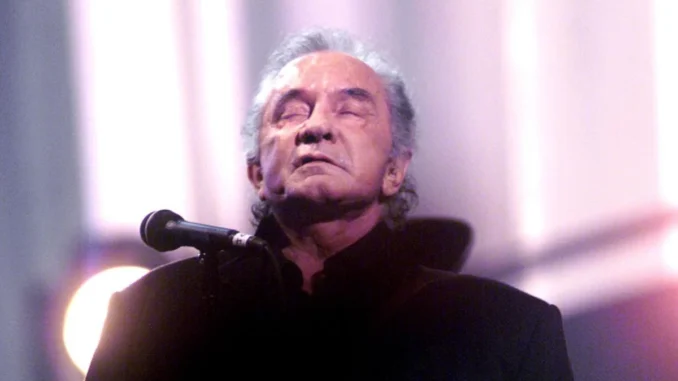
Johnny Cash was an American singer, songwriter, musician, actor, and author whose baritone voice, stark musical vision, and uncompromising honesty made him one of the most influential and commercially successful artists in the history of American music.
His signature sound, dark, minimal, and deeply rooted in the American folk, gospel, and country traditions, produced a catalogue of enduring songs including “I Walk the Line,” “Ring of Fire,” “Man in Black,” “Jackson,” “Folsom Prison Blues,” and his haunting late-career cover of Nine Inch Nails’ “Hurt,” which many consider one of the greatest music videos ever made.
Known as “The Man in Black,” Cash was inducted into the Country Music Hall of Fame, the Rock and Roll Hall of Fame, and the Gospel Music Hall of Fame, one of only a handful of artists to achieve all three.
He sold over 90 million records worldwide and won 19 Grammy Awards, including the Grammy Lifetime Achievement Award. He died in September 2003, just four months after his beloved wife June Carter Cash, at the age of 71.
| John R. Cash | |
|---|---|
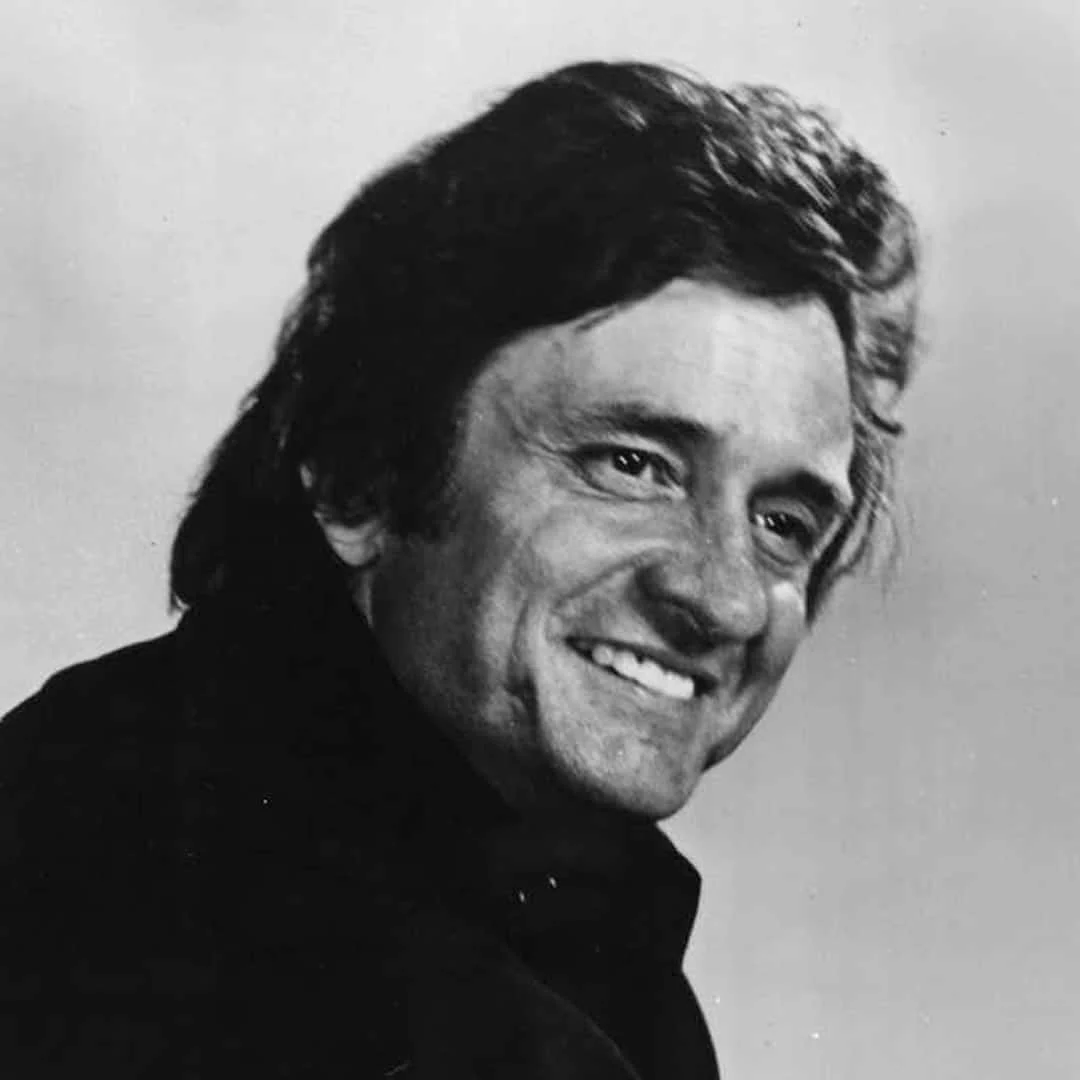 John R. Cash: History · Bio · Photo
|
|
| Wiki Facts & About Data | |
| Full Name: | John R. Cash |
| Stage Name: | Johnny Cash; "The Man in Black" |
| Born: | February 26, 1932 |
| Age: | Age at Death: 71 |
| Death: | September 12, 2003 |
| Birthplace: | Kingsland, Arkansas, USA |
| Nationality: | American |
| Occupation: | Singer, Songwriter, Musician, Actor, Author |
| Height: | 6 feet 1.5 inches (1.87 m) |
| Religion: | Christian (Baptist; later Methodist) |
| Parents: | Ray Cash (Father, sharecropper and farmer); Carrie Cloveree Rivers Cash (Mother) |
| Siblings: | Roy, Louise, Jack (deceased 1944), Reba, Joanne, Tommy Cash |
| Spouse: | Vivian Liberto (m. 1954–1966, divorced); June Carter Cash (m. 1968–2003, until her death) |
| Children: | Rosanne Cash, Kathy Cash, Cindy Cash, Tara Cash (with Vivian Liberto); John Carter Cash (with June Carter) |
| Net Worth: | Approximately $60 million at time of death (Celebrity Net Worth) |
Early Life
John R. Cash was born on February 26, 1932, in Kingsland, Arkansas, the fourth of seven children of Ray Cash and Carrie Rivers Cash.
When he was three years old, the family relocated to Dyess, Arkansas, a colony established by the Roosevelt administration’s Federal Emergency Relief Administration to provide land for impoverished families during the Great Depression.
The Cashes were given a house and 20 acres of cotton land; from early childhood, Cash worked the fields alongside his parents and siblings. The poverty and hard work of his Depression-era Arkansas childhood, the landscape of the Mississippi Delta, and the powerful gospel music he heard in church from infancy would all deeply permeate his songwriting.
The most formative tragedy of Cash’s early life was the death of his older brother Jack on May 20, 1944. Jack, then 14, was killed when he was pulled into an industrial saw at the school’s agriculture building and suffered catastrophic injuries; he died eight days later. Cash, then 12, was profoundly affected by his brother’s death, which Jack faced with remarkable religious composure.
The experience deepened Cash’s own spiritual life and sense of mortality, themes that would run through his music for the next six decades. Cash’s mother recognized his musical gifts early, arranging for him to take voice lessons at age nine. He had a high tenor voice that deepened dramatically during adolescence into the distinctive bass-baritone that became one of the most recognizable voices in American music.
Education and Military Service
Cash attended Dyess High School and graduated in 1950. He briefly enrolled at Keathley Agricultural School, then worked at an automobile manufacturing plant in Pontiac, Michigan, before enlisting in the United States Air Force in 1950.
He served with the Security Service at Landsberg Air Base in West Germany, where he purchased his first guitar and performed with his first band, the Landsberg Barbarians, formed with fellow airmen.
While stationed in Germany, he intercepted Soviet radio transmissions as a Morse code operator, and also intercepted the first news of Joseph Stalin’s death in 1953. He was discharged as a Staff Sergeant in July 1954.
Career
After his Air Force discharge, Cash moved to Memphis, Tennessee, where he studied to become a radio announcer and performed locally.
He approached Sun Records founder Sam Phillips and, after being initially turned away, returned with guitarist Luther Perkins and bassist Marshall Grant, calling themselves the Tennessee Two. Phillips was sufficiently impressed to sign Cash, and his debut single for Sun, “Cry! Cry! Cry!” (1955), reached No. 14 on the Billboard country chart.
His follow-up, “Folsom Prison Blues” (1955), was inspired by the film Inside the Walls of Folsom Prison (1951) and introduced the outlaw mythology that would run through his career. “I Walk the Line” (1956), which he wrote as a personal reminder of his commitment to his first wife Vivian, became his first No. 1 hit and established him as one of the major talents at Sun alongside Elvis Presley, Carl Perkins, and Jerry Lee Lewis.
Cash moved to Columbia Records in 1958, where he achieved further commercial success with albums including Now, There Was a Song! (1960) and hit singles like “Ring of Fire” (1963), written by June Carter Cash and Merle Kilgore about June’s feelings for Cash, which reached No. 1 on the country charts and No. 17 on the pop charts.
Despite his commercial success, the 1960s were personally turbulent years: Cash became severely addicted to prescription amphetamines and barbiturates, his behavior grew erratic and destructive, and his first marriage to Vivian Liberto deteriorated.
He was arrested seven times between 1961 and 1967 for misdemeanors mostly related to his drug use. On June 5, 1965, he was arrested in Starkville, Mississippi, for picking flowers in someone’s garden at 2 a.m. while under the influence, an incident he later described as the low point of his life.
June Carter Cash, who had been touring with Cash as part of the Carter Family, became the most stabilizing force in his life. She helped him fight his addiction, encouraged his Christian faith, and eventually married him on February 26, 1968, his birthday, in Franklin, Kentucky. Their son John Carter Cash was born in 1970.
The same year as their marriage, Cash recorded At Folsom Prison, a live album recorded at Folsom Prison on January 13, 1968, that revitalized his career, won two Grammy Awards, and became one of the best-selling live albums in history. Its success led to At San Quentin (1969), which produced the crossover hit “A Boy Named Sue.” Cash hosted The Johnny Cash Show on ABC television from 1969 to 1971, a pioneering mainstream platform for country, folk, and rock artists.
Throughout the 1970s and 1980s he released further albums and collaborated extensively with family members and with the supergroup The Highwaymen (alongside Willie Nelson, Waylon Jennings, and Kris Kristofferson, formed in 1985).
Cash’s late-career renaissance came through his partnership with producer Rick Rubin, who signed him to American Recordings in 1993. The resulting series of albums, American Recordings (1994), Unchained (1996), American III: Solitary Man (2000), American IV: The Man Comes Around (2002), and posthumously released further volumes, stripped Cash back to his most elemental: voice, guitar, darkness, mortality.
His cover of Nine Inch Nails’ “Hurt” (2002), with its accompanying music video, became a cultural phenomenon, widely regarded as one of the most powerful expressions of mortality and regret in the history of recorded music. Cash suffered from autonomic neuropathy, a complication of diabetes, in his final years, which affected his movement and nervous system.
June Carter Cash died on May 15, 2003, at the age of 73. Johnny Cash died on September 12, 2003, of complications from diabetes, at the age of 71. He died at Baptist Hospital in Nashville, Tennessee. He is buried at Hendersonville Memory Gardens in Hendersonville, Tennessee, alongside June.
Awards and Nominations
- 19 Grammy Awards
- Grammy Lifetime Achievement Award (1999)
- Country Music Hall of Fame — Inducted (1980)
- Rock and Roll Hall of Fame — Inducted (1992)
- Gospel Music Hall of Fame — Inducted (2010, posthumous)
- Songwriters Hall of Fame — Inducted (1977)
- Presidential Medal of Freedom (2004, posthumous)
- Kennedy Center Honors (1996)
Social Media
- Official estate/legacy Instagram: @johnnycash
- Official Facebook: /johnnycash
Personal Life
Cash was married twice. His first marriage to Vivian Liberto (1954–1966), with whom he had four daughters (Rosanne, Kathy, Cindy, Tara), ended amid the chaos of his drug addiction.
His second marriage to June Carter Cash (1968–2003) was a celebrated and deeply loving union that lasted until June’s death in May 2003; Cash followed her four months later. Cash struggled with prescription drug addiction throughout the 1960s and relapsed periodically throughout his life.
He underwent heart surgery in 1988 and was hospitalized multiple times in his later years with various health complications.
He was known for his personal generosity, his deep Christian faith, his support of prisoners and the incarcerated, and his advocacy for Native American rights (documented on his 1964 album Bitter Tears: Ballads of the American Indian).
His daughter Rosanne Cash became a celebrated singer-songwriter in her own right. A biographical film, Walk the Line (2005), starring Joaquin Phoenix as Cash and Reese Witherspoon as June Carter Cash, earned Witherspoon the Academy Award for Best Actress.
Net Worth
At the time of his death in September 2003, Johnny Cash’s estimated net worth was approximately $60 million, according to Celebrity Net Worth.
His primary income streams throughout his career included record sales, touring revenues, television and film royalties, and the enduring catalog of his compositions.
Discography
- With His Hot and Blue Guitar! (1957)
- Songs of Our Soil (1959)
- Ride This Train (1960)
- Bitter Tears: Ballads of the American Indian (1964)
- At Folsom Prison (1968)
- At San Quentin (1969)
- Man in Black (1971)
- American Recordings (1994)
- Unchained (1996)
- American III: Solitary Man (2000)
- American IV: The Man Comes Around (2002)
Conclusion
Johnny Cash gave American music one of its most distinctive and enduring voices, not just literally, in the incomparable baritone that rumbled through over 50 studio albums, but in the moral voice of a man who identified with the outsider, the outlaw, the prisoner, and the sinner without ever pretending that their situations were anything other than tragic.
His music encompassed love and death, faith and doubt, the beauty of the American landscape and the darkness of the human heart, and did so with a directness and lack of pretension that made him beloved across genres, generations, and borders.
At 71, he died four months after the woman who had saved his life, a final punctuation mark on one of American music’s greatest love stories.
Related People




Leave a Reply