Judy Garland was an American actress and singer whose extraordinary vocal gifts, emotional depth on screen, and the terrible personal price she paid for her early Hollywood stardom made her one of the most beloved and celebrated performers of the 20th century.
Born Frances Ethel Gumm in 1922 in Grand Rapids, Minnesota, she was placed in the MGM studio system as a child and spent her entire adolescence under its control, managed, medicated, overworked, and manipulated by the people charged with her professional development in ways that would devastate her health for the rest of her life.
Yet she produced work of transcendent quality: her performance as Dorothy Gale in The Wizard of Oz (1939) remains the most beloved in American cinema history, her concert performances were legendary for their emotional rawness and connection with audiences, and her album Judy at Carnegie Hall (1961) won five Grammy Awards and spent 95 weeks on the Billboard chart.
She died in June 1969, at 47, of an accidental barbiturate overdose. In 1999, the American Film Institute ranked her as the eighth-greatest female screen legend in the history of cinema.
| Frances Ethel Gumm | |
|---|---|
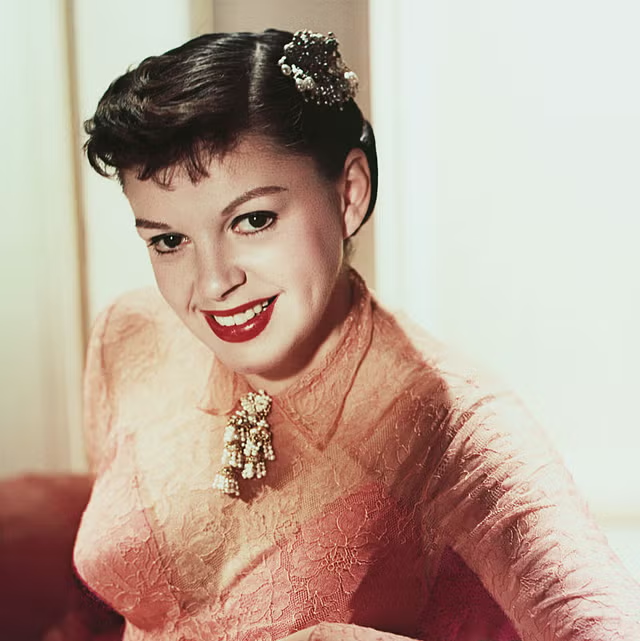 Frances Ethel Gumm: History · Bio · Photo
|
|
| Wiki Facts & About Data | |
| Full Name: | Frances Ethel Gumm |
| Stage Name: | Judy Garland |
| Born: | June 10, 1922 |
| Age: | Judy Garland |
| Death: | June 22, 1969 |
| Birthplace: | Grand Rapids, Minnesota, USA |
| Nationality: | American |
| Occupation: | Actress, Singer |
| Height: | 4 feet 11.5 inches (1.51 m) |
| Parents: | Francis Avent Gumm (Father, theater owner); Ethel Marion Milne Gumm (Mother, pianist and stage mother) |
| Siblings: | Mary Jane "Suzy" Gumm (sister); Dorothy Virginia "Jimmie" Gumm (sister) |
| Spouse: | David Rose (m. 1941–1944); Vincente Minnelli (m. 1945–1951); Sid Luft (m. 1952–1965); Mark Herron (m. 1965–1967); Mickey Deans (m. March 1969 – her death June 1969) |
| Children: | Liza Minnelli (b. 1946, with Vincente Minnelli); Lorna Luft (b. 1952, with Sid Luft); Joey Luft (b. 1955, with Sid Luft) |
| Net Worth: | Essentially none at time of death (heavily indebted) |
Early Life
Frances Ethel Gumm was born on June 10, 1922, in Grand Rapids, Minnesota, the third daughter of Francis Avent Gumm and Ethel Marion Milne Gumm.
Her father managed a local movie theater and performed in amateur musical events; her mother was an accomplished pianist who became Frances’s dominant influence, ambition driver, and lifelong burden. Frances displayed remarkable musical gifts from infancy, she reportedly began singing along with her father at the theater when she was barely two years old.
At two and a half, her parents put her onstage for the first time, performing “Jingle Bells” at her father’s theater on Christmas Day 1924. She performed professionally from that day forward, joining her two older sisters Mary Jane and Dorothy in a vaudeville act called “The Gumm Sisters” that toured the Midwestern circuits from 1926 onward.
The family relocated to Lancaster, California, in 1926, where her father purchased a new theater, and subsequently to Hollywood in 1934, where Ethel enrolled the children in acting and singing lessons and aggressively pursued industry connections.
In 1934, when Frances was 13, the family adopted the stage name “Garland” (suggested by a friend named George Jessel), and Frances began performing under the name “Judy Garland.” MGM talent scout Al Rosen saw her perform and recommended her to Louis B. Mayer.
On September 27, 1935, at 13, Judy Garland signed her first MGM contract. The studio system that received her had a profoundly destructive relationship with the teenage star it would create. MGM executives, anxious about Judy’s figure and weight in an era of obsessive on-camera leanness, began giving her amphetamine-based diet pills almost immediately.
These were combined with barbiturates to help her sleep, creating a pattern of chemical dependency that would escalate throughout her adolescence and adult life, with devastating long-term physical and psychological consequences that studios and managers regularly enabled and exploited.
Education
Judy Garland received her schooling primarily through the MGM studio school system, the University Studios Little Red Schoolhouse, where child actors at the studio were educated between filming commitments.
Her formal schooling was severely limited by the demands of her career.
Career
Garland’s first significant MGM appearances were in a series of short films and then the Broadway Melody of 1938 (1937), in which her rendition of “You Made Me Love You”, a birthday tribute to a photograph of Clark Gable, became a sensation and confirmed her extraordinary natural ability to project emotion through song. Her career-defining role came in 1939 when she was cast as Dorothy Gale in The Wizard of Oz. The film cost $2.8 million to produce, required enormous technical innovation, and featured a score by Harold Arlen and E.Y. Harburg that produced the Oscar-winning song “Over the Rainbow,” which became permanently associated with Garland and ranked No. 1 on the Recording Industry Association of America’s list of the 365 Songs of the Century. The film won Garland a special juvenile Academy Award (an honorary Oscar) for “the best performance as a juvenile.” The Wizard of Oz initially performed only modestly at the box office, but became a beloved cultural institution through repeated television broadcasts beginning in 1956.
Throughout the early 1940s, Garland appeared in a succession of highly successful MGM musicals, often paired with Mickey Rooney, including Babes in Arms (1939, their first film together), Strike Up the Band (1940), Babes on Broadway (1941), and For Me and My Gal (1942). She also appeared in two major solo starring roles that are among her finest screen work: Meet Me in St. Louis (1944, directed by Vincente Minnelli) and The Clock (1945). During this period, her drug dependency deepened, her weight fluctuated dramatically, and her reliability on set became increasingly problematic. MGM suspended her multiple times.
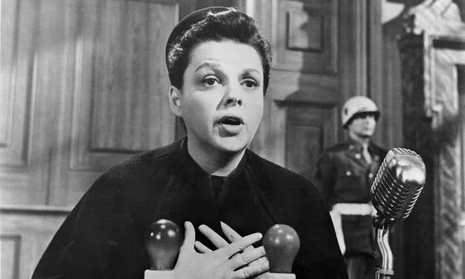
In 1950, after years of deteriorating health, missed filming days, and hospitalization, MGM terminated her contract. She subsequently reinvented herself as a concert and recording artist, and her comeback concert at the London Palladium in April 1951, where she received a 4-minute standing ovation, launched the second great phase of her career. She then mounted a legendary Broadway engagement at the Palace Theatre in New York (19 weeks, 184 sold-out performances, 1951–1952). Her film comeback in A Star Is Born (1954), produced by her then-husband Sid Luft, was critically acclaimed, her performance earned an Academy Award nomination for Best Actress, but the film’s commercial performance was limited by Warner Bros.’ drastic cuts to its original long running time, and the project nearly bankrupted the Lufts. Her 1961 album Judy at Carnegie Hall, a double live album recording two successive Carnegie Hall performances, won five Grammy Awards including Album of the Year and is regularly cited as one of the greatest live albums ever recorded. She also appeared in Stanley Kramer’s Judgment at Nuremberg (1961), earning an Academy Award nomination for Best Supporting Actress.
The final years of her life were marked by severe physical deterioration from decades of drug dependency, financial crisis, personal instability, and a series of unsuccessful concert engagements during which her failing health made consistent performance impossible. Her fifth and final marriage, to young nightclub manager Mickey Deans in March 1969, was undertaken in London, where she had been trying to mount a concert residency at Talk of the Town. On June 22, 1969, Deans found her dead in the bathroom of their rented Chelsea cottage. The coroner ruled the cause of death an “accidental” overdose of barbiturates, specifically Seconal, noting that the level of barbiturates in her system was approximately ten times the normally fatal dose. She was 47 years old. Her death, reported on June 22, 1969, occurred in the same week as the Stonewall riots in New York City; many historians have noted the profound connection between the grief of the LGBTQ+ community at her passing and the intensity of the events that followed.
Awards and Nominations
- 1940 — Academy Award — Honorary Juvenile Oscar (The Wizard of Oz) — Win
- 1955 — Academy Award — Best Actress (A Star Is Born) — Nominated
- 1962 — Academy Award — Best Supporting Actress (Judgment at Nuremberg) — Nominated
- 1962 — Grammy Award — Album of the Year (Judy at Carnegie Hall) — Win
- 1962 — Grammy Award — Best Female Vocal Performance (Judy at Carnegie Hall) — Win
- Grammy Lifetime Achievement Award (posthumous, 1997)
- Kennedy Center Honors (posthumous inclusion in commemorations)
- Cecil B. DeMille Award (Golden Globe, 1962)
- AFI’s 100 Greatest Screen Legends — No. 8 Female (1999)
Personal Life
Judy Garland was married five times. Each marriage was complicated by her health struggles, financial difficulties, and the extreme pressures of her career. Her second husband, director Vincente Minnelli (married 1945, divorced 1951), was the father of her eldest daughter Liza Minnelli, who went on to a celebrated entertainment career of her own. Her third husband, Sid Luft (married 1952, divorced 1965), was the father of Lorna Luft and Joey Luft and the producer of A Star Is Born. Garland has long been an iconic figure in LGBTQ+ culture, with gay men being among her most devoted fans, a connection she openly acknowledged and reciprocated with warmth. She spoke candidly in later years about her struggles with prescription drugs and her belief that the studio system had destroyed her health. Her daughter Liza Minnelli has described her mother as a woman of extraordinary generosity, warmth, and emotional intelligence whose gifts were exploited and whose wellbeing was chronically neglected by the powerful men around her.
Net Worth
Judy Garland died with essentially no personal assets and significant debts.
Despite earning enormous sums throughout her career, she was left insolvent by a combination of extravagant personal spending, mismanagement by successive husbands and managers, and the financial chaos that accompanied her health crises. Her estate after death was reported to owe substantially more than it held in assets.
Filmography
- The Wizard of Oz (1939), Dorothy Gale
- Babes in Arms (1939)
- Meet Me in St. Louis (1944)
- The Clock (1945)
- Easter Parade (1948)
- A Star Is Born (1954), Esther Blodgett/Vicki Lester
- Judgment at Nuremberg (1961), Irene Hoffman
- A Child Is Waiting (1963)
- I Could Go On Singing (1963), Jenny Bowman (final film)
Conclusion
Judy Garland’s life is one of American entertainment’s most heartbreaking stories, a story of exceptional gifts systematically damaged by an industry that prioritized profit over the welfare of the child it had created as a product.
Yet what survives is not primarily the tragedy: it is the voice, the performance, the quality of emotional truth she brought to everything she did.
“Over the Rainbow” is not beloved because of what happened to Judy Garland afterward; it is beloved because of what she put into it at 16, a longing so pure and personal that it transcends its fictional context entirely. That quality, the ability to make music feel privately addressed to whoever was listening, was her supreme gift, and no amount of institutional cruelty could take it from her.
Related People





Leave a Reply