
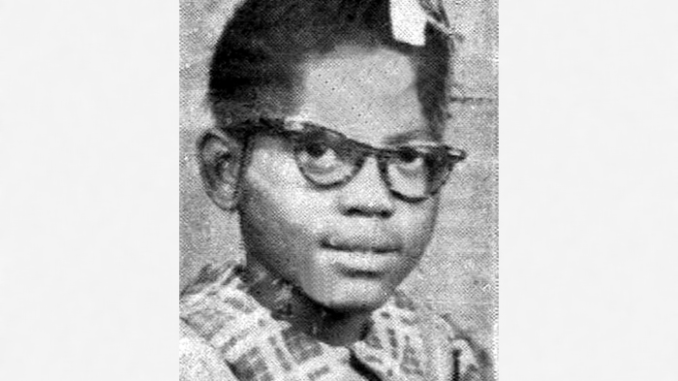
Addie Mae Collins was a 14-year-old African American girl from Birmingham, Alabama, who was killed on September 15, 1963, when members of the Ku Klux Klan detonated a bomb at the 16th Street Baptist Church, a building that served as a central hub for Civil Rights activity in the city.
Her death, along with those of three other young girls, Cynthia Wesley, Carole Robertson, and Carol Denise McNair, shocked the nation and the world, accelerating public and political momentum behind the Civil Rights Movement and galvanising support for landmark legislation that would help dismantle the system of racial segregation in the American South.
Though she lived for only 14 years, Addie Mae Collins’s name has been forever enshrined in the history of the American struggle for racial equality.
| Addie Mae Collins | |
|---|---|
 Addie Mae Collins: History · Bio · Photo
|
|
| Wiki Facts & About Data | |
| Full Name: | Addie Mae Collins |
| Born: | April 18, 1949 |
| Age: | 14 at Death |
| Death: | September 15, 1963 |
| Birthplace: | Birmingham, Alabama, USA |
| Nationality: | American |
| Parents: | Julius Collins (father), Alice Collins (mother) |
| Siblings: | Six siblings, including sister Sarah Collins (later Sarah Collins Rudolph), who survived the bombing but lost her right eye |
Early Life
Addie Mae Collins was born on April 18, 1949, in Birmingham, Alabama, to Julius and Alice Collins. She was one of seven children in the family and grew up in the racially segregated city of Birmingham, which had earned the grim nickname “Bombingham” due to the frequency of racially motivated terrorist attacks carried out by members of the Ku Klux Klan and other white supremacist groups against the Black community.
Despite the oppressive atmosphere, Addie Mae was known by those who knew her as a bright, outgoing, and artistic girl with a joyful spirit. She was a member of the congregation at the 16th Street Baptist Church, attending services regularly with her parents and siblings.
Friends and family described her as especially enterprising and unafraid. Among the remembered details of her personality, she would go door to door in white neighbourhoods of Birmingham selling aprons and potholders hand-stitched by her mother to help supplement the family’s income, an act of courage and practicality in a deeply segregated city where such movement could itself carry risks. She enjoyed singing and had been preparing to join the choir at the 16th Street Baptist Church.
Education
Addie Mae Collins was enrolled in school in Birmingham at the time of her death. However, verified details about the specific school she attended have not been widely recorded in primary historical sources.
What is documented is that she was active in her church community and was participating in Sunday School activities on the morning of her death.
The 16th Street Baptist Church and the Civil Rights Context
The 16th Street Baptist Church in Birmingham was far more than a place of worship in 1963. It served as a critical organising centre for the Civil Rights Movement, hosting meetings led by figures including the Reverend Martin Luther King Jr., Ralph Abernathy, and Fred Shuttlesworth. The Southern Christian Leadership Conference (SCLC) and the Congress on Racial Equality (CORE) used the church as a rallying point as they worked to register African Americans to vote in Birmingham, a city that was at the time considered one of the most violently resistant to racial integration in the entire American South. Alabama’s Governor George Wallace had made preserving racial segregation a cornerstone of his administration, and the Birmingham chapter of the KKK was among the most active and violent in the country.
By September 1963, racial tensions in Birmingham had reached a boiling point. A federal court order had come down mandating the integration of Alabama’s school system, and the KKK had already carried out two bombings in the city within the preceding eleven days.
On the evening of September 14, 1963, members of the Birmingham KKK’s Cahaba River Group planted fifteen sticks of dynamite beneath the steps on the east side of the 16th Street Baptist Church, underneath what turned out to be the girls’ restroom.
The Bombing and Its Immediate Aftermath
On the morning of Sunday, September 15, 1963, Addie Mae Collins arrived at the 16th Street Baptist Church with her sister Sarah and several other children to prepare for Youth Day services. She and the other girls gathered in the basement lounge to prepare for the service. Addie Mae was reportedly helping another girl, Denise McNair, fasten her sash when the bomb detonated at approximately 10:22 a.m. The explosion destroyed a substantial portion of the building, sending shattered glass, stone, and debris through the basement. Addie Mae Collins, Cynthia Wesley, Carole Robertson, all aged 14, and 11-year-old Carol Denise McNair were killed instantly or near-instantly in the blast. More than twenty other people were injured.
Among the injured was Addie Mae’s younger sister, Sarah Collins, who was 12 years old at the time. Sarah survived the bombing but lost her right eye to the flying glass and sustained other serious injuries. Years later, Sarah Collins Rudolph became a powerful public witness to the attack, sharing her experience of calling out “Addie, Addie, Addie” in the dust and dark of the ruined basement, and receiving no answer.
Justice and Convictions
Despite the FBI identifying four primary suspects, Thomas Blanton, Robert Chambliss, Bobby Frank Cherry, and Herman Cash, all members of Birmingham’s KKK Eastview Klavern #13, the investigation was closed in 1968 without indictments, largely because witnesses were reluctant to testify and FBI surveillance evidence was inadmissible in court. It would take decades for justice to be delivered.
Robert Chambliss was the first to be convicted, found guilty of first-degree murder in 1977, fourteen years after the bombing. He died in prison in 1985. Thomas Blanton and Bobby Frank Cherry were each convicted of murder in 2001 and 2002 respectively, nearly four decades after the attack. Herman Cash died in 1994 without ever being charged. The three convictions brought some measure of accountability, though they came far too late for the families of the four girls.
Legacy and Cultural Memory
The deaths of Addie Mae Collins, Cynthia Wesley, Carole Robertson, and Denise McNair provoked national outrage and played a pivotal role in building support within the John F. Kennedy administration, and subsequently the Lyndon B. Johnson administration, for civil rights legislation. The moral weight of four children murdered in a house of worship on a Sunday morning proved impossible to ignore, and the bombing is widely credited with hastening the passage of the Civil Rights Act of 1964. The Reverend Martin Luther King Jr. delivered the eulogy at the joint funeral of three of the four girls, calling them “martyred heroines of a holy crusade for freedom and human dignity.”
The bombing and its victims have been commemorated in numerous cultural works. Spike Lee’s 1997 documentary “4 Little Girls” brought renewed attention to the case and the lives of the four victims, including Addie Mae, and was nominated for an Academy Award for Best Documentary Feature. The 16th Street Baptist Church still stands and operates today as an active congregation, and the site is a registered historic landmark. A civil rights memorial near the church honours the memory of Addie Mae Collins and the other victims of racial violence during the Civil Rights era.
In a particularly poignant chapter of the Collins family story, in 1998 the family requested that Addie Mae’s body be exhumed and moved to a different cemetery. When investigators went to retrieve her remains, her body could not be located, decades of neglect had left cemetery records incomplete and her exact burial location lost. The incident added yet another layer of grief to a family that had already endured so much.
Conclusion
Addie Mae Collins did not have the opportunity to live a full life, to pursue her dreams, or to see the country that murdered her transform in the decades that followed. She was a child, creative, spirited, and full of potential, whose life was extinguished by hatred. Yet her name, and those of her three fellow victims, became a moral reckoning that the nation could not avoid. The 16th Street Baptist Church bombing, and the four little girls who died there, stand as one of the most powerful testimonies in American history to both the depravity of racial terror and the enduring human capacity to resist it. Addie Mae Collins was 14 years old. She mattered then. She matters now.
Related People








Leave a Reply