
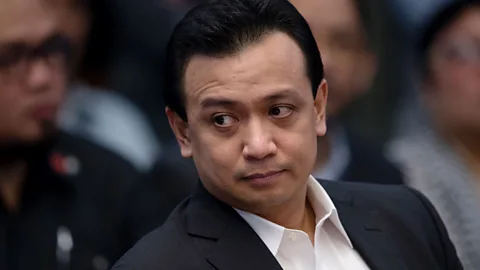
Antonio “Sonny” Fuentes Trillanes IV is one of the most compelling, polarizing, and genuinely consequential figures in the history of Philippine politics.
A decorated naval officer who became a mutineer, a prisoner who was elected to the Senate while still behind bars, a senator who staged a hotel siege while on trial, a politician who spent seven and a half years in detention yet never stopped fighting and a man whose decade-long battle to defend his amnesty against a sitting president culminated in a landmark Supreme Court ruling that permanently invalidated one of Rodrigo Duterte’s most politically motivated acts.
Born in Caloocan City, Metro Manila, on August 6, 1971, Trillanes is the son of a Philippine Navy captain and a woman from Capiz province a heritage that may partly explain the unusual combination of military discipline and political fire that defines his character.
From the moment he led 321 junior officers in the 2003 Oakwood Mutiny to protest corruption in the Armed Forces of the Philippines, to his twelve years in the Senate as one of its most prolific and combative legislators, to his ongoing post-Senate activism, academic career, and the 2025 Caloocan mayoral race he contested and lost “Sonny” Trillanes has lived a political life so dramatic that it would strain credulity as fiction.
His biography is not simply the story of one politician it is a window into the turbulent, complex, and intensely contested soul of Philippine democracy itself.
| Antonio Fuentes Trillanes IV | |
|---|---|
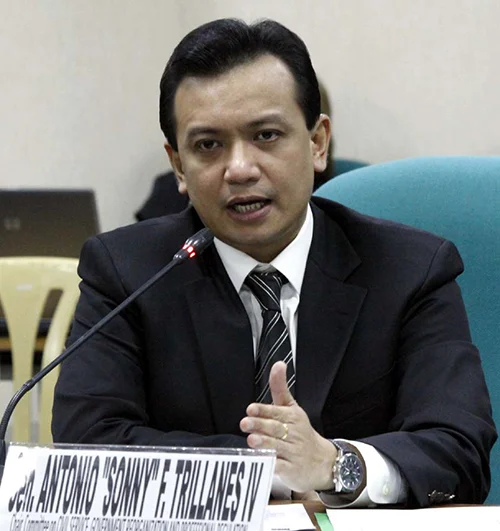 Antonio Fuentes Trillanes IV: History · Bio · Photo
|
|
| Wiki Facts & About Data | |
| Full Name: | Antonio Fuentes Trillanes IV |
| Stage Name: | Sonny |
| Born: | August 6, 1971 |
| Age: | 54 years old |
| Birthplace: | Caloocan City, Metro Manila, Philippines |
| Nationality: | Filipino |
| Occupation: | Former Senator, Former Naval Officer, Academic Lecturer, Political Activist |
| Height: | 5 feet 9 inches (175 cm) |
| Religion: | Christianity (Roman Catholic) |
| Parents: | Navy Father: Captain Antonio Floranza Trillanes III, Mother: Estelita Diaz Fuentes |
| Siblings: | Four siblings (including Antonio Jr. and Antonio III) |
| Spouse: | Arlene G. Orejana-Trillanes |
| Children: | Francis Seth Trillanes, Thea Estelle Trillanes (Alan Andrew Trillanes, deceased at 21 days) |
| Net Worth: | Estimated ₱5 million – ₱15 million (relatively modest by Philippine political standards) |
Early Life
Antonio Fuentes Trillanes IV was born on August 6, 1971, in Caloocan City, Metro Manila a densely populated urban district that forms part of the National Capital Region of the Philippines.
He grew up in Caloocan, a city he would later contest for the mayoralty over five decades after his birth, and traces his roots to two distinct provincial cultures: his father, Navy Captain Antonio Floranza Trillanes III (PMA Class of 1959), came from Ligao City, Albay in the Bicol region, while his mother, Estelita Diaz Fuentes, hails from Ivisan, Capiz in the Western Visayas region.
He is the fourth in a line of men named Antonio Trillanes, a naming tradition that speaks to the deep familial pride and continuity that shaped his upbringing.
Growing up the son of a Philippine Navy captain provided the young Sonny with an early and enduring exposure to military culture the discipline, the esprit de corps, the institutional loyalty, and crucially the awareness of how military corruption and political patronage could hollow out those same institutions from within.
His father’s service to the Philippine Navy was a source of family pride, and the contrast between that ideal of service and the reality of military corruption that Trillanes would later witness firsthand as a naval officer became the personal moral wound that drove him to mutiny.
He is one of five siblings, and by all accounts was a focused, academically driven, and idealistic young man characteristics that made the trajectory from honor student to mutineer to senator to prisoner to professor all the more remarkable to those who knew him in his formative years.
Education
Antonio Trillanes IV’s educational record is one of the most distinguished of any Philippine politician of his generation a track record spanning three universities, a military academy graduation with honors, two Harvard executive programs, and sustained academic excellence across every institution he attended.
He completed his elementary education at Siena College of Quezon City, graduating in 1983, before proceeding to Angelicum School (now Angelicum College) in Quezon City for his secondary education, which he completed in 1987.
For tertiary education, he initially enrolled at De La Salle University (DLSU) in Manila, pursuing a Bachelor of Science in Electronics and Communications Engineering (BS ECE) from 1987 to 1991.
However, in 1991 after four years at DLSU and in his final undergraduate year Trillanes made the pivotal decision to sit and pass the highly competitive Philippine Military Academy (PMA) entrance examination. He left DLSU and entered the PMA’s four-year program.
At the Philippine Military Academy in Baguio City, Trillanes excelled with distinction. He graduated in 1995 with a degree in Naval Systems Engineering, earning the coveted distinction of Cum Laude graduating with honors from one of the Philippines’ most demanding and competitive educational institutions.
During his PMA years, he was awarded the Mathematics Plaque, the Physical Science Plaque, and the Tambuli Award for Electrical/Electronics Engineering, reflecting his outstanding academic performance in the hard sciences.
In 2002, while serving as a naval officer, Trillanes pursued graduate studies at the University of the Philippines Diliman (UP Diliman), earning a Master’s degree in Public Administration with a major in Public Policy and Program Management.
His academic performance at UP was so exceptional that he received two consecutive University Scholar Awards for achieving a Grade Point Average (GPA) of 1.0 to 1.25 the highest possible academic distinction at UP Diliman across two consecutive semesters.
In 2014 and 2015, already serving as a senator, Trillanes attended the prestigious Harvard Kennedy School in Cambridge, Massachusetts, completing the National and International Security Program (2014) and the Leadership in Development Program (2015) executive education programs attended by senior policymakers, military officers, and government officials from around the world.
Career
Philippine Navy Career (1995–2003)
After graduating cum laude from the PMA in 1995, Trillanes was commissioned as an officer of the Philippine Navy, where he served in various roles across eight years of active naval service.
He held positions including Administrative and Personnel Officer of the Philippine Fleet Patrol Force and Procurement Officer and Instructor at the Naval Education and Training Command.
As Procurement Officer of the Naval Training and Education Command, Trillanes distinguished himself by reforming the procurement system a reform that generated accumulated savings of over four million pesos for the government, an impressive anti-corruption achievement within a system notorious for graft and overpricing. For his meritorious service, he was awarded a total of 23 assorted merit medals, campaign ribbons, and badges.
Among the highlights of his naval service was a daring search and rescue operation in 1998 during the sinking of the ill-fated M/V Princess of the Orient a passenger ferry that capsized in the South China Sea during a super typhoon with catastrophic loss of life.
Trillanes and his unit braved the life-threatening conditions of the typhoon to rescue 32 survivors, a feat of courage that earned him significant recognition within the Navy. He also participated in numerous naval operations against the Abu Sayyaf Group and other armed lawless elements in the southern Philippines.
The 2003 Oakwood Mutiny
The event that transformed Antonio Trillanes from a decorated naval officer into a national figure and fundamentally altered the course of Philippine political history occurred on July 27, 2003, in the heart of Makati City’s financial district.
On that day, Trillanes led 321 junior officers and enlisted men of the Armed Forces of the Philippines calling themselves the “Bagong Katipuneros” (New Patriots) in seizing the Oakwood Premier Ayala Center (now Ascott Makati), a luxury serviced apartment building in Makati. The group walked out in full military uniform and combat gear, explosives strapped to their bodies, and occupied the Oakwood tower for 18 tense hours.
Their stated grievances were specific and incendiary: they alleged rampant corruption in the Armed Forces of the Philippines under the administration of President Gloria Macapagal-Arroyo, including allegations that military officials were complicit in bomb plots a claim of extraordinary gravity. They demanded Arroyo’s resignation and the restructuring of the civilian-military relationship.
The mutiny lasted 18 hours before ending peacefully, as the military negotiated a stand-down. Trillanes and his fellow mutineers were arrested, charged with coup d’état and rebellion, and sent before a general court martial. He was detained at the Makati Regional Trial Court’s jurisdiction. The mutiny failed in its immediate political objectives Arroyo remained in power but succeeded in placing the issue of military corruption on the national political agenda.
The 2007 Manila Peninsula Siege
Barely four months after being elected senator while still in detention, Trillanes escalated his confrontation with the Arroyo administration dramatically.
On November 29, 2007, Trillanes walked out of his court hearing in Makati, joined by Brigadier General Danilo Lim and approximately 25 others, and marched to the nearby Manila Peninsula Hotel in Makati’s financial district.
There, they seized control of the hotel lobby and called on the public and the military to join them in ousting President Arroyo. Former Vice President Teofisto Guingona Jr. joined them at the hotel and called for a “new EDSA.”
The six-hour standoff ended when government soldiers backed by armored personnel carriers that broke through the hotel’s front doors forced Trillanes and Lim to surrender. They were re-arrested and sent to Camp Bagong Diwa in Taguig City. Several journalists who had been inside covering the siege were also briefly arrested a move that triggered an international press freedom outcry.
Election to the Senate While in Detention (2007)
In one of the most extraordinary episodes in Philippine democratic history, Trillanes filed his certificate of candidacy for the 2007 Philippine Senate election on February 7, 2007 while he was still detained on coup d’état charges at a Makati detention facility. He ran initially as an independent candidate before accepting an invitation from the Genuine Opposition coalition as a guest senatorial candidate against Arroyo’s administration slate.
His campaign was unprecedented in every dimension. With no access to the campaign trail, Trillanes ran his senatorial campaign primarily through the social networking site Friendster making him one of the world’s first politicians to campaign primarily through social media. His anti-corruption message resonated powerfully with an electorate deeply disillusioned by the Arroyo administration, and despite being a prisoner, he won the election with over 11 million votes.
He became the youngest senator elected under the 1987 Constitution at the age of 35 a record he had to share with Bam Aquino in 2013. His election while in detention was the first and remains the only instance of a national candidate winning office from behind bars in Philippine history.
The Senate’s refusal to allow him to attend sessions triggered the formation of the “Paglingkurin si Trillanes” (Let Trillanes Serve) Movement a civil society campaign that included former UP President Francisco Nemenzo Jr. and former Vice President Teofisto Guingona Jr.
Amnesty, Release, and Senate Career (2010–2019)
In December 2010, newly elected President Benigno “Noynoy” Aquino III granted Trillanes a presidential amnesty for all charges related to the Oakwood Mutiny and the Manila Peninsula siege, in accordance with Republic Act 9851. Trillanes was released after seven and a half years of detention, and was finally able to take his seat in the Philippine Senate.
In 2013, running under the Nacionalista Party, Trillanes won re-election to the Senate for a second six-year term garnering over 14 million votes, a significant increase from his first electoral performance. His second term ran from 2013 to 2019.
During his twelve-year Senate tenure, Trillanes was one of the chamber’s most prolific and combative legislators. He filed a total of 1,490 bills and resolutions, of which 98 were enacted into law a conversion rate and raw volume that earned him recognition as the senator with the most number of national bills passed into law as principal author and principal sponsor during his Senate career, according to the Philippine Senate’s own official records.
He chaired multiple Senate committees, including: the Senate Committee on National Defense and Security (2013–2016), the Senate Blue Ribbon Committee (2014–2016), the Committee on Civil Service and Government Reorganization, the Congressional Oversight Committee on the AFP Modernization Act, the Select Oversight Committee on Intelligence and Confidential Funds, the Legislative Oversight Committee on the Visiting Forces Agreement, and the Committee on Amateur Sports Competitiveness, among others.
As Blue Ribbon Committee chair, he led 25 hearings between August 2014 and January 2016 that exposed alleged corrupt practices by then-Vice President Jejomar Binay and his family during their tenure as mayor of Makati City. The hearings were among the most high-profile Senate investigations of the decade.
2016 Vice Presidential Campaign
Ahead of the 2016 national elections, Trillanes declared his candidacy for Vice President of the Philippines, running without a presidential running mate of his own and endorsing the presidential bid of Grace Poe.
His campaign was marked by aggressive attacks on then-Davao City Mayor and presidential candidate Rodrigo Duterte, including widely circulated allegations that Duterte held a bank account containing ₱2.2 billion at BPI’s Julia Vargas branch in Pasig. He ultimately lost the vice presidential election.
The Duterte Era The Amnesty Battle (2017–2024)
With the election of Rodrigo Duterte as President in 2016, Trillanes became the administration’s most vocal, persistent, and fearless critic and in return, became one of its primary targets.
In September 2018, President Duterte signed Proclamation No. 572, purporting to revoke Trillanes’ amnesty on the grounds that Trillanes had allegedly not fulfilled the procedural requirements for the amnesty’s grant. The revocation was accompanied by orders for Trillanes’ re-arrest and the re-filing of rebellion charges against him.
What followed was one of the most dramatic episodes in Philippine senatorial history. Trillanes took refuge inside the Senate building, refusing to be arrested, and the Senate in an extraordinary bipartisan show of institutional solidarity declared the Senate premises off-limits to arresting officers without congressional authorization. The standoff drew global media attention.
Trillanes challenged the amnesty revocation all the way to the Supreme Court of the Philippines. On April 3, 2024 nearly six years after Duterte’s proclamation the Supreme Court, in a landmark en banc ruling penned by Associate Justice Maria Filomena Singh, declared in G.R. Nos. 241494, 256660 & 256078 that “the amnesty granted to former senator Antonio F. Trillanes IV is valid and that its revocation through Proclamation No. 572, issued by former President Rodrigo R. Duterte, is unconstitutional” grounded on the primacy of Article III of the Bill of Rights. It was one of the most significant constitutional rulings of the post-Marcos era.
Post-Senate Academic Career (2019–Present)
After completing his Senate tenure in 2019, Trillanes transitioned to academia, becoming a full-time lecturer in public policy at two of the Philippines’ most prestigious universities: the UP National College of Public Administration and Governance (NCPAG) at the University of the Philippines Diliman, and the Ateneo de Manila University. He also launched a public affairs vlog called “TRx: Trillanes Explains”, through which he continues to engage with policy issues and political developments for a digital-native audience.
2022 Senate Comeback Bid Unsuccessful
In 2022, Trillanes attempted to return to the Senate, running under the Liberal Party opposition slate in the May 2022 midterm elections. He finished 21st in the final senatorial standings just outside the top 12 winning slots failing to regain his Senate seat.
2025 Caloocan City Mayor Bid Defeat
In January 2024, Trillanes expressed his intent to run for Mayor of Caloocan City in the 2025 Philippine general election returning to electoral politics in his home city and constituency. On July 15, 2024, he formally joined Aksyon Demokratiko and confirmed his candidacy, with former city councilor PJ Malonzo as his running mate for vice mayor.
He positioned himself as an opposition candidate against the Malapitan political dynasty, which had held the Caloocan mayoralty since 2013 first through Oca Malapitan (2013–2022) and then through Along Malapitan (2022–present). Trillanes described the Malapitans as a “corrupt political dynasty” and campaigned on a platform of anti-corruption, youth empowerment, business development, and quality social services under the banner of “Bagong Caloocan” (New Caloocan).
However, his campaign faced steep structural challenges. A Social Weather Stations (SWS) survey from April 2025 showed Trillanes at just 14% voter preference against Along Malapitan’s 82% a near-insurmountable gap in a city where the Malapitan family’s decade-long machine politics had built deep community roots. He ultimately lost the mayoral race on May 12, 2025, placing second behind Malapitan.
Key Legislation
During his 12 years as senator, Trillanes authored or co-authored significant legislation in the areas of national security, anti-corruption, governance, and civil service reform. Ninety-eight of his bills were enacted into law the highest volume of nationally enacted legislation as principal author in his cohort. Key legislative contributions included measures modernizing the AFP, strengthening disaster risk reduction, reforming government procurement, and enhancing oversight of intelligence and confidential funds.
Controversies
The Oakwood Mutiny and Manila Peninsula Siege (2003 & 2007)
The most fundamental controversy of Trillanes’ career is his leadership of two armed actions against a sitting government the 2003 Oakwood Mutiny and the 2007 Manila Peninsula Siege. Critics argue that regardless of the legitimacy of his anti-corruption grievances, both actions were illegal, dangerous, and fundamentally anti-democratic representing an attempt to use military force to override a constitutionally elected government.
Supporters counter that the actions reflected principled resistance to a corrupt administration and that Trillanes’ willingness to face the legal consequences of his actions unlike most Filipino politicians demonstrated his moral seriousness. The legal resolution of both matters ultimately came through the amnesty granted by President Aquino III and upheld by the Supreme Court in 2024.
Duterte Bank Account Allegations (2016)
In the run-up to the 2016 elections, Trillanes publicly alleged that Rodrigo Duterte held a secret bank account containing ₱2.2 billion a figure he linked to corruption during Duterte’s tenure as Davao City Mayor. Duterte denied the allegations and challenged Trillanes to prove them. A joint Senate-Ombudsman inquiry was subsequently launched. The allegations drove one of the most bitter personal political feuds in recent Philippine history and directly contributed to Duterte’s subsequent attempt to revoke Trillanes’ amnesty after winning the presidency.
Libel Case Junjun Binay (2021)
In 2017, following Trillanes’ years of Senate Blue Ribbon Committee hearings that accused former Vice President Jejomar Binay’s family of corruption, Junjun Binay the former Makati mayor and son of the Vice President filed a libel case against Trillanes, accusing him of making malicious and unfounded public accusations against the Binay family. In 2021, the Makati Regional Trial Court Branch 148 found Trillanes guilty of libel, fining him ₱100,000 and ordering him to pay ₱500,000 in moral damages and litigation costs. Trillanes contested the ruling.
Amnesty Revocation Duterte’s Proclamation No. 572 (2018)
President Duterte’s revocation of Trillanes’ amnesty in September 2018 through Proclamation No. 572 and the government’s attempt to have him re-arrested on rebellion charges constituted the most serious legal threat of Trillanes’ post-prison life.
The episode triggered a constitutional crisis, a Senate standoff, and ultimately a Supreme Court battle that lasted six years. As noted above, the Supreme Court ruled in Trillanes’ favour in April 2024, declaring the revocation unconstitutional.
Plunder Charges Against Bong Go and Duterte (2024)
In July 2024, Trillanes filed formal plunder charges against Senator Bong Go and former President Rodrigo Duterte, alleging that Go had unduly enriched himself by leveraging his relationship with then-President Duterte to channel billions of pesos in government contracts to his family’s companies including CLTG Builders (₱4.6 billion) and Alfrego Builders (₱1.74 billion). The charges represented the latest chapter in Trillanes’ years-long campaign to hold Duterte and his allies legally accountable.
Awards & Recognitions
- 23 Military Merit Medals, Campaign Ribbons, and Badges Awarded during his Philippine Navy career for meritorious service, including the M/V Princess of the Orient rescue operation and AFP counter-terrorism operations.
- Mathematics Plaque, Physical Science Plaque, and Tambuli Award Awarded at the Philippine Military Academy upon graduation cum laude in 1995.
- University Scholar Awards (x2) University of the Philippines Diliman (2002) For achieving a GPA of 1.0–1.25 in two consecutive semesters of his Master’s program the highest academic distinction at UP Diliman.
- Harvard Kennedy School Completion National and International Security Program (2014) and Leadership in Development Program (2015)
- Most National Bills Passed Into Law as Principal Author Recognized by the Philippine Senate upon completion of his Senate tenure in 2019, having authored or co-authored 98 laws across his 12-year legislative career.
- Historic Distinction: First and only national candidate in Philippine history to win elected office while under detention.
- Youngest Senator under the 1987 Constitution Elected at age 35 in 2007 (a record later shared with Bam Aquino in 2013).
Social Media
Antonio Trillanes is one of the most digitally active politicians in the Philippines a strategic choice that dates back to his pioneering 2007 senatorial campaign on Friendster, and which he has sustained through successive political cycles.
- Facebook: His primary digital platform, with over one million followers across his social media accounts as of 2025. His Facebook page is his most active public forum for political commentary, legislative advocacy, and direct engagement with supporters. He can be reached at his official Facebook page under the name Antonio “Sonny” Trillanes IV.
- Twitter/X: Active on Twitter/X, where he shares political statements, responds to current events, and maintains engagement with the national political conversation. His Twitter presence has been particularly combative during periods of political tension. @TrillanesSonny
- YouTube TRx: Trillanes Explains: After leaving the Senate in 2019, Trillanes launched a YouTube vlog series called “TRx: Trillanes Explains” a policy and political commentary program in which he breaks down complex governance issues, responds to political developments, and maintains his public profile outside of elected office.
Personal Life
Antonio Trillanes IV is married to Arlene G. Orejana-Trillanes, whom he has described in multiple public contexts as his pillar of strength particularly through the extraordinary ordeal of his seven-and-a-half years of detention.
The couple has two surviving children: Francis Seth Trillanes and Thea Estelle Trillanes. They also had a third child, Alan Andrew Trillanes, who died of illness when he was just 21 days old a devastating personal loss that Trillanes has spoken about with characteristic directness in public.
By the accounts of colleagues, students, and journalists who have worked with him closely, Trillanes is a man of intense personal convictions, fierce institutional loyalties, and a confrontational directness that makes him both admired and feared in equal measure.
He does not hedge his words, does not retreat from positions once taken, and has demonstrated a willingness to accept severe personal consequences imprisonment, physical danger, professional risk in defense of causes he believes in. Whether one views those qualities as principled courage or reckless stubbornness depends largely on where one stands in the Philippine political spectrum.
Since leaving the Senate, he has become a respected academic voice at UP Diliman and Ateneo de Manila University, engaging a new generation of students in the study of public policy and governance. He is known to be a devoted family man, and his wife’s steadfast support through his years of detention and legal battles has been one of the most publicly acknowledged aspects of his personal story.
Net Worth
Antonio Trillanes IV’s net worth is estimated at approximately ₱5 million to ₱15 million a relatively modest figure by Philippine political standards, particularly for a man who served two terms in the Senate.
His financial profile reflects a career built on public service rather than business accumulation, and he has consistently distinguished himself from the wealthy political families the Binays, the Dutertes whose corruption he has spent much of his career investigating and exposing.
His income sources include his legislative salaries and allowances during his Senate tenure (2007–2019), his academic lecturer’s salary at UP Diliman and Ateneo de Manila University, income from public speaking engagements and media appearances, and any returns on personal investments.
His Statement of Assets, Liabilities, and Net Worth (SALN) filings during his Senate career consistently showed modest personal wealth a fact that has been cited by supporters as evidence of his personal integrity and by critics as irrelevant to questions of political judgment.
FAQs
Who is Antonio Trillanes IV?
Antonio “Sonny” Fuentes Trillanes IV is a former Filipino senator (2007–2019), retired Philippine Navy lieutenant, and political activist known for leading the 2003 Oakwood Mutiny and the 2007 Manila Peninsula Siege against the Arroyo administration, and for his fierce opposition to Rodrigo Duterte’s presidency.
When was Antonio Trillanes born?
He was born on August 6, 1971, in Caloocan City, Metro Manila, Philippines.
Where did Antonio Trillanes study?
He attended Siena College (elementary), Angelicum School (secondary), De La Salle University (BS ECE, 1987–1991), the Philippine Military Academy (BS Naval Systems Engineering, graduated cum laude, 1995), and the University of the Philippines Diliman (Master’s in Public Administration, 2002). He also completed executive programs at Harvard Kennedy School in 2014 and 2015.
What is the Oakwood Mutiny?
The Oakwood Mutiny was a failed armed action led by Trillanes and 321 junior military officers on July 27, 2003, in which they seized the Oakwood Premier Ayala Center in Makati City to protest corruption in the AFP under President Arroyo’s government. It ended peacefully after 18 hours and resulted in Trillanes’ arrest and 7.5 years of detention.
Was Trillanes elected senator while in prison?
Yes. In 2007, he filed his candidacy while under detention, campaigned primarily via Friendster (then a leading social network), and won with over 11 million votes becoming the first and only national candidate in Philippine history to win elected office while detained.
Who granted Trillanes amnesty?
President Benigno “Noynoy” Aquino III granted Trillanes amnesty in December 2010, releasing him after seven and a half years of detention. When President Duterte tried to revoke the amnesty in 2018, the Supreme Court ruled in April 2024 that the revocation was unconstitutional.
Who is Antonio Trillanes married to?
He is married to Arlene G. Orejana-Trillanes. They have two surviving children: Francis Seth and Thea Estelle. A third child, Alan Andrew, passed away at 21 days old.
Did Trillanes win the 2025 Caloocan mayoral race?
No. He contested the mayoral race in Caloocan City in the May 12, 2025 general elections but lost to incumbent mayor Along Malapitan, placing second. Pre-election surveys had shown him trailing significantly, with a 14% voter preference rating against Malapitan’s 82%.
What is Antonio Trillanes doing now (2025)?
As of 2025, Trillanes is active as a political commentator, opposition figure, academic lecturer at UP Diliman and Ateneo de Manila University, and host of the YouTube vlog “TRx: Trillanes Explains.” He continues to file cases against political adversaries, including plunder charges against Senator Bong Go and former President Duterte, and remains one of the most prominent voices in the Philippine opposition.
What is Antonio Trillanes’ net worth?
His estimated net worth is approximately ₱5 million to ₱15 million relatively modest for a two-term senator, reflecting a career defined by public service rather than personal wealth accumulation.
Conclusion
Antonio “Sonny” Trillanes IV’s biography is the story of a man who has consistently chosen the harder path and paid the personal price for that choice. Arrest, seven and a half years of imprisonment, legal persecution by a sitting president, failed electoral bids, a libel conviction none of it silenced him or caused him to abandon the positions and the causes he had staked out at great personal cost.
Whatever one thinks of his methods and the Oakwood Mutiny and Manila Peninsula Siege remain genuinely controversial episodes that cut to the heart of questions about democratic legitimacy, civil-military relations, and the limits of political protest his record of legislative productivity, his personal financial modesty, his Harvard-trained policy expertise, his Supreme Court vindication against Duterte’s unconstitutional amnesty revocation, and his ongoing willingness to take on the most powerful political figures in the Philippines through formal legal channels all point to a politician who has, at every stage of his unusual career, believed something real and fought for it at real personal cost.
In a political landscape often characterized by expedience, opportunism, and the careful calculation of personal advantage, Sonny Trillanes is whatever else he may be the real article. And in the Philippines of 2025 and beyond, that remains a genuinely rare and consequential thing to be.
Related People



Leave a Reply