
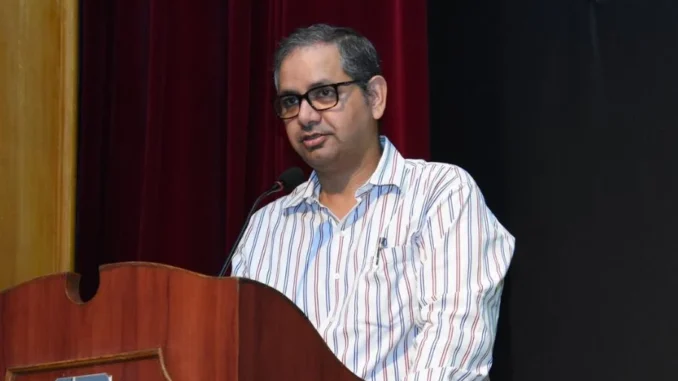
In a system where visibility often defines influence, Dushyant Nariala built his career differently. With minimal public attention, he emerged as one of the most trusted administrators within the West Bengal government.
A 1993 batch IAS officer of the West Bengal cadre with over three decades of dedicated public service, Dushyant Nariala is a man whose name may not have frequently appeared in newspaper headlines but whose steady, institution-oriented administrative presence shaped some of the most consequential governance decisions in West Bengal over the past thirty years.
From disaster management to school education, from Gorkhaland Territorial Administration to correctional administration, from North Bengal development to the very summit of the state’s bureaucratic hierarchy his career is a masterclass in building enduring administrative influence through consistency, institutional trust, and the quiet accumulation of cross-sectoral expertise.
The Election Commission of India appointed Dushyant Nariala, a senior bureaucrat of the 1993 batch of the Indian Administrative Service, as the new Chief Secretary of West Bengal.
His appointment in March 2026 at a moment of extraordinary political sensitivity, just hours after the Model Code of Conduct was enforced ahead of the 2026 West Bengal Assembly elections placed him at the helm of the state’s entire administrative machinery at one of the most consequential junctures in its recent history.
It was, in every sense, the culmination of a career built on trust, competence, and the kind of institutional depth that election commissions and governments reach for when the stakes are highest.
Profile
| Full Name | Dushyant Nariala |
| Born | 2 June 1967 |
| Age | 58 Years Old (as of 2026) |
| Domicile State | Haryana |
| Nationality | Indian |
| Occupation | Indian Administrative Service (IAS) Officer |
| IAS Batch | 1993 |
| Cadre | West Bengal |
| Recruitment Type | Direct Recruit (DR) via UPSC Civil Services Examination |
| IAS Identity Number | 01WB036300 |
| Educational Qualification | B.Sc. (Physics), Kurukshetra University; LL.B. (Second Division), Kurukshetra University |
| Languages Known | English, Hindi |
| Current Posting | Former Chief Secretary, West Bengal (March–May 2026); likely proceeding to Central Deputation |
| Expected Superannuation | June 2027 (based on date of birth 2 June 1967 and IAS retirement age of 60) |
Early Life
Born on June 2, 1967, Dushyant Nariala belongs to the West Bengal cadre of the IAS. His domicile state is Haryana the state with which he has a personal origin and family connection though his professional life has been spent entirely in West Bengal, where he has served since his induction into the Indian Administrative Service in 1993.
The combination of a Haryanvi origin and a career spent in West Bengal is a characteristic of many IAS officers allocated to state cadres outside their home states through the cadre allocation system a deliberate policy of the Government of India designed to ensure that senior civil servants bring an outside perspective and a degree of independence from local political and social pressures to their roles.
The specific details of Dushyant Nariala’s family background his parents’ identities and professions, his early childhood, and the circumstances that shaped his decision to pursue civil service are not publicly documented. Nariala’s journey does not follow the usual narrative arcs. There are no widely known personal struggles, no public speeches that define him, no high-profile media presence.
Instead, his story is built on something quieter years of internal trust, crisis handling, and the ability to manage complexity without drawing attention to himself. This personal reticence extends to his biographical origins: he is a man defined by his professional record rather than by the personal storytelling that characterises many public figures.
What is established from the public record is that he pursued his education in Haryana at Kurukshetra University one of the significant state universities in the Haryana-Punjab region before clearing the UPSC Civil Services Examination and joining the IAS in 1993 at the age of 26.
His allocation to the West Bengal cadre placed him at the beginning of a career that would unfold entirely within one of India’s most politically complex, culturally rich, and administratively demanding states.
Education
Academically, Shri Nariala holds a Bachelor of Laws (LL.B.) degree with Second Division and a Bachelor of Science (B.Sc.) degree in Physics from Kurukshetra University, also completed with Second Division. Kurukshetra University located in Kurukshetra, Haryana, in the heart of the region historically associated with the Mahabharata is one of Haryana’s principal public universities, offering programmes across science, law, commerce, and the humanities.
His academic grounding in both science and law has contributed to his analytical approach to governance and public administration. The combination of a physics background and a law degree is a distinctive educational profile one that equips an administrator with both the quantitative, analytical rigour of scientific training and the interpretive, regulatory, and procedural framework of legal education.
In the day-to-day work of a senior IAS officer who must simultaneously understand technical infrastructure issues, interpret legal provisions, manage institutional processes, and navigate regulatory frameworks this dual academic grounding proves genuinely useful.
Like most IAS officers, Nariala began his journey with foundational training at the Lal Bahadur Shastri National Academy of Administration in Mussoorie. His association with the academy did not end there. Years later, he returned as Joint Director, an indication that his understanding of governance was valued not just in the field but also in shaping future officers.
His role as Joint Director at LBSNAA represents one of the most significant endorsements available within the Indian civil service system an acknowledgment, by the institution responsible for training India’s administrators, that the officer’s experience and perspective are valuable enough to share with the next generation of civil servants.
Career
Early Postings and Foundation Building (1993–2010)
While many of his early district-level postings are not publicly documented, his career steadily moved into positions that required coordination, trust, and institutional understanding. He became known less for public-facing roles and more for his ability to manage systems from within.
In the early phase of his career, Dushyant Nariala served in the foundational district and sub-district roles that form the bedrock of every IAS officer’s administrative education postings as Sub-Divisional Officer, Additional District Magistrate, and district-level positions that gave him firsthand experience of rural governance, land revenue administration, law and order, and developmental programme implementation across West Bengal’s complex and diverse geography.
His sustained association with the School Education Department where he served as Secretary and earlier as State Project Director of Paschim Banga Rajya Shishu Shiksha Mission was one of the most socially significant phases of his career. The Paschim Banga Rajya Shishu Shiksha Mission is West Bengal’s implementation vehicle for the centrally sponsored Sarva Shiksha Abhiyan (Education for All) programme responsible for universal elementary education coverage, teacher deployment, school infrastructure development, and learning outcome improvement across the state’s vast network of primary and upper primary schools. His role as State Project Director of this mission placed him at the heart of one of West Bengal’s most critical social policy domains the education of millions of children across all 23 of the state’s districts.
Joint Director LBSNAA, Mussoorie
Years after his initial LBSNAA foundational training, he returned as Joint Director an indication that his understanding of governance was valued not just in the field but also in shaping future officers. His tenure as Joint Director at the Lal Bahadur Shastri National Academy of Administration in Mussoorie represents a significant national-level recognition of the quality of his administrative experience and the depth of his governance understanding.
In this role, he contributed to the training and mentorship of IAS probationers from across India sharing the institutional knowledge accumulated through his years of field experience in West Bengal with the next generation of civil servants entering the service from across the country.
Principal Secretary School Education Department (Continued)
His career trajectory included serving as Secretary and Principal Secretary in the School Education Department of the Government of West Bengal.
His continued engagement with education administration at the Principal Secretary level gave him comprehensive oversight of one of the largest state departments in West Bengal managing curriculum policy, teacher recruitment and deployment, school infrastructure, examination administration, and the implementation of centrally sponsored education schemes across a state with one of the most complex and historically significant education systems in India.
Principal Secretary Personnel and General Administration Department (2017–2018)
His experience in Personnel and General Administration includes serving as Principal Secretary during 2017–2018, where he dealt with cadre management, service matters, and administrative reforms. The Personnel and General Administration Department is one of the most sensitive and consequential departments in any state government it manages the human resources of the entire state civil service, handles service matters, promotions, transfers, and disciplinary proceedings, and is responsible for implementing administrative reforms.
An officer trusted to lead this department brings with it the confidence of the highest levels of state government it is not a posting that can be given to anyone except someone whose judgment, integrity, and understanding of service rules are beyond question.
Principal Secretary Self Help Groups and Self Employment Department
Among his documented postings is his tenure as Secretary in the Self Help Groups and Self Employment Department a portfolio focused on micro-enterprise development, women’s economic empowerment, and grassroots livelihood creation across West Bengal.
This department administers the state government’s SHG network one of the largest and most significant in India and its effective administration has direct implications for the economic wellbeing of millions of women and families across rural Bengal.
Principal Secretary Disaster Management and Civil Defence Department (January 2020 – August 2024)
Before assuming his current responsibilities, Shri Nariala served as Principal Secretary to the Government, Disaster Management and Civil Defence Department, West Bengal from January 2020 to August 2024. During this tenure, the department dealt with multiple high-pressure situations demanding preparedness, coordination, and rapid response.
This was perhaps the most demanding and consequential single posting of Dushyant Nariala’s career. The four and a half years from January 2020 to August 2024 were, by any measure, one of the most challenging periods in West Bengal’s recent disaster management history.
The period encompassed the COVID-19 pandemic which struck the state with particular severity and required an unprecedented level of inter-departmental coordination, public health management, and administrative mobilisation as well as multiple cyclone events, including Super Cyclone Amphan in May 2020, which was one of the strongest cyclones to make landfall in the Bay of Bengal in decades.
This period coincided with some of the most challenging years for governance cyclones, natural disasters, and the COVID-19 pandemic. In a state frequently exposed to extreme weather events, disaster management is not a routine department; it is the backbone of emergency response. Nariala’s role involved coordinating large-scale responses, aligning multiple departments, and ensuring that administrative machinery worked under pressure.
His tenure was marked by systematic strengthening of disaster management mechanisms, inter-agency coordination, and administrative preparedness.
His sustained presence in this department for the full period from 2020 to 2024 rather than being moved to other postings mid-tenure, as commonly happens with senior IAS officers reflects the West Bengal government’s deliberate decision to retain an experienced and trusted administrator in a critical portfolio during a period of sustained emergency.
Promotion to Additional Chief Secretary Apex Pay Scale (September 2024)
In September 2024, he was promoted to the rank of Additional Chief Secretary, one of the highest positions in the state bureaucracy.
The promotion to the Apex Pay Scale as Additional Chief Secretary is the penultimate step in the IAS hierarchy placing an officer just one step below the Chief Secretary, in the highest pay scale available in the state administrative structure.
In 2024, Nariala was elevated to the rank of Additional Chief Secretary in the apex scale, the highest level in the bureaucratic hierarchy. It marked his entry into the final layer of leadership within the state administration. By this point, his career had followed a clear pattern: steady progression, critical departments, and increasing responsibility without public projection.
Additional Chief Secretary Disaster Management and Civil Defence (2024)
Following his promotion to the Apex Pay Scale, Nariala initially continued in the Disaster Management portfolio at the enhanced seniority level of Additional Chief Secretary reflecting the continuity and institutional memory that the West Bengal government valued in maintaining his oversight of this critical department during the transition to higher seniority.
Additional Chief Secretary North Bengal Development Department and Principal Secretary GTA (December 2024 – March 2026)
Shri Dushyant Nariala IAS (West Bengal 1993), presently Additional Chief Secretary, Disaster Management and Civil Defence Department, was transferred and appointed as Additional Chief Secretary North Bengal Development Department with additional charge of Principal Secretary Gorkhaland Territorial Administration (GTA), West Bengal.
This posting was both administratively significant and politically sensitive. The North Bengal Development Department oversees development planning, infrastructure investment, and social welfare programmes in the tea garden districts, forest areas, and hill communities of northern West Bengal a region with a distinct cultural and demographic character, significant ethnic minority communities, and a history of political demands for greater autonomy.
The Gorkhaland Territorial Administration established in 2011 to provide a degree of autonomous governance to the Darjeeling hills is one of the most politically delicate institutional arrangements in West Bengal, with multiple competing political factions and a long history of agitation for separate statehood.
Since December 2024, he has served as Principal Secretary to the GTA, where he works on administrative coordination, development planning, and governance issues related to the Darjeeling hills.
His appointment to both the North Bengal Development Department and the GTA simultaneously reflects the West Bengal government’s confidence in his political sensitivity and his ability to navigate complex, multi-stakeholder governance environments.
In August 2024, Shri Nariala also assumed additional charge as Principal Secretary, Irrigation and Waterways Department a critical portfolio with long-term implications for agriculture, water management, and climate resilience.
Shri Nariala was given the additional charge as Additional Chief Secretary Correctional Administration Department, West Bengal adding prison and correctional services oversight to his already substantial portfolio of concurrent responsibilities.
Empanelment as Secretary, Government of India (March 2026)
Shri Dushyant Nariala IAS (West Bengal 1993) has been empanelled as Secretary at the Centre a formal recognition by the Appointments Committee of the Cabinet of the Government of India that he is suitable for appointment as Secretary to the Government of India, the highest non-constitutional administrative position in the Indian civil service.
This empanelment which came just days before his appointment as Chief Secretary of West Bengal represented the full national recognition of his administrative stature. In 2022, Nariala was empanelled for appointment to the rank of Additional Secretary and equivalent positions in the Government of India, with his subsequent 2026 empanelment at Secretary level marking a further step up to the highest tier of central government empanelment.
Chief Secretary West Bengal (March 2026)
The Election Commission of India appointed Dushyant Nariala as the new Chief Secretary of West Bengal. His appointment comes at a critical juncture, just hours after the Model Code of Conduct was enforced following the announcement of the 2026 Assembly election schedule. Nariala succeeds Nandini Chakravorty, who was relieved of her duties as the state’s top bureaucrat.
In March 2026, Dushyant Nariala assumed office as the Chief Secretary of West Bengal, succeeding Nandini Chakravorty. The timing of his appointment was significant. It came during an administrative reshuffle linked to an election-sensitive period, when governance requires both stability and experience.
His elevation signalled the system’s preference for continuity and control during a crucial phase. As Chief Secretary, he now stands at the top of the state’s administrative structure, coordinating departments, advising the political leadership, and ensuring that governance runs without disruption.
As Chief Secretary during the 2026 West Bengal Assembly elections one of the most consequential state elections in India in years Nariala was responsible for ensuring the entire state bureaucracy operated in compliance with the Election Commission’s directives, that electoral rolls were accurate, that government resources were not misused for political purposes, and that all state administrative machinery functioned with the impartiality that democratic elections demand.
His tenure coincided with the BJP’s historic 206-seat victory over Mamata Banerjee’s TMC the most significant political change in West Bengal since 2011. Following the election results and the subsequent formation of the BJP government under Chief Minister Suvendu Adhikari (or his designated successor), insiders from the state Secretariat said that in all probability, Nariala will be released for a central deputation to New Delhi a transition that would take him from the Chief Secretary’s office to a Secretary-level posting in the Government of India, the natural next step for a senior officer empanelled at Secretary level.
Controversies
Supreme Court Rebuke Malda Violence Case (April 2026)
In a sharp and rare courtroom rebuke, the Supreme Court of India strongly criticised Dushyant Nariala, the Chief Secretary of West Bengal, over the administration’s handling of the recent violence in Malda, where seven judicial officers were allegedly held hostage for several hours during SIR (Special Intensive Revision of electoral rolls)-related duties.
During the hearing, the Bench questioned why repeated attempts by judicial authorities to contact the state’s top bureaucrats had failed, with the Chief Justice delivering an unusually stern observation: “Do not elevate yourself to such a height that even the Chief Justice cannot reach you.”
Appearing through video conference, Dushyant Nariala said he had travelled to New Delhi for an official meeting and was on a flight between 2 PM and 4 PM when calls were allegedly made. He also claimed no calls from judicial officers in Kolkata had reached him.
The explanation, however, did not satisfy the Bench. Justice Joymalya Bagchi responded sharply “You cannot be so high and mighty that the Chief Justice is unable to reach you. Please come down a little so that the Chief Justice too can establish contact with you.”
The Supreme Court directed both the Chief Secretary and the DGP to submit a written apology to the Chief Justice of the High Court. The Bench observed “You must apologise. It is a gross failure of civil administration and police officials.”
The incident placed Nariala who had built his career on a reputation for quiet, institutional competence in an unusual and uncomfortable spotlight. The Supreme Court’s rebuke was one of the most high-profile judicial interventions involving a West Bengal Chief Secretary in recent years, and it raised serious questions about the state administration’s responsiveness to judicial emergencies and the accountability of senior bureaucrats during the election period.
The court ultimately dropped further coercive action after accepting his explanation, but the written apology directive and the public nature of the criticism left a mark on what had been an otherwise unblemished three-decade career.
Social Media
Dushyant Nariala IAS does not maintain a publicly known personal social media presence. Consistent with his professional reputation as a low-profile, institution-focused administrator, he has kept his digital footprint entirely minimal throughout his career.
Official information about his postings and career history is available through the Government of West Bengal’s Personnel and Administrative Reforms Department (PAR) posting lists, the DoPT IAS Civil List, and India’s leading bureaucracy tracking portals including Indian Bureaucracy (indianbureaucracy.com), Whispers in the Corridors (whispersinthecorridors.com), Indian Masterminds (indianmasterminds.com), and The Secretariat (thesecretariat.in).
Personal Life
Dushyant Nariala maintains a strictly private personal life one of the most consistent features of a career otherwise characterised by institutional openness and administrative accountability. Information about his marital status, family, and personal relationships is not publicly available in any verified source.
He is described by those who have worked with him as a composed, methodical, and deeply institution-oriented administrator qualities that have made him effective across very different portfolios from school education to disaster management to North Bengal’s politically sensitive governance landscape.
Nariala’s rise offers a different kind of narrative one where influence is built behind closed doors, decisions shape outcomes without headlines, and authority grows through consistency rather than projection. He speaks English and Hindi fluently languages that have served him across his career in the West Bengal government, where Bengali is the primary language of administration at the district level but English and Hindi remain essential at the secretariat level.
His return to LBSNAA as Joint Director years after his own foundational training is one of the most humanly revealing details of his career: it suggests a man who retained the intellectual engagement with governance theory and the mentorship impulse that made him willing to step back from field administration to invest in the education of the next generation of Indian civil servants.
Salary and Service Details
As a 1993 batch IAS officer in the Apex Pay Scale the highest pay level in the IAS hierarchy below Secretary to the Government of India Dushyant Nariala’s salary is at the apex of the 7th Pay Commission Pay Matrix for state-level officers.
The Apex Scale (Level 17 of the Pay Matrix) carries a fixed pay of ₹2,25,000 per month supplemented by Dearness Allowance, HRA, and other official entitlements. As Chief Secretary, he was additionally entitled to official government accommodation, an official vehicle with security, a dedicated secretariat staff, and all other position-specific benefits associated with the state’s highest administrative office.
His expected date of superannuation is June 2027 based on his date of birth of 2 June 1967 and the IAS mandatory retirement age of 60. If he proceeds to central deputation as a Secretary to the Government of India following the conclusion of his Chief Secretary tenure, his final years in service will be at the very apex of the Indian civil service hierarchy.
Frequently Asked Questions (FAQs)
Who is Dushyant Nariala IAS?
Dushyant Nariala is a 1993 batch IAS officer of the West Bengal cadre who served as the Chief Secretary of West Bengal from March 2026. He is one of the most senior and experienced administrators in West Bengal’s civil service, known for his work in disaster management, school education, North Bengal development, and the Gorkhaland Territorial Administration.
When was Dushyant Nariala born?
He was born on 2 June 1967.
How old is Dushyant Nariala IAS?
As of 2026, Dushyant Nariala is 58 years old. His expected retirement date is June 2027.
What is Dushyant Nariala’s educational background?
He holds a Bachelor of Science (B.Sc.) degree in Physics and a Bachelor of Laws (LL.B.) degree, both from Kurukshetra University in Haryana, both completed with Second Division.
What is Dushyant Nariala’s IAS batch?
He belongs to the 1993 batch of the IAS, West Bengal cadre. His official DoPT IAS identity number is 01WB036300.
When was Dushyant Nariala appointed Chief Secretary of West Bengal?
He was appointed Chief Secretary of West Bengal on 16 March 2026 by the Election Commission of India, just hours after the Model Code of Conduct was enforced ahead of the 2026 West Bengal Assembly elections. He succeeded Nandini Chakravorty in the role.
Why was Dushyant Nariala criticised by the Supreme Court?
In April 2026, the Supreme Court of India criticised him over the state administration’s handling of violence in Malda, where seven judicial officers were allegedly held hostage during SIR-related duties. The court noted that repeated attempts by judicial authorities to contact senior state officials had failed, and directed Nariala and the DGP to submit written apologies to the Chief Justice of the Calcutta High Court.
What is Dushyant Nariala’s most important career achievement?
His appointment as Chief Secretary of West Bengal in March 2026 at the most politically sensitive moment in the state’s recent electoral history is the culmination of a career built on institutional trust and cross-sectoral expertise. His four-and-a-half-year tenure as Principal Secretary of Disaster Management and Civil Defence (2020–2024), spanning the COVID-19 pandemic and multiple major cyclone events including Amphan, is regarded as his most consequential professional contribution.
Has Dushyant Nariala been empanelled at the Centre?
Yes. He was empanelled for Additional Secretary equivalent posts in 2022, and subsequently empanelled as Secretary to the Government of India in March 2026 the highest empanelment level available to a state cadre IAS officer for central government postings.
What is Dushyant Nariala’s domicile state?
His domicile state is Haryana, though his entire IAS career has been spent in the West Bengal cadre.
Conclusion
Dushyant Nariala’s biography is the story of the kind of civil servant that India’s administrative system most needs but least celebrates the quiet professional who builds trust through decades of consistent, effective, and ethical service rather than through public visibility, political connections, or headline-generating moments. From his foundational years in district administration to his school education work shaping the learning futures of millions of West Bengali children, from his LBSNAA stint mentoring the next generation of civil servants to his crisis management during cyclones and a pandemic, from his sensitive stewardship of North Bengal and Gorkhaland politics to his appointment as Chief Secretary at the most consequential moment in West Bengal’s recent political history his career is a sustained argument for the proposition that good governance is built quietly, brick by institutional brick, over many years of unglamorous but essential work.
The Supreme Court rebuke of April 2026 was a rare and unwelcome blemish on a career otherwise notable for its institutional propriety a reminder that even the most experienced administrators can be caught in situations that demand faster, more responsive action than the bureaucratic instinct for process always permits. It was, in the broader sweep of a thirty-year career, an anomaly rather than a defining moment.
In a world that often celebrates visibility, Nariala’s rise offers a different kind of narrative one where influence is built behind closed doors, decisions shape outcomes without headlines, and authority grows through consistency rather than projection. And now, as he leads West Bengal’s bureaucracy, that quiet approach is at the centre of one of the state’s most critical administrative roles. As he moves toward the final years of a career that has shaped West Bengal’s governance in ways both visible and invisible, Dushyant Nariala’s legacy will be measured not in speeches or headlines but in the institutional strength, the administrative systems, and the governance capacity that three decades of quiet, steady service have helped to build.
Related People








Leave a Reply