
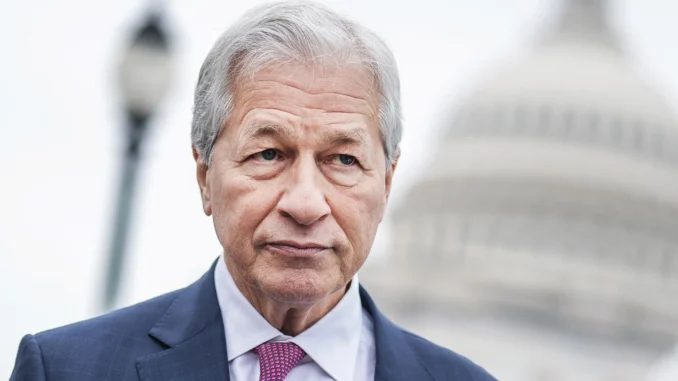
When people talk about the most powerful figures in global banking and finance, one name consistently rises to the top Jamie Dimon. As the Chairman and Chief Executive Officer of JPMorgan Chase, the largest bank in the United States by assets, Jamie Dimon has spent decades reshaping the financial landscape of America and the world.
He is not just a banker, he is a strategist, a crisis manager, a public voice on economic policy, and one of the few bank executives to become a billionaire largely through his own leadership and ownership stake in the company he leads.
Born into a family deeply rooted in the world of stockbroking and finance, Dimon was practically bred for Wall Street. Yet his path to the pinnacle of American banking was far from smooth it was marked by mentorship, ambition, a painful firing, a dramatic comeback, health scares, and a relentless drive that transformed JPMorgan Chase into a global financial powerhouse with more than $3.2 trillion in assets.
| James Dimon | |
|---|---|
 James Dimon: History · Bio · Photo
|
|
| Wiki Facts & About Data | |
| Full Name: | James Dimon |
| Born: | March 13, 1956 |
| Age: | 70 years old |
| Birthplace: | New York City, New York, United States |
| Nationality: | American |
| Occupation: | Businessman, Banking Executive, Chairman & CEO of JPMorgan Chase |
| Height: | 5 feet 11 inches (178 cm) |
| Religion: | Greek Orthodox (roots; not publicly specified) |
| Parents: | Theodore Dimon (Father), Themis Dimon (Mother) |
| Siblings: | Ted Dimon Jr., Peter Dimon |
| Spouse: | Judith Kent (married 1983) |
| Children: | Laura Dimon, Julia Dimon, Kara Leigh Dimon |
| Relationship: | Married |
| Net Worth: | $2.7 billion – $3 billion |
Early Life
James Dimon known to the world simply as Jamie Dimon was born on March 13, 1956, in New York City, New York. He grew up primarily in the Queens area of New York and was raised in a household where the language of finance was as common as table conversation.
His family has deep Greek roots: his paternal grandfather, Panos Papademetriou, immigrated to the United States from Greece, arriving nearly penniless. Upon immigrating, Panos changed the family surname from Papademetriou to Dimon, a decision that would forever brand the family name in the annals of Wall Street history.
Panos Papademetriou Dimon’s journey in America was a classic immigrant success story. He initially worked as a busboy before landing a job at the Atlantic Bank of New York, where he worked his way up to the position of vice president.
He later left to become a stockbroker at Shearson, Hammill & Co., because, as Jamie later recalled, “he could do that and make more money.” Panos went on to mentor his son, Jamie’s father, into the same profession, and together, father and son worked as stockbrokers for 19 years.
Jamie’s father, Theodore Dimon, followed his father into the financial world and became a stockbroker and eventually a vice president at American Express. His mother, Themis Dimon, was a psychologist and academic with a sociology background, giving Jamie a dual influence of analytical thinking and financial acumen from a very early age. Jamie is the second of three sons. He has two brothers older brother Peter Dimon and his fraternal twin Ted Dimon Jr. (some sources also list Peter as older).
Growing up, Dimon was immersed in the world of stocks, investing, and brokerage simply by being present at the family dinner table. His grandfather and father discussed business openly, and young Jamie soaked it all in.
According to the biography Last Man Standing: The Ascent of Jamie Dimon and JPMorgan Chase by Duff McDonald, Dimon learned a great deal about the brokerage industry “across the kitchen table.” He worked summers in his father’s and grandfather’s New York office as a teenager, further cementing his fascination with finance.
Beyond finance, Dimon inherited a love for reading and self-improvement from his grandfather. “My grandfather was a fascinating guy: He spoke six languages, he walked miles a day, he read a lot,” Dimon recalled. In high school, he began reading books on investing and finance, including the legendary Security Analysis by Benjamin Graham and David Dodd the same book that shaped the investment philosophy of Warren Buffett.
Jamie Dimon attended the Browning School, a prestigious private all-boys school in Manhattan, where he excelled academically and developed a strong intellectual foundation that would later serve him well in both business school and his professional career.
Education
After graduating from Browning School, Jamie Dimon enrolled at Tufts University in Medford, Massachusetts. He graduated summa cum laude (or cum laude, per some sources) in 1978 with a Bachelor of Arts in Economics and Psychology a dual focus that would prove instrumental in his understanding of both markets and human behavior.
During his undergraduate years at Tufts, he was actively involved in student government and deepened his interest in organizational behavior and economics.
After a brief stint in management consulting at the Management Analysis Center, a consulting firm in Boston, Dimon decided to pursue advanced education. He was accepted into Harvard Business School, one of the most prestigious business schools in the world.
There, he distinguished himself as a standout student, graduating in 1982 as a Baker Scholar an honor reserved exclusively for the top 5% of the graduating class. Harvard professor Jay O. Light noted of Dimon: “He was generally perceived as one of the very brightest guys in finance in that class.”
It was during his time at Harvard that Dimon interned at Goldman Sachs, one of the most coveted firms on Wall Street. After graduation, Goldman Sachs as well as Morgan Stanley offered him a job. He turned them both down. Instead, on the advice of his soon-to-be mentor, Sandy Weill, Dimon chose a different and ultimately more defining path. It was also at Harvard that he met Judith Kent, a Wellesley College alumna, who would later become his wife.
Career
Early Career at American Express
After completing his MBA at Harvard Business School in 1982, Jamie Dimon turned down high-profile offers from Goldman Sachs and Morgan Stanley to join American Express under the mentorship of Sanford “Sandy” Weill, a legendary figure in American finance. Dimon served as vice president and assistant to the president at American Express. Weill had known Jamie’s father personally, and the two families had maintained a close relationship even attending Passover dinners together. Dimon’s mother had gifted Weill a copy of her son’s Harvard thesis, and Weill was immediately impressed.
At American Express, Dimon quickly distinguished himself through his sharp financial instincts and his willingness to challenge conventional thinking. He and Weill left American Express in 1985, after Weill departed under strained circumstances, and the two began co-leading a new financial venture together.
Rise Through Commercial Credit and Travelers Group
In 1986, at just 30 years old, Dimon was appointed Chief Financial Officer (CFO) of Commercial Credit Group, a consumer finance company that Weill had taken over. Dimon’s aggressive cost-cutting and operational efficiency helped transform Commercial Credit into a profitable enterprise. He later became the company’s president as well.
From Commercial Credit, Weill and Dimon built an empire through a series of mergers and acquisitions. Commercial Credit acquired Primerica Corporation in 1988, which in turn owned Smith Barney. Dimon served as president and CFO of Primerica, and then as Chief Administrative Officer and later COO and Chairman/CEO of Smith Barney. The empire continued to expand when Primerica acquired Travelers Group.
Dimon was instrumental in building this financial conglomerate. He held the role of Co-Chairman and Co-CEO of Salomon Smith Barney Holdings in 1997, and when Travelers Group merged with Citicorp in 1998 to create Citigroup, one of the world’s largest financial services companies, Dimon became President of Citigroup.
The Firing That Changed Everything
In a stunning and widely reported turn of events, Sandy Weill fired Jamie Dimon from Citigroup in 1998. The two men had developed growing tensions over leadership and ambitions. As Weill later explained to The New York Times: “He wanted to be CEO, and I didn’t want to leave.” The firing was a public and deeply personal blow. Dimon had spent 16 years of his career building businesses alongside Weill, and being ousted at the height of their success together was a defining and humbling moment in his life.
However, in Dimon’s own words, the experience “impacted my net worth, not my self worth.” He spent roughly two years reflecting and exploring opportunities before making his dramatic comeback.
Reinvention at Bank One
In March 2000, Jamie Dimon accepted the position of Chairman and CEO of Bank One Corporation, at the time the fifth-largest bank in the United States. Based in Chicago, Bank One was a struggling institution with operational inefficiencies and structural challenges. Dimon’s strategy was immediate and bold he slashed costs aggressively, eliminated corporate perks ranging from tickets to the U.S. Open tennis tournament to regional managers’ salary excesses, and refocused the bank on sound fundamentals.
His initiatives were deeply unpopular internally one insider reportedly told Bloomberg that Dimon was “going down like cod-liver oil” but they were effective. Within a few years, Bank One had been dramatically revitalized. The bank managed mutual funds under the One Group family, was one of the largest credit card issuers in the world with nearly 52 million cards in circulation and $74 billion in managed receivables, and had retail and corporate banking operations spanning the U.S. and a dozen other countries.
JPMorgan Chase: The Defining Chapter
In July 2004, JPMorgan Chase acquired Bank One in a landmark $58 billion deal. Dimon became President and Chief Operating Officer of the combined company. On December 31, 2005, he was named CEO of JPMorgan Chase, and exactly one year later, on December 31, 2006, he was also named Chairman of the Board a title he continues to hold to this day.
Dimon’s vision for JPMorgan Chase was clear: build a fortress balance sheet, manage risk rigorously, diversify revenue streams, and invest in technology and people. His early years as CEO were defined by operational discipline and cultural transformation within the bank.
Navigating the 2008 Financial Crisis
The defining test of Dimon’s leadership came during the global financial crisis of 2007–2008, when the collapse of the subprime mortgage market triggered the worst financial meltdown since the Great Depression. While virtually every major bank in the United States was struggling with institutions like Bear Stearns, Lehman Brothers, Washington Mutual, Wachovia, and Citigroup either collapsing or teetering on the edge JPMorgan Chase, under Dimon’s disciplined stewardship, emerged relatively unscathed.
Dimon had insightfully ordered JPMorgan Chase to divest its exposure to subprime mortgage securities ahead of the crisis, a prescient risk management decision that proved to be one of the most consequential in modern banking history. When the crisis hit, JPMorgan Chase was uniquely positioned not as a victim, but as a stabilizing force.
In March 2008, with support from the U.S. Federal Reserve, JPMorgan Chase acquired Bear Stearns, the once-storied investment bank that was on the verge of collapse, at a deeply discounted price. Later that same year, after Washington Mutual the largest savings and loan association in the United States failed, JPMorgan Chase acquired its banking operations as well. These two crisis-era acquisitions significantly expanded JPMorgan Chase’s footprint in investment banking and consumer banking respectively.
President Barack Obama acknowledged Dimon’s handling of the crisis, saying he did “a pretty good job managing an enormous portfolio.” By 2011, JPMorgan Chase had become the largest bank in the United States by assets, a testament to Dimon’s strategic leadership during the most turbulent period in modern financial history.
Post-Crisis Growth and Controversies
After the financial crisis, Dimon continued to expand JPMorgan Chase’s global footprint and profitability. Under his leadership, the bank became a dominant force across investment banking, consumer banking, commercial banking, asset management, and payments. JPMorgan Chase’s revenues exceeded $170 billion in recent years, and the bank consistently delivered return on tangible common equity above 20%.
However, Dimon’s tenure was not without controversy. In 2012, JPMorgan Chase disclosed a trading loss of at least $2 billion (which ultimately grew to approximately $6 billion) related to positions taken by a trader dubbed the “London Whale.” The episode led to investigations by the Federal Reserve, the SEC, and the FBI, and Dimon’s compensation was reduced from $23 million to $11.5 million that year. He was forthright about the failure, describing the strategy as “flawed, complex, poorly reviewed, poorly executed and poorly monitored.”
In 2013, JPMorgan Chase reached a landmark $13 billion settlement with the U.S. Department of Justice related to mortgage-backed securities sold before the financial crisis the largest settlement with a single entity in U.S. history at the time. Dimon expressed frustration, noting that many of the claims related to companies JPMorgan Chase had acquired during the crisis at the government’s encouragement.
In 2023, JPMorgan Chase acquired First Republic Bank after its collapse, further cementing its position as the dominant U.S. banking institution. Also in 2023, Dimon testified under oath in connection with lawsuits over JPMorgan Chase’s relationship with the late Jeffrey Epstein, a matter that attracted significant public scrutiny.
In January 2026, then-President Donald Trump filed a $5 billion lawsuit against JPMorgan Chase and Dimon, alleging that his accounts were closed for political reasons a claim that attracted widespread attention and was vigorously contested by the bank.
As of 2026, JPMorgan Chase holds over $3.2 trillion in assets, making it the largest financial institution in the United States and one of the most powerful banks in the world. Dimon has stated no plans to leave the bank or enter government service, and he continues to be one of the most quoted and followed voices in global finance.
Awards & Nominations
Over his remarkable career, Jamie Dimon has received numerous prestigious honors and recognitions that reflect his stature as one of the most influential business leaders of his generation:
- Time Magazine’s 100 Most Influential People in the World Named to this prestigious list in 2006, 2008, 2009, and 2011, recognizing his global impact on finance and business leadership.
- Golden Plate Award (2006) Presented by the American Academy of Achievement at a ceremony hosted by Chicago Mayor Richard M. Daley, honoring his outstanding leadership and contributions to business.
- International Executive of the Year (2010) Awarded by the Executives’ Club of Chicago for his transformative leadership in the financial sector.
- Banker of the Year (2010) Presented by American Banker magazine in recognition of his outstanding contributions to the banking industry.
- Businessperson of the Year (2011) Awarded by Fortune magazine for his leadership during one of the most challenging periods in banking history.
- Directorship 100 (2011) Named among the most influential corporate leaders by the National Association of Corporate Directors for excellence in corporate governance.
- Intrepid Salute Award (2012) Recognized by the Intrepid Sea, Air, and Space Museum for his commitment to economic growth and innovation.
- Bower Award for Business Leadership (2015) Awarded by the Franklin Institute and the Wharton School at the University of Pennsylvania.
- Gold Medal (2016) Presented by the Americas Society for his role in fostering strong economic relationships across the Americas.
- Carnegie Medal of Philanthropy (2017) Awarded for making substantial and sustained contributions to philanthropy through the James and Judith K. Dimon Foundation.
- Outstanding Alumnus (2019) Honored by the Financial Times for his achievements and global leadership in the business world.
- Legion of Honour (2022) France’s highest civilian award, bestowed upon Dimon for his efforts in strengthening economic ties between the United States and France.
- CEO of the Decade Named by various business publications recognizing his nearly two-decade tenure of exceptional leadership at JPMorgan Chase.
- Forbes and Fortune Most Powerful People Lists Consistently ranked among the world’s most powerful business executives across multiple years.
- Barron’s Top CEOs in the World Repeatedly named among the best-performing CEOs globally based on long-term company performance.
Social Media
Unlike many of his contemporaries in the business world, Jamie Dimon maintains a relatively low-key and professional presence on social media.
He does not maintain a personal Twitter/X or Instagram account and is known for valuing privacy in his personal life. However, his professional presence and public commentary are accessible through several platforms:
- LinkedIn: Jamie Dimon is active on LinkedIn, where he is listed as Chairman of the Board and Chief Executive Officer of JPMorgan Chase. His LinkedIn profile has a significant following and is a platform through which he shares op-eds, shareholder letters, and commentary on economic issues. His LinkedIn handle is linkedin.com/in/jamiedimon.
- JPMorgan Chase Official Channels: Most of Dimon’s public statements, shareholder letters, interviews, and commentary are distributed through JPMorgan Chase’s official website at jpmorganchase.com, as well as the bank’s official social media pages on LinkedIn, Twitter/X, and YouTube.
- Annual Shareholder Letter: One of the most widely read documents in global finance each year is Jamie Dimon’s annual letter to JPMorgan Chase shareholders. Distributed through the company’s investor relations platform, the letter typically covers everything from the bank’s performance to his views on the global economy, geopolitics, technology, and the future of finance. It has become required reading for investors, policymakers, and business leaders worldwide.
- Wikipedia: His official Wikipedia page at en.wikipedia.org/wiki/Jamie_Dimon is one of the most comprehensive publicly accessible summaries of his life and career.
- Forbes Profile: Forbes tracks and updates Jamie Dimon’s net worth in real time as part of their Billionaires Index. His Forbes profile can be accessed at forbes.com under the billionaires section.
Personal Life
Despite commanding one of the most powerful financial institutions in the world and being one of the most recognized names in global finance, Jamie Dimon is known for maintaining a deeply private and family-first personal life. He has often been quoted saying, “I’ve always said family first, country second, JPMorgan literally last.”
Dimon met his wife, Judith Kent, while both were students at Harvard Business School. Judith was a Wellesley College graduate. The couple married in 1983 and have been together ever since. They have three daughters together: Laura Dimon, Julia Dimon, and Kara Leigh Dimon. While Dimon’s daughters have pursued their own careers and interests, the family has largely remained out of the public spotlight, consistent with Dimon’s philosophy of protecting his family’s privacy.
Dimon and his wife, Judith, are also well-known philanthropists. Together, they established the James and Judith K. Dimon Foundation, which donates to a wide range of causes including education, healthcare, community development, and social equity initiatives. They are also involved with the Robin Hood Foundation, a non-profit dedicated to fighting poverty in New York City, which has raised over $2 billion and provided food, shelter, and job training for thousands of New Yorkers.
Health Challenges
Dimon has faced two major health challenges in his life, both of which he handled with characteristic transparency and fortitude. In 2014, he was publicly diagnosed with throat cancer. He underwent eight weeks of intense radiation and chemotherapy, completing treatment in September 2014. His openness about the diagnosis was praised for its integrity and for the reassurance it gave to investors and employees alike.
In March 2020, at the age of 63 and at the height of the early COVID-19 pandemic, Dimon underwent emergency open-heart surgery to repair an acute aortic dissection a life-threatening condition involving a tear in the wall of the aorta. The surgery was successful. During his recovery, JPMorgan Chase’s co-presidents Gordon Smith and Daniel Pinto ran the bank. By April 2020, Dimon had returned to work remotely. Both health crises demonstrated his resilience and his unwillingness to be sidelined by adversity.
Controversies
Dimon is also a figure who has not shied away from controversy. He has had a complex and evolving relationship with politics, having donated substantially to Democratic Party candidates early in his career and later distancing himself from strict partisan alignment.
He famously told CNBC in 2019: “My heart is Democratic, but my brain is kind of Republican.” He served briefly on President Trump’s business advisory council in 2016 before Trump disbanded it in 2017.
In 2011, Dimon engaged in a high-profile heated exchange with Bank of Canada Governor Mark Carney, publicly criticizing Basel III regulations as “anti-American.” The “London Whale” trading scandal of 2012 attracted intense scrutiny, as did the bank’s $13 billion mortgage settlement in 2013 and the Jeffrey Epstein-related lawsuits in 2023.
In January 2026, President Trump’s $5 billion lawsuit against JPMorgan Chase and Dimon added yet another headline to his already highly scrutinized career.
Dimon is also known for his disciplined daily routines. He wakes up at 5 a.m. every day and is known for carrying a sheet of paper on which he writes organized lists of things to do, items to check on, and matters to remember systematically crossing them off as they are completed. This habit has become something of a symbolic representation of his methodical, detail-oriented leadership style.
Net Worth
Jamie Dimon is one of the rare bank chief executives in American history to have become a billionaire largely through his ownership stake in the company he leads. His enormous wealth is a direct reflection of decades of leadership excellence and his personal investment in JPMorgan Chase.
As of December 2025, Forbes estimated Jamie Dimon’s net worth at approximately $3 billion. Other sources, including Bloomberg Billionaires Index and real-time Forbes tracking throughout 2025, placed his net worth in the range of $2.5 billion to $2.78 billion. These figures fluctuate with JPMorgan Chase’s stock price, as the bulk of his wealth is tied to his significant equity stake in the bank.
As of filings in April 2024, Dimon and his family held approximately 7.5 million shares of JPMorgan Chase, valued at around $1.8 billion at the time. His annual compensation has consistently placed him among the highest-paid CEOs in the United States: he received $23 million for fiscal year 2011, $20 million for 2013, $34.5 million in 2022, $36 million in 2023, and a staggering $39 million in 2024, comprising a base salary of $1.5 million and performance-based bonuses primarily paid in JPMorgan stock.
Beyond his JPMorgan stake and compensation, Dimon’s net worth is further supported by a portfolio of high-value real estate assets, including a Park Avenue apartment in New York City and a 34-acre estate in Bedford, New York. His primary source of income, however, remains his leadership role at JPMorgan Chase, where his compensation is directly tied to the bank’s financial performance and shareholder returns.
Dimon’s wealth has funded significant philanthropic activity through the James and Judith K. Dimon Foundation and other charitable vehicles, further cementing his legacy as both a financial titan and a civic contributor.
FAQs
Who is Jamie Dimon?
Jamie Dimon is an American billionaire businessman and the Chairman and Chief Executive Officer of JPMorgan Chase & Co., the largest bank in the United States by assets. He is widely regarded as one of the most powerful and influential figures in global finance.
When and where was Jamie Dimon born?
Jamie Dimon was born on March 13, 1956, in New York City, New York, United States.
What is Jamie Dimon’s net worth?
As of 2025–2026, Jamie Dimon’s net worth is estimated at approximately $2.7 billion to $3 billion, according to Forbes and other financial tracking sources. The majority of his wealth is derived from his significant ownership stake in JPMorgan Chase.
Who is Jamie Dimon’s wife?
Jamie Dimon is married to Judith Kent. The couple met while both were students at Harvard Business School and have been married since 1983. They have three daughters together: Laura, Julia, and Kara Leigh Dimon.
How tall is Jamie Dimon?
Jamie Dimon stands approximately 5 feet 11 inches tall (178 cm).
What is Jamie Dimon’s educational background?
Jamie Dimon attended the Browning School in Manhattan, earned a Bachelor of Arts in Economics and Psychology from Tufts University (graduating in 1978), and received a Master of Business Administration (MBA) from Harvard Business School in 1982, graduating as a Baker Scholar top 5% of his class.
How did Jamie Dimon become famous?
Jamie Dimon rose to global fame through his exceptional leadership in banking and finance, most notably through his role as Chairman and CEO of JPMorgan Chase. He became particularly well known for steering JPMorgan Chase through the 2008 global financial crisis with relative stability, a feat that cemented his reputation as the most trusted and capable banker in America.
Was Jamie Dimon ever fired?
Yes. In 1998, Jamie Dimon was fired from Citigroup by his longtime mentor Sandy Weill. The dismissal came amid growing tensions over leadership ambitions. Dimon later characterized the experience as one that affected his net worth but not his self-worth. He went on to become CEO of Bank One in 2000 and subsequently CEO of JPMorgan Chase in 2006.
What health issues has Jamie Dimon faced?
In 2014, Jamie Dimon was diagnosed with throat cancer and underwent eight weeks of radiation and chemotherapy. In March 2020, he underwent emergency heart surgery to repair an acute aortic dissection. He recovered successfully from both health challenges and returned to leading JPMorgan Chase.
Does Jamie Dimon have plans to run for president?
Dimon has on several occasions expressed admiration for the role of the presidency and acknowledged he would “love to be president,” but he has consistently said that running a campaign would be “too hard and too late.” As of late 2024, Dimon confirmed he had no plans to join the government and intended to remain at JPMorgan Chase.
What is JPMorgan Chase’s current size under Jamie Dimon?
Under Jamie Dimon’s leadership, JPMorgan Chase has grown into the largest bank in the United States, with over $3.2 trillion in assets as of 2025–2026, making it one of the largest and most powerful financial institutions in the entire world.
Conclusion
Jamie Dimon is more than just a banker he is a living embodiment of resilience, discipline, and vision in the world of global finance. Born into a Greek-American family with deep roots in Wall Street, Dimon rose through the ranks of some of the most prestigious financial institutions in American history, endured a very public professional setback, and came back stronger than ever to build and lead what is today the most powerful bank in the United States.
From his early days as a young executive mentored by Sandy Weill at American Express and Travelers Group, to his dramatic comeback at Bank One, to his historic leadership of JPMorgan Chase through the 2008 financial crisis and beyond Dimon’s career is a masterclass in banking excellence, crisis management, and strategic vision.
He has overseen the acquisition of Bear Stearns, Washington Mutual, and First Republic Bank, transformed JPMorgan into a global powerhouse with $3.2 trillion in assets, and emerged as the most respected and outspoken voice in American finance.
Outside the boardroom, Dimon is a devoted family man married for over four decades to Judith Kent, a committed philanthropist through the James and Judith K. Dimon Foundation, and a public intellectual who weighs in fearlessly on economic policy, geopolitics, regulation, and the future of technology. His annual shareholder letters are widely read as some of the most insightful documents in global business.
Having faced and overcome throat cancer and emergency heart surgery, with a net worth of nearly $3 billion and no signs of slowing down, Jamie Dimon’s legacy is already secured.
He is, by virtually every measure, the most consequential banker of his generation and one of the most important business leaders in the modern era. His story is a powerful reminder that ambition, preparation, intellectual honesty, and the courage to bounce back from failure are the true foundations of lasting greatness.
Related People







Leave a Reply