
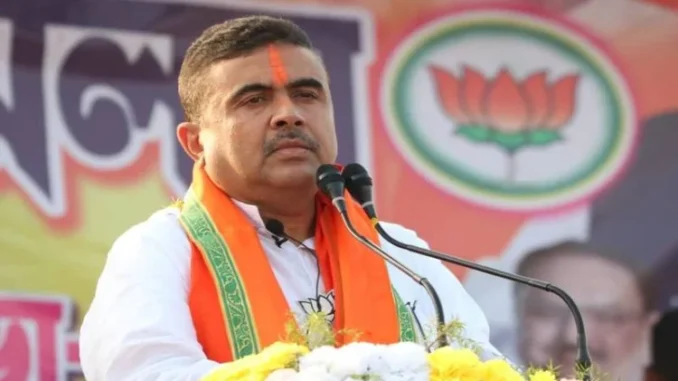
Suvendu Adhikari is one of India’s most influential and compelling political figures of the modern era. Born in the heartland of West Bengal’s coastal politics, he has risen from a grassroots organiser to become the man who twice defeated a sitting Chief Minister a feat virtually unprecedented in Indian democratic history.
From his early days as a Congress councillor to becoming the Bharatiya Janata Party’s most powerful face in West Bengal, Suvendu Adhikari’s journey is a story of tenacity, political acumen, and bold decision-making that has permanently reshaped Bengal’s political landscape.
Known for his iron-willed grassroots connect, fierce oratory, and strategic brilliance, Adhikari played a decisive role in the historic 2007 Nandigram movement and later masterminded the BJP’s resurgence in West Bengal.
His dramatic defection from the Trinamool Congress (TMC) in December 2020 and his subsequent victory over Chief Minister Mamata Banerjee in both 2021 and 2026 assembly elections have cemented his legacy as one of the most consequential politicians in contemporary Indian history.
| Suvendu Adhikari | |
|---|---|
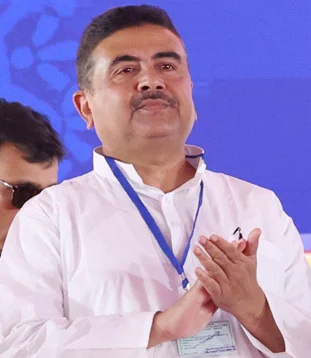 Suvendu Adhikari: History · Bio · Photo
|
|
| Wiki Facts & About Data | |
| Full Name: | Suvendu Adhikari |
| Born: | December 15, 1970 |
| Age: | 55 years old |
| Birthplace: | Karkuli, Purba Medinipur, West Bengal, India |
| Nationality: | Indian |
| Occupation: | Politician, Member of Legislative Assembly (MLA) |
| Religion: | Hinduism |
| Parents: | Sisir Adhikari (Father), Gayatri Adhikari (Mother) |
| Siblings: | Dibyendu Adhikari (Brother), Soumendu Adhikari (Brother) |
| Spouse: | Unmarried |
| Children: | None |
| Relationship: | Single |
| Net Worth: | Approx. ₹70.78 lakh (declared assets, 2026 affidavit) |
Early Life
Suvendu Adhikari was born on December 15, 1970, in Karkuli village in the Purba Medinipur district of West Bengal, India. He is of Bengali Hindu descent and belongs to one of the most politically influential families in coastal Bengal. His father, Sisir Adhikari, is a veteran politician who served as the Member of Parliament from Kanthi constituency and as Minister of State in the Second Manmohan Singh government. His mother is Gayatri Adhikari.
Growing up in such a deeply political environment meant Suvendu was immersed in the world of governance, public service, and people’s movements from a very young age. His family’s stronghold in the Purba Medinipur region particularly in the areas of Contai (Kanthi) and the surrounding coastal belt gave the young Suvendu early exposure to grassroots electoral politics, community organizing, and the pulse of rural Bengal.
His two brothers, Dibyendu Adhikari and Soumendu Adhikari, are also politically active. Dibyendu was elected to the Lok Sabha from the Tamluk constituency, while Soumendu served as the chairman of the Kanthi Municipal Corporation and was later elected from the Kanthi Lok Sabha constituency in the 18th Lok Sabha. The Adhikari family’s influence across Purba Medinipur is such that the district is often referred to informally as the “Adhikari kingdom.” Suvendu himself has remained unmarried and has no children, dedicating his life entirely to politics and public service.
Education
Suvendu Adhikari completed his formal higher education at Rabindra Bharati University, one of West Bengal’s premier public universities named after Nobel laureate Rabindranath Tagore. He earned a Master of Arts (M.A.) degree from the university in the year 2011, even while he was already an active and prominent politician. This reflects the man’s ability to balance academic pursuits alongside his demanding political responsibilities.
His educational qualifications are formally declared in his 2021 and 2026 election affidavits submitted to the Election Commission of India. While his academic background in the humanities provided a scholarly foundation, it is widely acknowledged that Suvendu Adhikari’s true education came from the streets, village squares, and people’s movements of West Bengal most notably from the historic Nandigram agitation of 2007. His understanding of ground-level politics, land rights, and the aspirations of rural communities gave him a political education far beyond any classroom.
Career
Early Political Beginnings (1995–1998)
Suvendu Adhikari entered politics in 1995, when he was elected as a councillor from the Indian National Congress (INC) in the Kanthi Municipality. This early foray into local governance gave him his first taste of electoral politics and public administration at the ward level. He served in this capacity for three years before making a pivotal move.
Joining Trinamool Congress (1998–2020)
In 1998, Suvendu Adhikari, along with his father Sisir Adhikari, joined the newly formed All India Trinamool Congress (AITC/TMC), led by Mamata Banerjee. This move aligned the Adhikari family with the rising opposition force in West Bengal, which was challenging the then-ruling Communist Party of India (Marxist), or CPI(M)-led Left Front government.
In 2006, Adhikari was elected to the West Bengal Legislative Assembly from the Kanthi Dakshin constituency a seat previously held by his father unseating the CPI(M) incumbent. That same year, he also became the Chairman of Kanthi Municipal Corporation. His win was part of a broader TMC wave that was beginning to challenge the Left Front’s long-standing dominance in the state.
The Nandigram Movement (2007)
The defining moment of Suvendu Adhikari’s political career came in 2007 during the Nandigram agitation one of the most pivotal events in West Bengal’s political history. When the Left Front government of Chief Minister Buddhadeb Bhattacharjee attempted to forcibly acquire agricultural land in Nandigram for an industrial chemical hub, farmers and villagers erupted in protest. Suvendu Adhikari stepped to the forefront, galvanizing local communities under the banner of the Bhumi Uchhed Protirodh Committee (BUPC) the Land Eviction Resistance Committee.
His leadership in the Nandigram movement transformed him from a local politician into a statewide figure. The protests, which turned violent when police opened fire on demonstrators, resulted in significant casualties and drew national attention. Adhikari’s role in leading and sustaining the resistance helped turn public opinion sharply against the Left Front government and gave the TMC massive political momentum. The Nandigram and Singur movements together are credited with paving the way for Mamata Banerjee’s historic 2011 electoral victory, which ended over three decades of Left Front rule in West Bengal.
Member of Parliament – Tamluk (2009–2016)
Riding on his enhanced stature, Suvendu Adhikari contested the 2009 Lok Sabha elections from the Tamluk constituency under the TMC banner. He defeated the CPI(M)’s strongman Lakshman Seth who had been a central figure in the Nandigram violence by a staggering margin of over 1.72 lakh votes. He retained the Tamluk Lok Sabha seat in the 2014 general election as well, becoming a two-term Member of Parliament.
During his time in Parliament, Adhikari was widely recognized as one of the most effective organizers in extending the TMC’s reach into CPI(M)-dominated districts across southern Bengal, including Bankura, Purulia, and Paschim Medinipur, making him virtually indispensable to Mamata Banerjee’s political machinery.
Cabinet Minister in West Bengal (2016–2020)
After voluntarily giving up his Lok Sabha seat to contest the 2016 assembly elections, Suvendu Adhikari won from the Nandigram constituency in the West Bengal Legislative Assembly election. He was subsequently inducted into Mamata Banerjee’s state Cabinet and served as Minister of Transport (2016–2020) and Minister of Irrigation and Water Resources (2018–2020). He was considered one of the most powerful ministers in the TMC government and Mamata Banerjee’s most trusted field commander during this period.
The Break with TMC and Joining BJP (2020)
Despite his loyalty and massive contributions to the TMC’s rise to power, Adhikari’s relationship with the party leadership began to strain around 2019–2020. The central tension was Mamata Banerjee’s decision to groom her nephew Abhishek Banerjee as the party’s de facto second-in-command a position that Adhikari had informally occupied by virtue of his organizational strength and grassroots dominance. Adhikari reportedly felt sidelined and marginalized in party decision-making.
On December 19, 2020, in one of the most dramatic political developments in recent Bengal history, Suvendu Adhikari formally joined the Bharatiya Janata Party (BJP) in the presence of Union Home Minister Amit Shah. His defection sent shockwaves through Bengal politics, triggering a cascade of TMC leaders and workers joining the BJP in its lead-up to the 2021 state elections. The Ministry of Home Affairs granted him a Z+ security cover the highest category in West Bengal and Y+ protection elsewhere, a reflection of the perceived threat to his safety.
The 2021 West Bengal Assembly Election – Defeating Mamata
The 2021 West Bengal Legislative Assembly election was a watershed moment in Adhikari’s career and in Bengali politics at large. He contested from Nandigram his own stronghold against none other than Chief Minister Mamata Banerjee herself, who chose the seat as a high-stakes gamble. In a nail-biting contest that riveted the entire country, Suvendu Adhikari defeated Mamata Banerjee by a narrow margin of 1,956 votes. While the TMC won the overall state election and retained power, Adhikari’s personal victory was an enormous political statement.
On May 10, 2021, Union Minister Ravi Shankar Prasad announced Suvendu Adhikari as the Leader of the BJP Legislature Party in the West Bengal Assembly. He subsequently became the Leader of the Opposition in the West Bengal Legislative Assembly, a position he would hold for the next five years.
Leader of the Opposition (2021–2026)
As Leader of the Opposition, Suvendu Adhikari remained one of the most vocal and combative voices against the Mamata Banerjee government. He championed issues of corruption, law and order, the rights of Hindu minorities, the implementation of the Citizenship Amendment Act (CAA), and the operational independence of central agencies like the CBI and the Enforcement Directorate. He consistently campaigned against what he described as the TMC’s protection of illegal infiltrators and alleged rigging of voter rolls in West Bengal.
The 2026 West Bengal Assembly Election – Historic Double Victory
In a truly extraordinary political development, during the 2026 West Bengal Legislative Assembly elections, Suvendu Adhikari contested from two constituencies simultaneously his home turf of Nandigram and Chief Minister Mamata Banerjee’s stronghold of Bhabanipur. He won both seats convincingly, defeating Mamata Banerjee in Bhabanipur by over 15,000 votes. The BJP secured a historic majority, winning approximately 206 of West Bengal’s 293 assembly seats, ending the TMC’s three-term rule in the state. This made Adhikari the frontrunner for the post of Chief Minister of West Bengal.
Defeating a sitting Chief Minister twice, in two different constituencies and two different election cycles, is virtually unprecedented in Indian democratic history. The last comparable event was in 1967. Suvendu Adhikari’s achievement stands as one of the most remarkable individual electoral performances in modern India.
Awards & Nominations
Suvendu Adhikari has not received formal ceremonial awards or recognitions, as his career has been entirely in the domain of electoral politics rather than arts, culture, or philanthropy. However, his political achievements represent a form of public recognition in their own right:
- Leader of the Opposition, West Bengal Legislative Assembly (2021–2026) – Appointed by the BJP legislature party following the 2021 election results.
- Leader of BJP Legislature Party, West Bengal (2021) – Announced by senior Union Minister Ravi Shankar Prasad.
- Z+ Security Cover – Granted by the Ministry of Home Affairs, reflecting his national-level political importance and the security threats he faces.
- Symbol of the Nandigram Movement – Widely recognized across Bengal as the political face of the historic 2007 land rights agitation.
- Chief Ministerial Frontrunner (2026) – Positioned as the BJP’s primary candidate for West Bengal Chief Minister following the party’s landmark 2026 election victory.
Social Media
Suvendu Adhikari maintains an active presence on social media platforms, using them as a key tool for political communication, public outreach, and mobilizing supporters across West Bengal and beyond.
- Twitter/X: Suvendu Adhikari is active on Twitter (now X) under the handle @SuvenduWB, where he regularly posts political commentary, reactions to state events, critiques of the TMC government, and updates on his public activities. He has amassed a significant following of hundreds of thousands of users.
- Facebook: He maintains an official Facebook page where he engages with a large constituency of supporters, sharing speeches, event photos, and news updates. His Facebook reach extends to millions of users during election cycles.
- YouTube: Video clips of his Assembly speeches and public addresses are widely circulated on YouTube, often garnering millions of views, particularly during contentious political moments.
Personal Life
Suvendu Adhikari has remained unmarried throughout his life, with no publicly known romantic relationships or children. He has devoted himself entirely to politics from a very young age, and his personal life reflects the singular dedication of a man who sees public service as his life’s vocation. He is known to be deeply family-oriented within his political household the Adhikari family is collectively one of the most powerful political dynasties in West Bengal.
Beyond politics, Adhikari has shown a keen interest in cricket and football. He has been actively involved in football organizations at the district and sub-divisional levels in Purba Medinipur, reflecting a connection to the sporting culture of rural Bengal that further endears him to his constituents.
Adhikari is known for his aggressive and confrontational political style. He speaks directly, without diplomatic hedging, and has built his brand on authenticity and proximity to ordinary people. He regularly holds public meetings (jansabhas) and grassroots outreach programs, maintaining a relentless schedule that keeps him in close contact with his voter base across Bengal.
Controversies
Suvendu Adhikari’s political journey has not been without controversy. He was investigated by the Central Bureau of Investigation (CBI) in connection with the Saradha Group Ponzi scheme one of Bengal’s largest financial frauds during his time as a TMC minister. He has vehemently denied any wrongdoing and characterized the allegations as politically motivated.
According to his 2026 election affidavit, Adhikari has 25 criminal cases registered against him, the majority of which were filed after his 2020 defection from the TMC to the BJP, which he describes as a coordinated campaign of political persecution by the TMC government. He has consistently appeared before courts as required and has maintained that none of the allegations against him have been proven.
Net Worth
Suvendu Adhikari’s financial profile is publicly documented through his statutory election affidavits submitted to the Election Commission of India. According to his 2026 election affidavit filed on March 30, 2026, his declared financial position is as follows:
- Annual Income (2024–25): ₹17.38 lakh more than double his declared income of ₹8.13 lakh in 2020–21.
- Movable Assets: ₹24.57 lakh (down from ₹59.31 lakh in 2021).
- Immovable Assets: Approximately ₹46.21 lakh, including houses, flats, and agricultural land in Purba Medinipur.
- Total Declared Assets (2026): Approximately ₹70.78 lakh.
- He had declared total assets of approximately ₹1.05 crore in his 2021 affidavit.
Compared to top national politicians, Suvendu Adhikari’s declared net worth is relatively modest. His primary source of income is his legislative salary as a Member of the West Bengal Legislative Assembly and the associated allowances of a Leader of the Opposition. The decline in declared assets between 2021 and 2026 has drawn attention, though Adhikari has declared all holdings transparently to the Election Commission without any outstanding loans or tax dues.
FAQs
Who is Suvendu Adhikari?
Suvendu Adhikari is an Indian politician and a prominent leader of the Bharatiya Janata Party (BJP) in West Bengal. He served as Leader of the Opposition in the West Bengal Legislative Assembly from 2021 to 2026 and is renowned for defeating Chief Minister Mamata Banerjee twice in two different constituencies in the 2021 and 2026 assembly elections.
When was Suvendu Adhikari born?
Suvendu Adhikari was born on December 15, 1970, in Karkuli, Purba Medinipur, West Bengal.
Is Suvendu Adhikari married?
No. Suvendu Adhikari is unmarried and has no children.
What party does Suvendu Adhikari belong to?
He is currently a member of the Bharatiya Janata Party (BJP). He was previously a member of the Trinamool Congress (1998–2020) and the Indian National Congress (1995–1998).
Why is Suvendu Adhikari famous?
He is most famous for defeating West Bengal Chief Minister Mamata Banerjee in the Nandigram constituency during the 2021 West Bengal Assembly elections, and again in Bhabanipur during the 2026 elections an unprecedented double victory over a sitting Chief Minister.
What is Suvendu Adhikari’s net worth?
Based on his 2026 election affidavit, his declared total assets amount to approximately ₹70.78 lakh, with an annual income of ₹17.38 lakh in 2024–25.
What is Suvendu Adhikari’s educational qualification?
He holds a Master of Arts (M.A.) degree from Rabindra Bharati University, which he completed in 2011.
Did Suvendu Adhikari become Chief Minister of West Bengal?
Following the BJP’s historic 2026 election victory in West Bengal, Suvendu Adhikari emerged as the frontrunner for the Chief Minister’s post, given his twin victories over Mamata Banerjee. The final decision was to be made by the BJP’s legislative party meeting.
What is Suvendu Adhikari’s role in the Nandigram movement?
He was one of the principal leaders of the 2007 Nandigram movement, galvanizing local farmers and communities under the Bhumi Uchhed Protirodh Committee against the Left Front government’s forcible land acquisition for industrial purposes.
Conclusion
Suvendu Adhikari’s biography is one of modern India’s most compelling political stories. From a small village in Purba Medinipur to the heights of West Bengal’s political arena, his journey reflects the power of grassroots politics, the courage to make bold decisions, and an unshakeable connect with the common people of Bengal.
His defection from the TMC, his back-to-back victories over a sitting Chief Minister, and his role in ending decades of Trinamool Congress dominance in West Bengal are feats that will be studied by political scholars for generations.
Whether one agrees with his politics or not, there is no denying that Suvendu Adhikari has permanently altered the political map of one of India’s most important states. As he steps into what promises to be the most consequential phase of his career, his story continues to evolve and Bengal, and indeed all of India, is watching.
Related People





Leave a Reply