
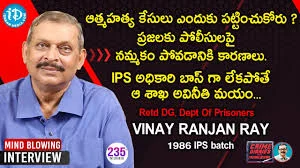
Who is Vinay Ranjan Ray IPS?
Vinay Ranjan Ray is a retired IPS officer of the Andhra Pradesh cadre, 1986 batch (Regular Recruit). He was allotted the Andhra Pradesh cadre with a home state of Bihar. His civil list number is 19861075 and his date of appointment to the IPS was 25 August 1986.
He is qualified with an M.A. degree and was born on 20 September 1959. He served in the Andhra Pradesh Police and Prisons establishment across a career spanning more than three decades, rising through the ranks from probationary officer to Director General of Police.
He is the recipient of the Police Medal for Distinguished Service (PM) in 2003 and the President’s Police Medal for Distinguished Service (PPMDS) in 2012 two of the most prestigious awards in the Indian police service.
| Vinay Ranjan Ray | |
|---|---|
|
Vinay Ranjan Ray: History · Bio · Photo
|
|
| Wiki Facts & About Data | |
| Full Name: | Vinay Ranjan Ray |
| Born: | September 20, 1959 |
| Age: | 66 years old |
| Birthplace: | Bihar, India |
| Nationality: | Indian |
Early Life
Vinay Ranjan Ray was born on September 20, 1959, and hails from the state of Bihar in eastern India. Bihar is one of India’s most historically rich states the birthplace of Buddhism, the seat of the Mauryan and Gupta empires, and a region with a deep tradition of producing scholars, administrators, and public servants who have made their mark across India’s civil and police services.
Growing up in Bihar during the 1960s and 1970s a period of significant social transformation, educational expansion, and the growing prestige of the Indian Administrative and Police Services as vehicles of upward mobility and national service Vinay Ranjan Ray developed the scholarly aptitude and public service orientation that would lead him to pursue and successfully complete the highly competitive UPSC Civil Services Examination.
Details of his specific hometown within Bihar, his parents’ names and occupations, and the particulars of his childhood and family background have not been documented in publicly available sources a reflection of the generally low public profile maintained by professional IPS officers who spend their careers in institutional service roles rather than in the national political or media spotlight.
What is known is that he was sufficiently academically accomplished to obtain a postgraduate Master of Arts degree, and subsequently competitive enough to secure selection into the Indian Police Service in the 1986 UPSC Civil Services Examination cohort.
Like many IPS officers of his generation who hailed from Bihar but were allotted to other state cadres, Vinay Ranjan Ray built his entire career in Andhra Pradesh a state with a rich and complex history, a vast geographical spread, and significant law enforcement challenges across its rural interior and coastal belt.
His career in Andhra Pradesh spanned more than three decades, encompassing the state’s pre-bifurcation era as a unified state, the contentious Telangana agitation period, and the eventual bifurcation of the state in June 2014 that created the separate states of Telangana and the residual Andhra Pradesh.
Education
According to the official Ministry of Home Affairs (MHA) Civil List of Indian Police Service officers, Vinay Ranjan Ray holds an M.A. (Master of Arts) degree as his listed educational qualification.
The specific subject of his postgraduate degree and the institution from which he obtained it have not been specified in publicly available official records.
In the context of the UPSC Civil Services Examination of the mid-1980s, which he cleared to enter the IPS, a Master of Arts degree was a standard and highly regarded qualification and the disciplinary focus of such a degree (whether in Political Science, History, Sociology, or another humanities or social science subject) would have provided him with an analytical and conceptual foundation well suited to the wide-ranging demands of senior police leadership.
The Indian Police Service examination of his era tested candidates comprehensively across general studies, optional subjects, and the personality interview demanding both breadth of knowledge and the clarity of thought required to navigate complex administrative and law enforcement situations. His successful selection in 1986 reflects the quality of his academic preparation and his competitive aptitude.
Career
Entry into the IPS and Early Career (1986 onwards)
Vinay Ranjan Ray was appointed to the Indian Police Service on August 25, 1986, as a member of the 1986 Regular Recruit (RR) batch of the Andhra Pradesh cadre.
He underwent his mandatory foundational and professional training at the Sardar Vallabhbhai Patel National Police Academy (SVPNPA) in Hyderabad the premier training institution for all IPS officers before being posted to his cadre state for district-level probationary service.
His early career, in keeping with the standard IPS career progression, would have involved postings at the district and sub-division levels serving as Assistant Superintendent of Police (ASP) and subsequently as Superintendent of Police (SP) in different districts of the then-unified Andhra Pradesh.
District-level policing in Andhra Pradesh during this era presented significant and varied challenges: the state had active Naxalite movements in its interior districts (particularly in the Rayalaseema and north Coastal Andhra regions), communal tensions in certain urban centres, and the complex law enforcement demands of a large, diverse state with both agrarian and industrial populations.
The Andhra Pradesh cadre of this era was also particularly notable for its senior leadership several of the 1985 and 1986 batch officers went on to hold some of the most important positions in Andhra Pradesh and national policing.
Vinay Ranjan Ray’s batch cohort in the AP cadre included distinguished officers such as V S K Kaumudi (who rose to Additional DGP at the Bureau of Police Research and Development, New Delhi, and later became IPS Director), Ram Prawesh Thakur (who rose to DGP Anti-Corruption Bureau), and Damodar Gautam Sawang (who became Commissioner of Police, Vijayawada and later the Director General of Police Head of Police Force of Andhra Pradesh). Ray served alongside and among these distinguished contemporaries throughout his career.
Senior Policing Career: Inspector General and Additional Director General Levels
As he progressed through the ranks from Superintendent of Police to Senior Superintendent of Police, then to Deputy Inspector General (DIG), Inspector General of Police (IG), and eventually Additional Director General of Police (ADGP) Vinay Ranjan Ray accumulated experience across multiple wings of Andhra Pradesh’s police establishment.
His posting as ADGP (Prisons), Andhra Pradesh Police represented his last senior-tier appointment before his elevation to the DGP grade placing him in charge of overseeing the state’s prison system and correctional services at the Additional DGP level.
The Andhra Pradesh prison system, which Vinay Ranjan Ray would go on to lead for the remainder of his service, is one of the largest and most complex in India managing dozens of central and district jails across the state, housing thousands of undertrial and convicted prisoners, and implementing the central government’s mandate for correctional services including vocational training, rehabilitation, and reintegration programmes.
The role demanded not only traditional command and control skills but also significant administrative acumen, financial management ability, and a commitment to the humane and lawful treatment of prisoners in accordance with both Indian law and international standards.
Promotion to Director General of Police (July 2016)
The defining formal milestone of Vinay Ranjan Ray’s career came on July 13, 2016, when the Andhra Pradesh government promoted five senior IPS officers to the DGP rank in a single order issued by Chief Secretary Satya Prakash Tucker.
Vinay Ranjan Ray was among the five and he was promoted to the grade of Director General of Police and retained in his posting as Director General of Police (Prisons and Correctional Services), Vijayawada. The promotion brought him to Pay Level 16 the apex level in the IPS pay scale and placed him among the nine DGP-rank officers then serving in the Andhra Pradesh cadre.
The simultaneous promotions reflected the standard bureaucratic process by which senior officers in the same batch are elevated together as vacancies arise and seniority criteria are met, following the UPSC Empanelment Committee’s review.
His retention in the Prisons and Correctional Services portfolio rather than transfer to a different DGP-level role indicated continuity of leadership in a department that benefited from his accumulated institutional knowledge of the state’s correctional system.
Post-Bifurcation Career in Residual Andhra Pradesh
The bifurcation of Andhra Pradesh in June 2014 following the enactment of the Andhra Pradesh Reorganisation Act divided the unified state into the new state of Telangana (with Hyderabad as its capital) and the residual state of Andhra Pradesh (with a temporary capital at Amaravati/Vijayawada).
All IPS officers of the AP cadre were notionally assigned to serve the residual AP following bifurcation, though in practice many officers continued for a period in the Hyderabad-based institutions before formal reallocation.
Vinay Ranjan Ray’s posting as DGP Prisons in Vijayawada the commercial capital of residual Andhra Pradesh placed him at the centre of the new state’s administrative establishment as it sought to build its independent institutional infrastructure.
He served in this role through the latter stages of his career, overseeing the Andhra Pradesh prison establishment during a critical period of post-bifurcation institutional consolidation.
DGP Succession Considerations (2019)
Vinay Ranjan Ray was among the senior DGP-rank officers of the 1986 batch whose names were formally forwarded by the Andhra Pradesh government to the Union Public Service Commission’s Empanelment Committee in 2019, when the state was identifying candidates to succeed the retiring DGP Ram Prawesh Thakur as Director General of Police (Head of Police Force) of Andhra Pradesh.
The names forwarded by the then-YS Jagan Mohan Reddy government included 1986-batch officers V S K Kaumudi, Ray Vinay Ranjan, and Gautam Sawang, along with 1987-batch officer T A Tripathi.
At the time, reports noted that Vinay Ranjan Ray was scheduled to retire from service in the near term making him less likely to be selected as the long-term DGP. The role ultimately went to D Gautam Sawang of the same 1986 batch.
Retirement
Vinay Ranjan Ray retired from the Indian Police Service upon reaching the mandatory IPS superannuation age of 60 years which, given his date of birth of September 20, 1959, would have placed his retirement date at September 30, 2019 (the last day of the month in which he turned 60, in accordance with standard Government of India superannuation rules for IPS officers). He retired after more than 33 years of continuous active service in the Indian Police Service.
Awards and Honours
Over his long and distinguished career, Vinay Ranjan Ray received formal government recognition on two separate occasions both among the most prestigious awards in the Indian police service:
- Police Medal for Meritorious Service (PM) 2003: The Police Medal for Meritorious Service is awarded by the President of India to police officers in recognition of valuable service of a high order. It is awarded to officers who have rendered meritorious service characterised by resource and devotion to duty over a sustained period. For Vinay Ranjan Ray, receiving this recognition in 2003 after approximately 17 years of active service acknowledged the quality and consistency of his contribution to Andhra Pradesh’s police establishment during his initial decades in the service.
- President’s Police Medal for Distinguished Service (PPMDS) 2012: The President’s Police Medal for Distinguished Service is the higher of the two formal police service awards awarded to officers who have rendered distinguished service of an exceptionally high order. Receiving the PPMDS in 2012 after 26 years in the IPS confirmed Vinay Ranjan Ray’s standing as a highly regarded senior officer within the Andhra Pradesh cadre, recognised at the national level by the highest constitutional authority.
Social Media
Vinay Ranjan Ray does not maintain a known public social media presence. Senior IPS officers of his generation who built their careers in an era preceding the dominance of digital platforms generally did not cultivate personal public profiles on platforms such as Twitter/X, Facebook, or Instagram.
His professional work and public service were conducted entirely through the institutional channels of the Indian Police Service and the Andhra Pradesh government, and his legacy is documented primarily in official government records, the MHA’s Civil List of IPS officers, and media coverage of official government orders and appointments relating to his role.
Personal Life
Vinay Ranjan Ray’s personal life including details about his family, spouse, children, and personal interests has not been documented in publicly available sources.
Like many IPS officers of his generation and career orientation, he maintained a private personal life away from the public domain, consistent with the institutional culture of the Indian Police Service which tends to separate an officer’s professional identity from their private affairs.
His family background in Bihar, where both a strong tradition of academic pursuit and a culture of government service are well established, provided the foundation for a career built on institutional dedication and professional excellence.
His career spanned the entire post-1986 era of Andhra Pradesh’s political and law enforcement history including the Naxalite insurgency periods, the Telangana agitation, the state bifurcation of 2014, and the subsequent challenges of building an independent correctional and policing infrastructure in residual Andhra Pradesh.
Those who served alongside him in the AP cadre have described him as a steady, professional, and reliable officer qualities consistent with the demanding role of heading a major state’s prison and correctional services establishment.
Net Worth
Vinay Ranjan Ray’s personal financial assets are not documented in the public domain. As a retired IPS officer of the DGP grade (Pay Level 16), he would be entitled to a government pension commensurate with his final pay scale one of the more substantial pensions available to retired Indian government officers, in addition to gratuity and other post-retirement benefits. IPS officers at the DGP level also receive various service benefits during their active tenure official residence, official vehicle, and related facilities though these cease upon retirement.
His net worth is best understood in terms of the substantial professional respect, institutional knowledge, and public service legacy that characterise a 33-year career in one of India’s most demanding civil services rather than in terms of accumulated personal wealth.
FAQs
Who is Vinay Ranjan Ray IPS?
Vinay Ranjan Ray is a retired Indian Police Service officer of the 1986 batch, Andhra Pradesh cadre. He served as Director General of Police, Prisons and Correctional Services, Andhra Pradesh, and was the recipient of both the Police Medal for Meritorious Service (2003) and the President’s Police Medal for Distinguished Service (2012).
What batch is Vinay Ranjan Ray IPS?
He belongs to the 1986 Regular Recruit (RR) batch of the Indian Police Service, Andhra Pradesh cadre. He was appointed to the IPS on August 25, 1986.
What is Vinay Ranjan Ray’s home state?
His home state is Bihar. He was allotted the Andhra Pradesh cadre of the IPS following his selection in the UPSC Civil Services Examination 1986.
What was Vinay Ranjan Ray’s last posting?
His last known posting was as Director General of Police (Prisons and Correctional Services), Andhra Pradesh, based in Vijayawada. He was promoted to the DGP grade on July 13, 2016, and retained in this role.
When was Vinay Ranjan Ray promoted to DGP?
He was promoted to the grade of Director General of Police on July 13, 2016, as part of an Andhra Pradesh government order that simultaneously promoted five IPS officers to the DGP rank.
What awards did Vinay Ranjan Ray receive?
He received the Police Medal for Meritorious Service (PM) in 2003 and the President’s Police Medal for Distinguished Service (PPMDS) in 2012 two of the most prestigious awards available to Indian police officers.
What is Vinay Ranjan Ray’s educational qualification?
According to the Ministry of Home Affairs Civil List of IPS officers, his listed educational qualification is an M.A. (Master of Arts) degree.
When did Vinay Ranjan Ray retire from the IPS?
Based on his date of birth of September 20, 1959, and the standard IPS superannuation age of 60 years, Vinay Ranjan Ray would have retired from the Indian Police Service on September 30, 2019, after more than 33 years of active service.
Was Vinay Ranjan Ray considered for AP DGP (Head of Police Force)?
Yes. In 2019, his name was among those forwarded by the Andhra Pradesh government to the UPSC Empanelment Committee for consideration as the Director General of Police (Head of Police Force) of Andhra Pradesh, following the retirement of DGP Ram Prawesh Thakur. However, given his own imminent retirement, D Gautam Sawang of the same 1986 batch was ultimately selected as the state’s DGP.
Which batch cohort did Vinay Ranjan Ray belong to in the AP cadre?
He belonged to the 1986 batch of the Andhra Pradesh IPS cadre, which included distinguished officers such as V S K Kaumudi, Ram Prawesh Thakur, and D Gautam Sawang who became the AP DGP (Head of Police Force).
Conclusion
Vinay Ranjan Ray’s career in the Indian Police Service is an exemplar of the dedicated, professional, and institutionally grounded service that forms the backbone of India’s civil services system.
A 1986-batch officer from Bihar, allotted to the Andhra Pradesh cadre at the outset of his career and serving there continuously for over three decades through the state’s unified era, its bifurcation, and the post-bifurcation consolidation of residual Andhra Pradesh he rose steadily through every rank of the IPS to reach its apex grade as Director General of Police.
His leadership of the Andhra Pradesh Prisons and Correctional Services one of the most operationally complex and humanistically demanding portfolios in any state police establishment was recognised twice by the Government of India through formal presidential awards: the Police Medal for Meritorious Service in 2003 and the President’s Police Medal for Distinguished Service in 2012. These honours reflect a career built not on political visibility or media prominence, but on the quiet, consistent, and technically excellent discharge of public duty across more than three decades of active service.
In an era when public discourse about the police often focuses on high-profile investigations, celebrity officers, and political controversies, officers like Vinay Ranjan Ray represent the silent institutional infrastructure of the Indian state the professionals who ensure that its prisons are managed lawfully, its correctional services are implemented conscientiously, and its law enforcement machinery functions with the disciplined continuity that democratic governance requires. His career is, in the truest sense of the phrase, a life of service and one worthy of record and recognition.
Related People






Leave a Reply