
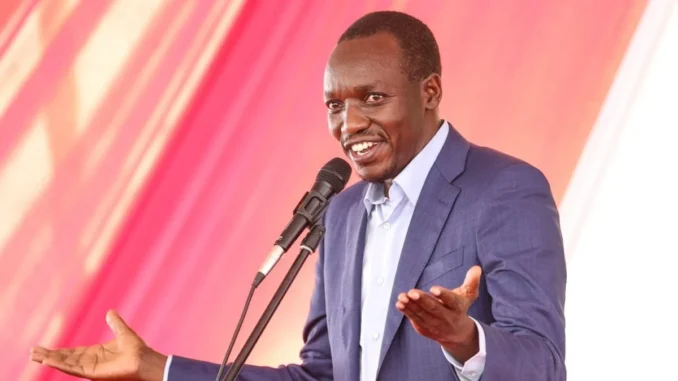
From selling sukuma wiki (kale) on the dusty streets of Kawangware in Nairobi to serving as the Governor of Kisii County, the story of Paul Simba Arati is one of the most compelling narratives in modern Kenyan politics.
A self-made man who grew up in humble circumstances in rural Kisii County, Arati turned his early struggles including poverty, school expulsions, and a grinding vegetable business into the foundation of a remarkable political career that has taken him from the Nairobi City Council chambers to the floor of the National Assembly, and ultimately to the highest office in one of Kenya’s most politically competitive counties.
Known for his directness, his unapologetic boldness, and his deep loyalty to the Orange Democratic Movement (ODM) and its leadership, Simba Arati has spent more than two decades building political capital through grassroots activism, community engagement, and a willingness to wade into the most contentious debates in Kenyan politics. As the second Governor of Kisii County and ODM’s Deputy Party Leader, he is today one of the most recognisable political figures in the Gusii region and one of the most polarising.
| Paul Simba Arati | |
|---|---|
 Paul Simba Arati: History · Bio · Photo
|
|
| Wiki Facts & About Data | |
| Full Name: | Paul Simba Arati |
| Born: | 28 November 1981 |
| Age: | 44 years old |
| Birthplace: | Botire Village, Motonto, Bobasi Constituency, Kisii County, Kenya |
| Nationality: | Kenyan |
| Occupation: | Politician, Governor, Entrepreneur, Social Worker |
| Height: | 5 feet 10 inches (approximately 178 cm) |
| Religion: | Christianity |
| Parents: | Mzee Arati Oroni (Father — deceased); Mama Jane Arati (Mother) |
| Siblings: | Three brothers (names not publicly disclosed) |
| Spouse: | Kwamboka (Chinese-born wife) |
| Children: | Two children (names not publicly disclosed) |
| Relationship: | Married |
| Net Worth: | Approximately $1.5 million USD (estimated) |
Early Life
Paul Simba Arati was born on 28 November 1981 in Botire Village, near Motonto Market in Bobasi Constituency, Kisii County, in the western highlands of Kenya. He is of the Abagusii ethnic group one of Kenya’s most culturally distinct and politically engaged communities and was raised in a Christian household where both faith and community values played a central role.
Arati grew up in a modest, middle-class family. His father, Mzee Arati Oroni, was a farmer and rancher who tended the family’s land in the fertile hills of Kisii County. Mzee Oroni was the kind of Kenyan patriarch whose values were rooted in the land, in hard work, and in the belief that education was the gateway to a better life. Sadly, he did not live to see his son reach the heights of the gubernatorial office. He passed away on 6 September 2015, at the age of 87, after a prolonged battle with cancer while Simba was serving as the Member of Parliament for Dagoretti North in Nairobi. His mother, Mama Jane Arati, is a small-scale businesswoman and entrepreneur who has remained a supportive presence throughout his life. Arati is reported to have three brothers, though the names of his siblings have never been made public.
Arati’s childhood was by no means tranquil or conventional. He has been candid in various interviews about the fact that he was not the most disciplined student in his early years. He began his primary school education in Kisii in 1987, but was reportedly transferred to Bura in Tana River County after persistent behavioural problems at his original school. He sat his Kenya Certificate of Primary Education (KCPE) examinations in 1994. His secondary school journey was equally turbulent he enrolled at Nyamache Secondary School in 1995 but was later expelled, before transferring to Suneka Secondary School in Kisii County, where he eventually completed his Kenya Certificate of Secondary Education (KCSE) examinations in 1998.
Despite these early difficulties, Arati’s formative years in Kisii left a deep impression on him. He witnessed firsthand the struggles of ordinary Kenyans the farmers who worked the tea and maize fields with little to show for it, the young people with ambition but no opportunities, the communities that had been left behind by the political class. These early observations would later shape the kind of politician he chose to become: one who, at least in rhetoric and often in practice, oriented his work toward the grassroots.
One of the most frequently recounted stories of Arati’s early adult life is his experience as a sukuma wiki (kale) vendor in Kawangware, one of Nairobi’s densely populated low-income settlements. After enrolling at Kenya Polytechnic for his diploma studies, Arati supplemented his income by selling vegetables in the market a hustle that, far from being a source of shame, became a defining part of his public political identity. He would later use this experience as the inspiration for one of his most celebrated community initiatives: the Kata Sukuma Competition, through which he reminded young Kenyans that even the humblest of trades can be the beginning of greatness.
Education
Notwithstanding the challenges of his early schooling, Simba Arati went on to build an impressive and wide-ranging academic portfolio one that spans institutions in Kenya and China, and that spans disciplines from tourism to business management to international relations.
After completing his KCSE at Suneka Secondary School, Arati enrolled at Kenya Polytechnic University College (now known as the Technical University of Kenya) in 2001. He pursued a Diploma in Tourism Management, which he completed in 2003. It was during this period that he also first engaged in student politics, attempting to vie for the position of Secretary-General of the Kenya Polytechnic Students Union a contest he claims he lost due to electoral manipulation. The experience, though frustrating at the time, gave him an early taste of the world of political competition that would come to define his adult life.
In 2004, Arati received a scholarship and travelled to Guangzhou, China, where he enrolled at Guangzhou University. There, he pursued a Bachelor’s degree in Business Management, which he completed and graduated from in 2006. His time in China was transformative in more ways than one not only did it equip him with an internationally grounded business education, but it was also where he met his future wife.
Upon returning to Kenya, Arati continued to invest in his academic development. In 2014, he enrolled at Jaramogi Oginga Odinga University of Science and Technology (JOOUST) in Kisumu, where he pursued a Bachelor of Arts in International Relations and Diplomacy with Information Technology. He subsequently undertook a Master of Business Administration (MBA) in Strategic Management at the same institution, completing his postgraduate studies in 2022 the same year he was elected Governor of Kisii County.
Some sources have also referenced an affiliation with the University of Nairobi, though the specific qualification associated with this connection has not been fully confirmed in publicly available records.
Arati’s academic journey from a polytechnic diploma to an MBA obtained while serving as a sitting Member of Parliament speaks to a man who takes self-improvement seriously and who has never allowed the demands of his political career to crowd out his commitment to education. It also serves as a powerful narrative tool in a country where many citizens place enormous value on formal qualifications as markers of credibility.
Career
Simba Arati’s career has unfolded across three distinct phases: an early business career, a decade-long tenure in the National Assembly, and his current role as Governor of Kisii County. Through each of these phases, he has demonstrated a combination of entrepreneurial instinct, political acumen, and an unflinching willingness to court controversy.
Business Career: Aipa Safaris and Vegetable Trading (2004–2008)
After graduating from Guangzhou University in 2006 and returning to Kenya, Arati embarked on a career in the private sector. He served as the Managing Director of Aipa Safaris Limited, a role he held between approximately 2004 and 2007. The company operated in the tourism and safari industry, a natural fit given his diploma in Tourism Management. This experience gave him foundational skills in business leadership, resource management, and client relations that would later prove useful in the complexities of county governance.
In parallel with his formal business career, Arati engaged in small-scale trade most notably the selling of vegetables in Kawangware, Nairobi. This seemingly unremarkable enterprise was, in fact, the crucible in which his political career was forged. Through daily interactions with ordinary Kenyans at the market, he built the networks, the friendships, and the grassroots credibility that made his subsequent entry into politics not only possible but genuinely organic. He was not a politician who descended upon a community from outside he was one of the community, known to the people at the street level.
Nairobi City Council: Councillor and Chairperson (2008–2012)
Arati made his formal entry into elective politics in 2007, when he contested for the position of Councillor in the Nairobi City Council. He did not win the election outright, but was subsequently nominated as a Councillor, a position he used to lay the groundwork for a broader political career. By 2008, he had secured the elected position and went on to serve as Chairperson of the General Purpose Committee at the Nairobi City Council, a role he held until 2012.
His time at the City Council gave Arati important experience in the mechanics of urban governance public service delivery, committee management, constituency engagement and helped him build the profile and the networks that would be necessary for his eventual leap to the national legislature.
Member of Parliament, Dagoretti North (2013–2022)
In the 2013 General Elections, running on the Orange Democratic Movement (ODM) ticket, Simba Arati successfully contested for and won the seat of Member of Parliament for Dagoretti North Constituency in Nairobi County. He was re-elected to the same seat in the 2017 General Elections, cementing a decade-long tenure in the National Assembly that would come to define his national political identity.
As a parliamentarian, Arati served on several important committees. He was a member of the Departmental Committee on Agriculture, Livestock, and Cooperatives, as well as the Committee on Implementation, which is responsible for overseeing the implementation of resolutions and decisions passed by the House. In these roles, he engaged with policy matters ranging from food security and agricultural development to the execution of government programmes groundwork that would directly inform his later agenda as a county governor.
On the floor of Parliament, Arati quickly developed a reputation as one of the most vocal and combative members of the ODM bench. He was a fierce defender of ODM leader Raila Odinga and never shied away from confrontation with political opponents, regardless of their seniority or the stakes involved. His sharp tongue, his willingness to escalate disputes to the point of physical altercation if necessary, and his genuine street-level popularity made him one of the most recognisable faces of ODM’s grassroots mobilisation machine in Nairobi.
One of his most notable constituency-level initiatives during his parliamentary tenure was the launch of the Kata Sukuma Competition on 9 June 2013, organised through his Simba Arati Foundation. The event, which saw 263 participants compete to determine the fastest sukuma wiki cutter in Dagoretti North, was accompanied by a cash prize of Ksh 25,000 for the winner. Beyond the entertainment value, the competition carried a powerful message: that no work is too small or too humble to be celebrated, and that the same vegetable that once fed Arati as a struggling student could be the foundation of a business and a life. The event generated widespread media coverage and became one of the most memorable community engagements of his parliamentary tenure.
He also championed youth empowerment initiatives, worked to expand access to education within his constituency, and advocated for improved healthcare services priorities that would later become the cornerstone of his gubernatorial agenda in Kisii.
Election as Governor of Kisii County (2022)
In the August 2022 General Elections, Simba Arati made the momentous decision to leave his safe Dagoretti North parliamentary seat and contest for the Kisii County Governorship effectively returning to his ancestral home to seek the highest executive position in the county. It was a high-risk gamble, pitting him against formidable opposition including Senator Sam Ongeri, one of Kisii’s most senior and most respected political figures, and former Chief Administrative Secretary Chris Obure.
Arati won the election convincingly, defeating both rivals and becoming the second Governor of Kisii County, succeeding James Ongwae, who had served since the devolution of power in 2013. He was sworn in on 25 August 2022 at a ceremony that marked not just a personal milestone but a generational shift in the county’s leadership.
Governance as Kisii County Governor (2022–Present)
Governor Arati’s administration has been guided by the County Integrated Development Plan (CIDP) 2023–2027 and a wide-ranging governance manifesto built around inclusive development, agricultural transformation, healthcare improvement, youth empowerment, and infrastructure investment.
One of the most dramatic early actions of his administration was the decision to audit the county payroll immediately upon assuming office. Within weeks of his swearing-in, Arati uncovered 861 ghost workers on Kisii County’s payroll employees who were drawing salaries without actually working for the county government. He invited the Ethics and Anti-Corruption Commission (EACC) to investigate the matter and publicly committed to eliminating wasteful expenditure as a prerequisite for meaningful development.
His administration’s agricultural agenda has prioritised support for smallholder farmers through subsidised inputs, extension services, and the strengthening of value chains in coffee, banana, and dairy the backbone crops of the Kisii economy. On the healthcare front, he has worked to upgrade county health facilities, improve the availability of essential medicines, and expand human resource capacity across the county’s health system. He has also launched the Elimu na Simba programme to support academically high-performing but economically disadvantaged students, and has been consistent in issuing county bursaries to Form One students across the county.
The Simba Shelter Scheme, his affordable housing initiative, represents one of the more ambitious social programmes of his administration, targeting the significant proportion of Kisii County residents who lack access to decent, affordable accommodation. In tandem with housing, his government has prioritised infrastructure development, clean water access, and environmental conservation as foundational pillars of a sustainable development agenda.
On the ODM national stage, Arati serves as the party’s Deputy Leader, a position that has placed him at the heart of some of Kenya’s most consequential post-2022 political realignments including the ODM’s participation in the broad-based government under President William Ruto, and the internal ODM tensions triggered by the rise of potential 2027 presidential candidates including Dr Fred Matiang’i.
Awards & Nominations
Simba Arati’s career has not been characterised by the kind of formal institutional awards that are often given to politicians or public servants. His recognition has come principally through the ballot box through the repeated affirmation of his constituents who re-elected him as MP and then elected him as Governor. These democratic mandates represent, in the truest sense, the highest form of recognition available to a public servant in a democratic system.
His governance of Kisii County has been noted in various regional forums as an example of proactive anti-corruption measures, with particular attention to his early move to expose ghost workers and invite independent oversight bodies to audit the county’s payroll a step that many county governments across Kenya have been reluctant to take. His Simba Arati Foundation has also been cited for its community-level contributions, particularly through youth empowerment and education support initiatives.
Social Media
Simba Arati maintains an active presence across several social media platforms, which he uses as tools for political communication, constituency engagement, and the dissemination of his administration’s work and policies.
On X (formerly Twitter), he operates under the handle @SimbaArati, which he joined in January 2013. His Twitter following has grown steadily over the years, accumulating over 75,900 followers with whom he engages on matters ranging from ODM party affairs and national political developments to county governance updates and personal reflections. His tweets tend to be direct and pointed characteristic of the combative political personality he is known for.
On Facebook, Arati maintains both a personal profile under Hon Simba Arati which has amassed over 64,000 followers and an official Governor’s page under Governor Simba Arati, which has accumulated over 10,000 followers and was created in April 2022 during his gubernatorial campaign. Facebook has historically been one of the most important platforms for political communication in Kenya, given its widespread usage across age groups and socioeconomic classes, and Arati uses both accounts actively to reach constituents and party supporters alike.
He also maintains a presence on Instagram under the handle @hon.simba.arati, though his activity on the platform has been more limited compared to his Twitter and Facebook engagement.
Personal Life
Simba Arati is a married man, and the story of how he met and married his wife is one of the most discussed and most unusual aspects of his personal biography because his wife, widely known by her Kisii name Kwamboka, is of Chinese origin.
Marriage to Kwamboka
Arati met Kwamboka during his time studying Business Management at Guangzhou University in China between 2004 and 2006. The two fell in love while Arati was pursuing his undergraduate degree, and he brought her back to Kenya after graduation. They married following the completion of their studies, and have built a life and a family together in Kenya, currently residing in Kisii County.
Kwamboka has maintained a deliberately low public profile throughout Arati’s political career, preferring the role of a private homemaker over that of a public political spouse. Very little is known about her background, her family, or her life before Kenya. However, she has made several notable public appearances at political events, most famously in January 2022 when a video of her addressing a campaign rally in Kisii County went viral across Kenyan social media. The video captivated the country not merely for the fact that it featured the wife of a prominent politician but because she addressed the crowd in fluent Kisii, a feat that delighted audiences and transformed her overnight into one of the most talked-about public figures in the country.
Arati has spoken about his marriage in several interviews, consistently framing it as a private matter while firmly defending his right to love and marry across cultural and national boundaries. In one widely quoted response to critics, he stated that he had married from Asia, that these were private family matters, and that wherever his wife was from had not affected his ability to lead and deliver for the people of his constituency and county. Together, the couple have two children, whose names have been kept out of the public domain.
The marriage did attract controversy, particularly during his gubernatorial campaigns in the predominantly patriarchal Gusii community, where some community elders and political opponents questioned whether a man married to a foreign national could genuinely represent and lead the Abagusii people. These critics were ultimately answered by the voters of Kisii County, who chose Arati decisively over his rivals in the August 2022 elections.
Physical Appearance
Simba Arati stands at approximately 5 feet 10 inches (around 178 centimetres) tall and weighs approximately 80 kilograms. He is typically seen in formal political attire at official functions and in more casual clothing when engaging directly with communities at the grassroots level. His physical bearing energetic, assertive, and never far from the centre of any crowd matches the combative and animated political personality for which he is widely known.
Controversies
Physical Altercation with Silvanus Osoro (2021): One of the most dramatic and widely reported incidents in Arati’s career was a public fistfight with South Mugirango MP Silvanus Osoro on 1 February 2021, at the funeral of the late father of former Kisii County Deputy Governor Joash Maangi. The incident occurred in the presence of then-Deputy President William Ruto and ODM leader Raila Odinga two of the fiercest political rivals in the lead-up to the 2022 General Election. Osoro, a staunch Ruto supporter, and Arati, an equally passionate Odinga supporter, exchanged blows before being quickly separated, disrupting the funeral proceedings entirely. The incident became one of the most talked-about political altercations in recent Kenyan political history.
Ghost Workers Scandal and Ethnic Profiling Accusations (2022–2023): Shortly after taking office, Arati’s crackdown on ghost workers on the county payroll while widely praised as an anti-corruption measure drew accusations from some Kisii leaders that his administration was using the exercise to unfairly target employees from the Abagetutu clan of the Abagusii community. Senator Richard Onyonka and Kitutu Chache South MP Anthony Kibagendi were among those who raised these concerns publicly, accusing the governor of profiling and discrimination rather than genuine good governance.
Political Rivalry with Silvanus Osoro (Ongoing): The bad blood between Arati and Osoro did not end with the 2021 funeral fight. Since Arati assumed the governorship and Osoro assumed his role as Majority Whip in the National Assembly under the Kenya Kwanza administration, the two men have continued to clash repeatedly at political meetings, at public gatherings, and through the media. Osoro has accused Arati of sidelining MCAs allied to Kenya Kwanza and of running county government affairs from his private home in Bobasi rather than from official county offices. He has also joined calls for a full public accounting of the Ksh 13 billion the county has received from the national government.
Endorsement of Dr Fred Matiang’i for Presidency (2025): In a move that signalled a potential rift within ODM, Arati publicly endorsed former Cabinet Secretary Dr Fred Matiang’i‘s presidential ambitions ahead of the 2027 General Elections and accompanied him during his tour of Kisii town in 2025. This was particularly notable given that ODM leader Raila Odinga had previously announced the party would field a candidate in 2027, and that Arati serves as ODM’s Deputy Leader. The endorsement sparked debate about whether it represented a shift in Arati’s political allegiances or simply a pragmatic alignment with a prominent figure from the Gusii community, and a fake social media graphic falsely attributed inflammatory anti-Raila statements to Arati in connection with the endorsement a post he publicly identified and dismissed as fabricated.
Marriage Controversy: As detailed in his personal life section, Arati’s marriage to a Chinese national generated significant controversy, particularly within Gusii cultural and political circles, where critics argued that his choice of a foreign spouse disqualified him from genuinely representing and leading the community. The controversy resurfaced at multiple points during his political campaigns, requiring Arati to repeatedly defend his right to personal autonomy in his private life.
School Expulsion History: Arati has been candid in public about having been expelled from Nyamache Secondary School before eventually completing his secondary education at Suneka Secondary School a piece of his biography that his political opponents have occasionally used to question his character, but which his supporters often cite as evidence of a man who overcame adversity to build a remarkable life.
Net Worth
Simba Arati’s estimated net worth is approximately $1.5 million USD, equivalent to roughly Ksh 900 million at prevailing exchange rates a figure that reflects both his accumulated assets and the earning capacity that comes with nearly two decades of public service at the highest levels of Kenyan governance.
As the Governor of Kisii County, Arati earns a monthly salary of approximately Ksh 900,000, with additional allowances that some sources suggest push his total monthly earnings to over Ksh 1.3 million. Prior to becoming governor, as a Member of Parliament, he earned approximately Ksh 532,500 per month in base salary, supplemented by various parliamentary allowances that significantly increased his effective take-home pay.
Beyond his public service income, Arati has interests in the private sector through his earlier entrepreneurial activities, including his role as Managing Director of Aipa Safaris Limited. He has also been associated with real estate holdings and general business investments consistent with his profile as a long-serving senior politician.
His philanthropic activities, conducted primarily through the Simba Arati Foundation, represent a dimension of his financial life that includes significant investment in community development bursaries, youth empowerment programmes, and constituency competitions which, while not directly contributing to personal wealth, reinforce his public brand and political influence.
FAQs
Who is Simba Arati?
Paul Simba Arati is a Kenyan politician and the current Governor of Kisii County. He is a member and Deputy Leader of the Orange Democratic Movement (ODM) and previously served for two consecutive terms as the Member of Parliament for Dagoretti North Constituency in Nairobi County. He is widely known for his bold political personality, his grassroots roots, and his marriage to a Chinese woman named Kwamboka.
How old is Simba Arati?
Simba Arati was born on 28 November 1981, making him 44 years old as of 2026. He celebrates his birthday in late November.
Where is Simba Arati from?
Arati was born in Botire Village, near Motonto Market, in Bobasi Constituency, Kisii County, in western Kenya. He is of the Abagusii ethnic group.
Who is Simba Arati’s wife?
Simba Arati is married to a Chinese woman popularly known by her Kisii name Kwamboka. He met her while studying Business Management at Guangzhou University in China. She is a homemaker who maintains a low public profile, though she attracted national attention in 2022 when a video of her addressing a political rally in fluent Kisii went viral.
How many children does Simba Arati have?
Simba Arati and his wife Kwamboka have two children together. The names of his children have not been publicly disclosed, as Arati has deliberately kept his family life away from the public eye.
What is Simba Arati’s educational background?
Arati attended Suneka Secondary School for his KCSE, then pursued a Diploma in Tourism Management at Kenya Polytechnic (now Technical University of Kenya). He went on to earn a Bachelor’s degree in Business Management from Guangzhou University in China, followed by a Bachelor of Arts in International Relations and Diplomacy and an MBA in Strategic Management from Jaramogi Oginga Odinga University of Science and Technology (JOOUST) in Kenya.
Why did Simba Arati fight Silvanus Osoro?
Arati and Silvanus Osoro who represents South Mugirango in the National Assembly got into a public fistfight on 1 February 2021 at a funeral in Kisii County, in the presence of then-Deputy President William Ruto and Raila Odinga. The altercation stemmed from deep political rivalry between the two men, who supported different presidential candidates in the build-up to the 2022 elections. Their feud has continued beyond the 2022 elections into their current roles.
What did Simba Arati do about ghost workers?
Shortly after becoming Governor of Kisii County in 2022, Arati initiated a comprehensive payroll audit and uncovered 861 ghost workers individuals drawing county salaries without performing any work. He invited the Ethics and Anti-Corruption Commission (EACC) to investigate and publicly committed to eliminating wasteful expenditure from the county government.
What is Simba Arati’s net worth?
Simba Arati’s estimated net worth is approximately $1.5 million USD (roughly Ksh 900 million), accumulated through nearly two decades of public service, entrepreneurial activities, and investments.
What is the Simba Arati Foundation?
The Simba Arati Foundation is a philanthropic initiative established by Arati during his parliamentary tenure, aimed at empowering his constituents and communities through youth programmes, educational support, and community competitions. Its most famous initiative is the Kata Sukuma Competition, launched in June 2013, which celebrated the dignity of small-scale vegetable selling as a legitimate livelihood.
Is Simba Arati related to Raila Odinga?
Simba Arati is not biologically related to Raila Odinga. However, he is one of Odinga’s most loyal political allies and currently serves as the Deputy Leader of ODM, Raila’s party. He has been among Odinga’s most vocal and most active supporters throughout his political career.
Conclusion
The biography of Paul Simba Arati is, at its core, a story about the distance a determined individual can travel from a rural Kenyan village to the highest office of one of the country’s most competitive counties and about what that journey demands in terms of sacrifice, resilience, controversy, and growth.
From the expelled schoolboy in Nyamache to the scholarship student selling sukuma wiki in Kawangware; from the polytechnic diploma holder who travelled all the way to Guangzhou and returned with a degree and a wife; from the nominated City Council councillor to the two-term Member of Parliament and the Governor who exposed nearly nine hundred ghost workers in his first weeks in office the arc of Arati’s life defies simplistic summaries.
He is a politician who inspires fierce loyalty and equally fierce opposition. His directness is admired by some and experienced as aggression by others. His marriage to a Chinese woman is a source of personal pride for him and a source of cultural anxiety for his critics. His anti-corruption declarations are celebrated by reformers and questioned by those who believe his politics are as transactional as anyone else’s in Kenya’s notoriously fluid political landscape.
What is beyond dispute, however, is that Simba Arati is a genuinely consequential figure in Kenyan politics a man who has shaped the political landscape of both Nairobi and Kisii County over more than two decades, and who shows no sign of slowing down as he positions himself for whatever comes next including, by his own long-standing admission, a potential presidential run at some point in the future. Whether that ambition is ever realised, the story of Simba Arati has already earned its permanent place in the living history of Kenya’s democratic experiment.
Related People







Leave a Reply