
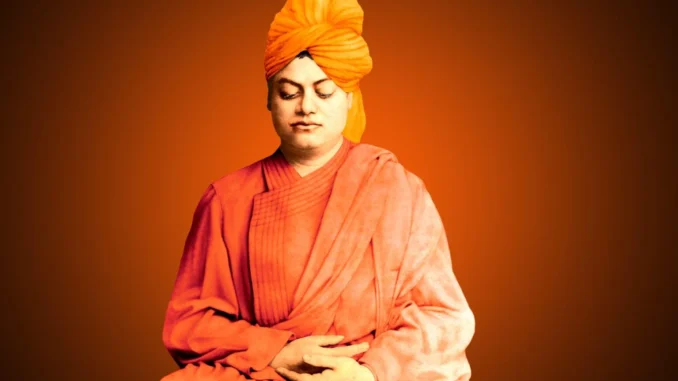
Swami Vivekananda, born Narendranath Datta, was an Indian Hindu monk, philosopher, author, orator, and social reformer whose 39 years on earth produced an intellectual and spiritual legacy that continues to shape the contours of Indian thought, national identity, and global religious dialogue more than 120 years after his death.
A direct disciple of the revered mystic Ramakrishna Paramahamsa, Vivekananda is best known in the West for his landmark address to the Parliament of the World’s Religions in Chicago on September 11, 1893, a speech that opened with the words “Sisters and Brothers of America” and was met with a standing ovation lasting several minutes.
The founder of the Ramakrishna Mission and Ramakrishna Math, he synthesised the ancient teachings of Vedanta and Yoga into a vision of active, compassionate, world-engaged spirituality that rejected both the passivity of quietist religion and the materialism of Western modernity.
| Narendranath Datta | |
|---|---|
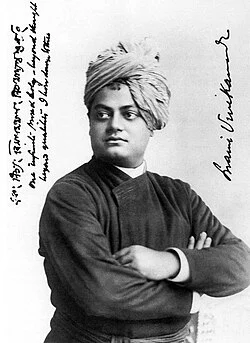 Narendranath Datta: History · Bio · Photo
|
|
| Wiki Facts & About Data | |
| Full Name: | Narendranath Datta |
| Born: | January 12, 1863 |
| Age: | (aged 39) |
| Death: | July 4, 1902 (aged 39) |
| Birthplace: | Calcutta, Bengal Presidency, British India (now Kolkata, West Bengal) |
| Nationality: | Indian (British subject) |
| Religion: | Hinduism (Advaita Vedanta) |
| Parents: | Vishwanath Datta (father, attorney); Bhuvaneswari Devi (mother) |
| Siblings: | 8 siblings |
Early Life
Narendranath Datta was born on January 12, 1863, in Calcutta, the cultural and intellectual capital of British India, into a well-established Bengali family.
His father, Vishwanath Datta, was an attorney at the Calcutta High Court, rational in outlook and Western in education, who instilled in Narendra a respect for rigorous thinking. His mother, Bhuvaneswari Devi, was a deeply religious woman whose devotion to Lord Shiva and her mastery of Hindu epics nurtured the spiritual sensitivity of her son. He was one of nine children.
From childhood, Narendra displayed an extraordinary combination of physical vitality, intellectual curiosity, and spiritual intensity, meditating from a young age, questioning religious claims rather than accepting them, and displaying the leadership qualities that would later define his public presence.
Education
Narendranath received his early education at home and then attended Ishwar Chandra Vidyasagar’s Metropolitan Institution in Calcutta.
He subsequently enrolled at the Presidency College, Calcutta, before transferring to the General Assembly’s Institution (now Scottish Church College), where he studied Western philosophy, history, and social science.
He earned his Bachelor of Arts degree from the University of Calcutta, one of the oldest and most prestigious universities in Asia.
He was a voracious reader across disciplines, engaging deeply with texts by David Hume, John Stuart Mill, Auguste Comte, Charles Darwin, and Herbert Spencer alongside the Hindu scriptures and the Bhagavad Gita.
Career and Spiritual Journey
Meeting Ramakrishna (1881–1886)
In 1881, at approximately 18 years of age, Narendranath visited the mystic Ramakrishna Paramahamsa at the Dakshineswar Kali Temple, initially approaching him with sceptical questions about the existence of God.
Ramakrishna’s immediate recognition of Narendranath as a spiritually exceptional soul, and his ability to give the young man direct experiences of transcendent states through touch, transformed a sceptic into a devoted disciple.
For the next five years, until Ramakrishna’s death from throat cancer in August 1886, Narendranath was his closest and most beloved disciple. Ramakrishna is reported to have said that Narendra was “a sage of yore who was born on earth to remove the misery of humanity.”
Wandering Monk and the Road to Chicago (1887–1893)
After Ramakrishna’s death, Narendranath took monastic vows and became Swami Vivekananda. He spent the next several years as a wandering monk, travelling the length and breadth of India on foot and by train, witnessing the poverty and suffering of India’s masses, experiences that radicalised his understanding of spirituality as inseparable from social service.
Observing the condition of the poor, he formulated what became his famous equation: service to human beings is service to God, “Daridra Narayana” (God in the guise of the poor).
In 1893, he adopted the name “Vivekananda” at the request of Maharaja Ajit Singh of Khetri State, and travelled to Chicago to attend the Parliament of the World’s Religions.
The Chicago Address and American Tour (1893–1895)
On September 11, 1893, Swami Vivekananda addressed the Parliament of the World’s Religions at the Art Institute of Chicago. His opening words, “Sisters and Brothers of America”, were greeted with a standing ovation of several minutes.
He spoke about the universal acceptance and tolerance that Hinduism represented, arguing for a religion that was not exclusive but inclusive of all paths to truth. The address created a sensation in the American press and made him an overnight celebrity.
He subsequently toured the United States and Europe extensively over the next three years, delivering lectures at Harvard, Columbia, and major cities across the eastern seaboard, establishing Vedanta societies, and engaging in philosophical debates with Western scholars and theologians.
Return to India, Ramakrishna Mission, and Final Years (1897–1902)
Vivekananda returned to India in January 1897, welcomed as a national hero. He founded the Ramakrishna Mission on May 1, 1897, at Belur Math on the banks of the Hooghly River near Calcutta, an institution dedicated simultaneously to the monastic pursuit of spiritual realisation and the active service of the poor through education, healthcare, and disaster relief.
He undertook a second tour of the West from 1899 to 1900, continuing to establish Vedanta societies and deliver lectures. His health, never robust and severely strained by his years of wandering and tireless lecturing, deteriorated rapidly from 1900 onward. He died on July 4, 1902, at Belur Math, aged 39, while in a state of deep meditation.
He had predicted his own death and told his disciples he would not live to be 40. The Government of India declared his birth anniversary, January 12, as National Youth Day in 1984.
Awards and Honours
- 1893 — Standing ovation and international acclaim, Parliament of the World’s Religions, Chicago
- 1984 — Birth anniversary declared National Youth Day by the Government of India
- Legacy: Belur Math, Ramakrishna Mission hospitals, schools, and relief organisations continue his mission globally
Personal Life
Swami Vivekananda took formal monastic vows following the death of his guru Ramakrishna, renouncing all worldly relationships and remaining celibate throughout his life. His personal relationships were those of a monk with his brother disciples and his students.
He was known for his physical strength and vitality in youth, his extraordinary personal magnetism, his biting wit, and his deep compassion for the suffering of others. He suffered from multiple health conditions including kidney disease and asthma in his later years.
Major Works
- Raja Yoga (1896)
- Karma Yoga (1896)
- Jnana Yoga
- Bhakti Yoga
- Lectures from Colombo to Almora (1897)
- My Master (1901)
- Complete Works of Swami Vivekananda (9 volumes, published posthumously)
Conclusion
Swami Vivekananda’s life was compressed into 39 years but its impact has been incalculable.
He introduced the world to the philosophical riches of Vedanta; he inspired India’s freedom movement by restoring national pride and self-belief; he built an institution, the Ramakrishna Mission, that has served millions of India’s poor across 125 years; and he gave humanity the message that the divine is not confined to any single tradition.
Subhas Chandra Bose said that Vivekananda “harmonised the East and the West, religion and science, past and present.” That harmony remains his most enduring gift to the world.
Related People




Leave a Reply