
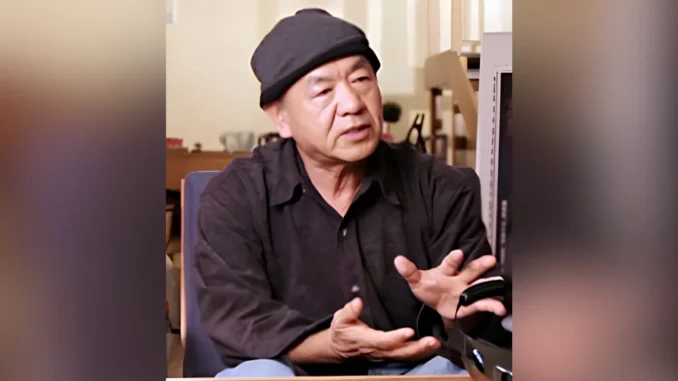
Kazuo Ebisawa was one of the most extraordinary and enduring figures in the history of Japanese animation. An art director and background artist whose career spanned more than five and a half decades, from the very dawn of Japanese television animation in 1969 to the most acclaimed anime films of the 21st century, he worked on some of the most iconic and culturally significant animated productions ever made, including Nausicaä of the Valley of the Wind, Akira, Kiki’s Delivery Service, Demon Slayer: Kimetsu no Yaiba, and the entire Fate franchise at ufotable.
In an industry that had long since migrated to digital tools and computer-generated backgrounds, Kazuo Ebisawa remained one of the last great practitioners of traditional hand-painted background art, refusing to abandon paper, brushes, and poster colour even as the world around him changed entirely. His insistence on this craft was not stubbornness; it was the foundation upon which ufotable’s celebrated visual identity was built. When the studio’s representative director Hikaru Kondo explained why ufotable’s productions are so visually distinctive, he pointed directly to Ebisawa’s hand-drawn work as the irreplaceable beating heart of that aesthetic.
On 14 April 2026, Kazuo Ebisawa passed away at the age of 72 or 73, with the news announced by ufotable on 30 April 2026. The announcement was met with an extraordinary outpouring of grief and reverence from the global anime community, and a recognition that Japanese animation had lost one of its last irreplaceable living links to its own golden past. This is his complete biography, a tribute to a life lived entirely in service of art.
| Kazuo Ebisawa (海老澤 一男) | |
|---|---|
 Kazuo Ebisawa (海老澤 一男): History · Bio · Photo
|
|
| Wiki Facts & About Data | |
| Full Name: | Kazuo Ebisawa (海老澤 一男) |
| Born: | 1953 |
| Death: | 14 April 2026, aged 72 |
| Nationality: | Japanese |
| Occupation: | Anime Art Director, Background Artist, Animation Art Department Professional |
Early Life
Kazuo Ebisawa was born in Japan in 1953, a Japan still rebuilding from the devastation of World War II, and one that was on the cusp of a cultural renaissance that would produce some of the 20th century’s most distinctive and globally influential art forms. The details of his early family life, hometown, parents, and education have never been made public. Like many of his generation of craftsmen in the Japanese animation industry, Ebisawa let his work speak for itself, maintaining a deep and consistent privacy about his personal life throughout his long career.
What is known is that from an early age, he gravitated toward visual art, and specifically toward the painstaking, detail-rich world of background painting, the practice of creating the richly detailed landscapes, interior spaces, natural environments, and cityscapes against which animated characters move and breathe. In Japan’s early animation industry, this was largely a manual craft: artists working with gouache, poster colour, and brush on paper, creating handmade scenes of extraordinary beauty that would appear on screen for only a few fleeting seconds.
Ebisawa entered this world as a teenager, and never left it, spending his entire professional life in service of the animated image, across more than half a century of Japanese animation history. He was still contributing to productions at ufotable at the time of his death in April 2026.
Career
Entry Into the Industry: Himitsu no Akko-chan (1969)
Kazuo Ebisawa began his animation career in 1969, joining the art team for the first episode of the television series Himitsu no Akko-chan, a foundational magical girl anime based on a manga by Fujio Akatsuka, produced by Toei Animation. The fact that his career began in 1969 places him among a generation of craftsmen who were present at the very origins of the Japanese television animation industry, which had launched only a few years earlier with Osamu Tezuka’s Astro Boy in 1963. This entry point into animation, as a teenage background artist contributing to one of television’s early Toei productions, would set the trajectory for the next five and a half decades of his life.
In the 1970s, Ebisawa worked as a freelance background artist contributing to a wide range of productions across Japan’s leading studios, including Toei Animation and Tokyo Movie. His credits from this period include background art contributions to iconic titles such as UFO Robo Grendizer, Arcadia of My Youth, Lupin the Third: The Mystery of Mamo, and Animal Treasure Island, works that represent some of the most beloved and historically significant anime of the decade.
First Art Direction Credit: Cyborg 009 (1980)
In 1980, Kazuo Ebisawa took on his first credited role as an art director, a significant step up from background artist, on the theatrical film Cyborg 009: Legend of the Super Galaxy. Art direction in anime encompasses responsibility not just for individual background paintings but for the entire visual world of a production: the colour palette, the architectural and environmental design language, the atmospheric quality of light and shadow, and the overall sense of place and mood that immersive animation requires. Taking on this role on a theatrical feature in 1980 marked his emergence as one of the discipline’s rising voices.
The Golden Age of Studio Ghibli and the 1980s
The 1980s were the decade in which Ebisawa’s reputation was cemented through his association with some of the most celebrated films in animation history. He contributed background art to Nausicaä of the Valley of the Wind (1984), the Hayao Miyazaki film that launched Studio Ghibli’s founding ethos and established Miyazaki as one of the world’s preeminent animation directors. He also contributed to Macross: Do You Remember Love? (1984), the landmark theatrical adaptation of the Super Dimension Fortress Macross television series, widely regarded as one of the finest examples of theatrical anime production of that era.
In 1986, his work appeared in The Transformers: The Movie, the American theatrical film based on the Hasbro toy line, which was notably co-produced with Japanese animation studios and whose backgrounds bore the distinctive quality of Japan’s finest craftsmen of the period.
His most personally significant contribution during this decade came in 1988, when he served as a key contributor to Akira, the groundbreaking cyberpunk theatrical film directed by Katsuhiro Otomo that is widely considered among the most technically ambitious and artistically influential animated films ever produced. Akira’s nighttime Neo-Tokyo cityscape, rain-slicked streets, neon-lit buildings, dark highways stretching across a futuristic urban hellscape, remains one of the most iconic visual achievements in animation history, and Ebisawa’s background work was integral to that achievement. His credits for Akira were acknowledged in international coverage of his death.
The following year, in 1989, he contributed background art to Kiki’s Delivery Service, the beloved Studio Ghibli film directed by Hayao Miyazaki, in which a young witch navigates a European-inspired seaside city on her broomstick. The film’s warm, sunlit townscapes and atmospheric coastal vistas are among its most enduring visual qualities, and Ebisawa’s hand was part of what made them so memorable.
The 1990s: Broad Contributions Across the Industry
The 1990s saw Ebisawa continue his prolific output across a wide range of productions. He served as art director on several OVAs and television series, and contributed background art to theatrical features including Lupin III: Farewell to Nostradamus, Magnetic Rose (the celebrated short film from the Memories anthology, directed by Satoshi Kon), Yu Yu Hakusho the Movie: Poltergeist Report, and X (the theatrical film adaptation of the CLAMP manga, directed by Rintaro). His 1990s output demonstrates the breadth of his work across genres and production styles, from action to psychological thriller to literary adaptation.
He also contributed background art to Little Nemo: Adventures in Slumberland, the ambitious US-Japan co-production adapting the beloved Winsor McCay comic strip, a film whose production difficulties were legendary within the industry but whose background art, contributed by some of Japan’s finest craftsmen, was universally praised.
Joining ufotable: From 2000 Onward
Around 2000, Kazuo Ebisawa joined ufotable, the Tokushima-based animation studio founded in 2000 by Hikaru Kondo, which would go on to become one of the most technically acclaimed and commercially successful animation studios in the world. His arrival at ufotable, as a veteran craftsman with over three decades of industry experience, was a defining moment in the studio’s artistic development. The Sakuga Blog, one of the most authoritative resources on Japanese animation production, noted that Ebisawa, by that point already carrying 51 years of industry history, “joined soon after [the studio’s founding], widening the studio’s repertoire some more” and described him as a “living legend of anime art direction.”
At ufotable, Ebisawa found a creative home that shared and celebrated his commitment to hand-drawn craftsmanship. While the broader industry was accelerating toward digital tools, ufotable, under Kondo’s direction, deliberately maintained a space for traditional techniques, and Ebisawa became the embodiment and guardian of that tradition within the studio. His background art became one of the defining visual characteristics of ufotable’s productions, setting them apart from the rest of the industry.
The Garden of Sinners, Return to Art Direction (2007–2013)
In 2008, Ebisawa returned to the art director role after a period as a background artist, taking on the majority of the hand-drawn background scenes for The Garden of Sinners: Chapter 4 – Garan no Dou. The Garden of Sinners (Kara no Kyoukai) is a series of eight theatrical films produced by ufotable between 2007 and 2013, based on Kinoko Nasu’s Type-Moon light novel series. The films are celebrated for their atmospheric, often eerily beautiful visual design, rain-soaked apartment towers, moonlit Japanese architecture, neon-lit urban corridors, and Ebisawa’s hand-drawn backgrounds are central to that atmosphere. He continued contributing to the series through its full run of eight films.
Fate/Zero and the Fate Franchise
Ebisawa played a key role in establishing the visual world of ufotable’s celebrated adaptation of Fate/Zero (2011–2012), the critically acclaimed television anime series written by Gen Urobuchi. His background art for the grim, rain-drenched urban environment of Fuyuki City, where the Fourth Holy Grail War is waged, brought a sombre, cinematic weight to the production that became one of its most praised visual qualities. He continued his work through Fate/stay night: Unlimited Blade Works (2014–2015), the television series adaptation of the second route of the iconic visual novel, and through all three films of the Fate/stay night: Heaven’s Feel trilogy (2017, 2019, 2020). His contributions to the Fate franchise at ufotable represent some of the most spectacular background art ever produced in television and theatrical animation.
Demon Slayer: Kimetsu no Yaiba, The Wisteria Scene That Shook the World (2019–2026)
The production that brought Kazuo Ebisawa to the attention of the widest possible global audience was Demon Slayer: Kimetsu no Yaiba, the runaway global phenomenon that became the highest-grossing anime film of all time with its 2020 theatrical film Mugen Train. Ebisawa contributed background art to the Demon Slayer television series from its debut in 2019. His most discussed contribution came in the fourth episode, “Final Selection,” in which the protagonist Tanjiro Kamado undergoes a life-or-death survival trial on a mountain whose wisterias are in full bloom, the flowers being poisonous to demons. The mountain forest background, with its cascading wisteria blossoms rendered in breathtaking hand-drawn detail, provoked widespread astonishment and online discussion when the episode aired, with viewers and animation industry professionals alike marveling at the level of tactile beauty achieved through purely traditional means. The mastermind behind those wisteria backgrounds was identified as Kazuo Ebisawa, and the scene became a defining illustration of what hand-painted background art could achieve that digital techniques could not replicate.
He continued contributing to Demon Slayer through its multiple seasons, theatrical films, and was still working on the anticipated Demon Slayer: Infinity Castle Arc theatrical film trilogy at the time of his death in April 2026. It is among the last great acts of his professional life, ensuring that Demon Slayer’s visual legacy would carry, in its most ambitious chapter yet, the warmth and texture of a 57-year career’s worth of mastery.
Television Art Direction Debut: Today’s Menu for the Emiya Family (2018)
In 2018, at the remarkable age of 65, Ebisawa took on the role of art director for a television series for the first time in his career, Today’s Menu for the Emiya Family (Emiya-san Chi no Kyou no Gohan), a charming slice-of-life ONA series set in the Fate universe, produced by ufotable. The production, a warm and gentle contrast to the epic scale of the Fate films, showcased his ability to bring the same quality of craft to domestic, intimate visual settings, kitchens, gardens, sunlit dining rooms, as he brought to fantastical and darkly dramatic ones. He served as art director for all 13 episodes of the first season.
The Philosophy of the Hand: Traditional Craft in a Digital Age
Perhaps the most remarkable aspect of Kazuo Ebisawa’s career in its final decades was his absolute refusal to transition to digital tools. While virtually the entire animation industry, in Japan and globally, had migrated to digital software for background production, Ebisawa continued to work exclusively with paper, brushes, and poster colour. Every background he produced was a physical, hand-painted artefact, created through the same techniques he had learned and perfected over more than fifty years.
ufotable representative director Hikaru Kondo has stated publicly that the studio’s famous visual style, the interplay of realistic detail with fantastical warmth and texture, the quality of light on stone and water and foliage, is built upon the foundation of Ebisawa’s hand-drawn work. Under his brush, as one account described it: “whether it’s the light reflections on modern city streets or the otherworldly scenes of a magical realm, everything possesses a unique warmth and texture” that digital production cannot replicate. His work was not merely a contribution to ufotable’s visual identity, it was, in a profound sense, its soul.
Death, 14 April 2026
Kazuo Ebisawa passed away on 14 April 2026, at the age of 72. ufotable announced his death on its official website on 30 April 2026. A private funeral was held on 20 April 2026, conducted by ufotable. In the official announcement, ufotable representative director Hikaru Kondo stated: “The funeral was held successfully by our company on April 20. Due to various circumstances, we respectfully decline any incense money, floral tributes, or condolence visits.” The cause of death was not publicly disclosed.
The announcement was met with an immediate and profound outpouring of grief from the global anime community, from animators and directors within Japan’s industry, to international fans who recognized Ebisawa’s work as fundamental to productions that had shaped their relationship with animation. Social media tributes described him as a “living legend,” a “guardian of hand-drawn art,” and “the man who painted the soul of ufotable.”
Awards & Recognition
- Described by the Sakuga Blog, the most authoritative English-language resource on Japanese animation production, as a “living legend of anime art direction” with 51 years in the industry, even before his death
- Recognized by ufotable representative director Hikaru Kondo as the foundational reason ufotable’s visual aesthetic is so distinctive, crediting Ebisawa’s hand-drawn backgrounds as the core of the studio’s identity
- His wisteria background in Demon Slayer Episode 4 (2019) became one of the most discussed and celebrated individual background art sequences in modern anime history, sparking global conversations about the value of traditional hand-painted techniques
- Contributed to multiple productions that are considered watershed moments in global animation history: Nausicaä (1984), Akira (1988), Kiki’s Delivery Service (1989), Demon Slayer (2019–2026)
- His career of 57 years in active professional animation, from 1969 to 2026, is one of the longest in the history of the medium
- His final contributions, to the Demon Slayer: Infinity Castle Arc theatrical films, ensure that his legacy will live on in what is expected to be one of the most commercially and artistically significant anime releases of the decade
Personal Life
Kazuo Ebisawa maintained a deeply private personal life throughout his five and a half decades of professional work. His family background, marital status, children, and personal relationships were never disclosed to the public, and this biography respects that privacy. What is known, and what constitutes, in a meaningful sense, his truest personal story, is the biography of his craft: a man who chose, day after day, decade after decade, to sit with paper and brush and poster colour, and to build worlds by hand that could move, entertain, inspire, and astonish audiences around the world.
Those who worked with him at ufotable describe a craftsman of extraordinary dedication and meticulous precision, a man who understood that the soul of a scene lives not in its characters but in the world those characters inhabit, and who devoted his life to building those worlds with the most human of tools: a paintbrush, a sheet of paper, and a lifetime of practice. He is survived by his art, which lives on in every frame of every production he touched.
Filmography / Complete Works
Background Art
- Himitsu no Akko-chan (TV, 1969), Background Art (debut)
- Mahou Tsukai Chappy (TV, 1970s), Background Art
- UFO Robo Grendizer (TV, 1975–77), Background Art
- Animal Treasure Island (movie), Background Art
- Arcadia of My Youth (movie, 1982), Assistant Art Director / Background Art
- Lupin the Third: The Mystery of Mamo (movie, 1978), Background Art
- Nausicaä of the Valley of the Wind (movie, 1984), Background Art
- Macross: Do You Remember Love? (movie, 1984), Background Art
- The Transformers: The Movie (US movie, 1986), Background Painter
- Akira (movie, 1988), Background Art / Art
- Kiki’s Delivery Service (movie, 1989), Background Art (Studio Ghibli)
- Tokyo Babylon (OAV, 1992–1994), Background Art
- Magnetic Rose (movie short, 1995), Background Art
- Lupin III: Farewell to Nostradamus (movie, 1995), Background Art
- Lupin the Third: The Hemingway Papers (special), Background Art
- Yu Yu Hakusho The Movie: Poltergeist Report (movie, 1994), Background Art
- X (movie, 1996), Background Art
- Little Nemo: Adventures in Slumberland (movie), Background Art
- Mind Game (movie, 2004), Background Art
- Black Rock Shooter (OAV, 2012), Background Art
- Patlabor WXIII (movie 3), Art Cooperation (Studio Biho)
- Mai Mai Miracle (movie), Background Art
- Allison & Lillia (TV, 2008), Background Art (eps 14–26)
Art Director Credits
- Cyborg 009: Legend of the Super Galaxy (movie, 1980), Art Director (debut as AD)
- Lightspeed Electroid Albegas (TV, 1983–84), Art Director (eps 14–45)
- Aladdin and the Wonderful Lamp (movie), Assistant Art Director
- Minori Scramble! (OAV), Art Director
- Master of Mosquiton (OAV), Art Director, Background Art
- Toriko (special), Art Director
- Yamato Takeru: After War (OAV), Art Director
- The Garden of Sinners (Kara no Kyoukai) (movie series, 2007–2013), Art Director, Background Art (ufotable)
- GYO: Tokyo Fish Attack (OAV, 2012), Art Director (ufotable)
- Fate/Zero (TV, 2011–2012), Art Director (ufotable)
- Fate/stay night: Unlimited Blade Works (TV, 2014–2015), Art Director (ufotable)
- God Eater (TV, 2015–2016), Art Director (ufotable)
- Tales of Zestiria the X (TV, 2016–2017), Art Director (ufotable)
- Fate/stay night: Heaven’s Feel I. presage flower (movie, 2017), Art Director (ufotable)
- Demon Slayer: Kimetsu no Yaiba (TV series, 2019–2024), Art Director / Background Art (ufotable)
- Today’s Menu for the Emiya Family (ONA, 2018), Art Director, Background Art (ufotable; all 13 eps)
- Fate/stay night: Heaven’s Feel II. lost butterfly (movie, 2019), Art Director (ufotable)
- Fate/stay night: Heaven’s Feel III. spring song (movie, 2020), Art Director (ufotable)
- Demon Slayer: Kimetsu no Yaiba – The Movie: Mugen Train (2020), Background Art (ufotable)
- Demon Slayer: Infinity Castle Arc (theatrical films, upcoming), Background Art (ufotable; final contribution)
- Magical Sisters Yoyo & Nene (movie), Background Art (ufotable)
FAQs
Who was Kazuo Ebisawa?
Kazuo Ebisawa was a legendary Japanese anime art director and background artist whose career spanned 57 years, from 1969 to 2026. He is best known for his work at ufotable on the Demon Slayer, Fate, and Garden of Sinners series, and for earlier contributions to Nausicaä of the Valley of the Wind, Akira, and Kiki’s Delivery Service.
When did Kazuo Ebisawa die?
Kazuo Ebisawa died on 14 April 2026, at the age of 72. ufotable announced his passing on 30 April 2026. A private funeral was held on 20 April 2026.
How old was Kazuo Ebisawa when he died?
He was 72 years old at the time of his death. He was born in 1953.
What was Kazuo Ebisawa famous for?
He was famous for his extraordinary hand-painted background art, his refusal to use digital tools in an industry that had long since moved on, and for the distinctive warmth and texture his work brought to ufotable’s visual identity. He was also celebrated for specific works including the wisteria background in Demon Slayer Episode 4 and his contributions to Akira and Kiki’s Delivery Service.
What studios did Kazuo Ebisawa work for?
Early in his career he worked freelance for Toei Animation, Tokyo Movie, and various other Japanese studios. From around 2000 until his death in 2026, he was associated with ufotable, the studio behind Demon Slayer, the Fate series, and The Garden of Sinners.
What was Kazuo Ebisawa’s most famous work?
His most globally recognized works include his background art contributions to Akira (1988), Nausicaä of the Valley of the Wind (1984), and Kiki’s Delivery Service (1989), and his extensive art direction at ufotable, particularly on Demon Slayer: Kimetsu no Yaiba, the Fate franchise, and The Garden of Sinners.
Why did Kazuo Ebisawa use traditional techniques?
Ebisawa could not and would not switch to digital tools, insisting on completing every background with paper, brushes, and poster colour, even as the entire industry migrated to digital. ufotable’s director Hikaru Kondo has credited this insistence as the reason for the studio’s distinctive, warmly textured visual style that sets it apart from its digital-first competitors.
What was Kazuo Ebisawa’s last work?
His final contribution was to the Demon Slayer: Infinity Castle Arc theatrical film trilogy, ufotable’s highly anticipated adaptation of the manga’s final arc, on which he was still working at the time of his death in April 2026.
When did Kazuo Ebisawa start his career?
He began his career in 1969, contributing background art to the first episode of Himitsu no Akko-chan (Toei Animation), placing him among the very first generation of professionals in Japanese television animation.
Conclusion
Kazuo Ebisawa’s life was, in the most complete and rare sense, a life given entirely to craft. He did not seek celebrity, did not seek recognition beyond his work, and did not adapt to the times when the times demanded he abandon the brush for the screen. He simply painted, for 57 years, across hundreds of productions, for generations of directors and studios, building the worlds in which beloved characters lived and breathed and fought and loved and died.
The wisteria mountain in Demon Slayer. The rain-slicked streets of Neo-Tokyo in Akira. The sunlit harbour town of Koriko in Kiki’s Delivery Service. The otherworldly darkness of Fuyuki City in Fate/Zero. The eerie apartment towers of The Garden of Sinners. These are not merely backgrounds. They are environments crafted with such care and precision that they become characters in themselves, frames of feeling that audiences carry with them long after the credits roll. They are Kazuo Ebisawa’s gift to Japanese animation, and through Japanese animation, to the world.
He leaves behind a body of work that spans the entire history of Japanese animation as a modern art form, from its television origins in 1969 to its current global cultural dominance. He leaves behind a studio, ufotable, whose visual identity he helped define and whose most acclaimed productions bear the indelible mark of his hand. And he leaves behind, in the Demon Slayer: Infinity Castle Arc films still to come, a final testament to what a lifetime of devotion to a craft can look like.
Rest in peace, Kazuo Ebisawa, 1953 to 14 April 2026. Thank you for every brushstroke.
Related People









Leave a Reply