
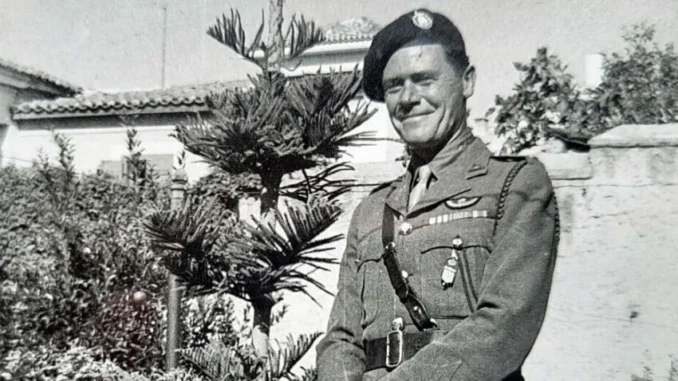
Major Philip Humphrey Peter Weaver known throughout his life simply as Peter was one of the most remarkable and quietly celebrated British special operations soldiers of the Second World War.
A multi-sport athlete, boxing promoter, and entrepreneur before the war transformed him into an elite covert operative, Weaver served in Churchill’s top-secret Auxiliary Units, parachuted behind Nazi enemy lines into occupied France in 1944 on the infamous Operation Bulbasket, miraculously escaped a German massacre that killed 31 of his comrades, continued sabotage operations in France, helped liberate the Bergen-Belsen concentration camp in April 1945, and landed in Norway to disarm German forces after VE Day before quietly returning to civilian life in Dorset and speaking almost nothing of his experiences for the rest of his life.
Born in British India in 1912 and died in Dorset in 1991, his extraordinary story is now finally receiving the recognition it deserves: SAS Rogue: The Clandestine Life of Peter Weaver — a book compiled from his personal diaries by his daughter Joanna Weaver and historian Will Ward was published on May 9, 2026, and his story is set to feature in the BBC’s hotly anticipated SAS Rogue Heroes Season 3.
| Philip Humphrey Peter Weaver | |
|---|---|
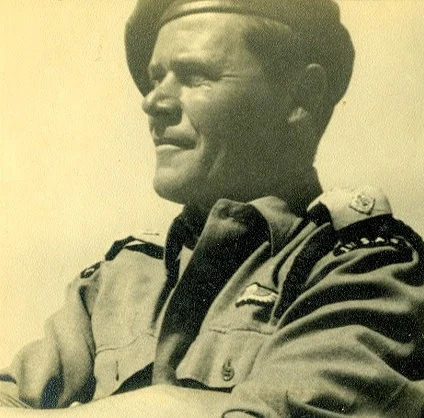 Philip Humphrey Peter Weaver: History · Bio · Photo
|
|
| Wiki Facts & About Data | |
| Full Name: | Philip Humphrey Peter Weaver |
| Stage Name: | Peter Weaver; Major Peter Weaver |
| Born: | March 12, 1912 |
| Age: | 114 years old |
| Death: | June 28, 1991, Poole, Dorset, England |
| Birthplace: | Kalimpong, West Bengal, British India |
| Nationality: | British |
| Parents: | Captain Humphrey Weaver, Indian Army — killed in action February 7, 1916, in Mesopotamia |
| Children: | Four daughters, including Joanna Burri-Weaver (who lives near Swanage, Dorset) |
Early Life
Philip Humphrey Peter Weaver was born on March 12, 1912, in Kalimpong a hill station in West Bengal, British India, situated in the foothills of the Himalayas and historically associated with the British Indian Army officer class. His birth in India reflected the imperial life of his father, Captain Humphrey Weaver of the Indian Army, who served the British Empire in the subcontinent.
Peter’s childhood was shadowed by one of the earliest and most formative tragedies of his life: his father was killed in action on February 7, 1916, serving in the Mesopotamia campaign one of the most gruelling and costly theatres of the First World War leaving Peter fatherless at the age of just four.
This early loss of a soldier father to war’s violence would take on a deeply personal resonance decades later, when Peter himself parachuted into occupied enemy territory facing the very real possibility of not returning. His daughter Joanna has reflected that she believes her father’s strict upbringing shaped partly by the absence of his father “stayed with him” throughout his life.
Following his father’s death, Peter returned to England. He is described as having had a degree of dyslexia, which created difficulties with the entrance examinations for several more prestigious schools. He was educated at King’s School, Bruton an independent school in Somerset where, despite his academic challenges, he excelled physically and athletically.
He became known as an outstanding sportsman: he played hockey at England-representative level as a Hampshire cricketer in 1938 and became a boxing promoter a diversity of sporting and competitive achievement that painted the picture of a physically vigorous, competitive young man with the natural endurance and resilience that special operations would later demand.
After school, Weaver worked for Robinsons of Bristol, a paper manufacturer. He attempted an early army career, starting in the Tank Corps in 1933 for a year having been promised a place at Sandhurst only to be told he was a month too old to be eligible upon completing his service.
He bought himself out and returned to civilian life, running a cigarette and sweet shop in Bournemouth, followed by dry-cleaning and fruit-machine businesses. By 1937 he had joined the Royal Engineers as a territorial (part-time) soldier.
He had also developed, during his teenage years spent in school holidays exploring the Purbeck hills of Dorset on his bicycle, an extraordinarily detailed personal knowledge of the caves, beaches, hills, and terrain of the Purbeck peninsula knowledge that would prove directly relevant to his wartime role.
Education
Peter Weaver attended King’s School, Bruton in Somerset for his secondary education an independent school founded in 1519, one of England’s oldest.
Despite reported challenges with dyslexia that limited his access to more academically competitive schools, King’s School provided him with an education grounded in physical excellence, character development, and the values of the English gentleman-soldier tradition.
His practical intelligence, physical gifts, and intimate knowledge of landscape would prove far more operationally valuable to the SAS than any academic qualification could have been. He did not pursue formal university education, choosing instead to enter the world of commerce and territorial military service in his twenties.
Military Career
Royal Engineers (Territorial) and Commissioning (1937–1941)
In 1937, Weaver joined the Royal Engineers as a territorial soldier part of the part-time reserve force that trained alongside civilian life.
He attended a 162 Officer Cadet Training Unit and was commissioned as a Second Lieutenant in the Dorset Regiment in April 1941, as the Second World War was fully underway and the British Army was massively expanding its officer corps.
His commission brought him into a regiment with deep roots in the Dorset landscape he knew intimately, and his posting would capitalise on exactly that knowledge.
Auxiliary Units Churchill’s Secret Army (1941–1943)
Upon his commissioning in April 1941, Lieutenant Peter Weaver was posted to a role that was not merely militarily sensitive but was one of the most secret operations in British wartime history: the Auxiliary Units a clandestine network established by Winston Churchill and the War Office in 1940, commonly known as “Churchill’s Secret Army.”
The Auxiliary Units were organised to serve as a stay-behind resistance force in the event of a German invasion of Britain a network of specially trained saboteurs and guerrilla fighters who would operate from concealed underground bunkers, attacking German supply lines and communications behind the front lines while the regular army was overwhelmed.
Weaver was posted as the officer in command of the West Dorset Scout Section of Auxiliary Units a section drawn from the Dorset Regiment.
His role was to train Home Guard Patrols across the Purbeck peninsula and West Dorset in covert skills: silent killing, demolitions, sabotage of infrastructure, map reading, and survival in hostile terrain. His unparalleled personal knowledge of the Purbeck hills the caves, the paths, the hidden beaches, the landscape he had explored obsessively on his bicycle as a schoolboy made him uniquely qualified for selecting hidden bunker locations and designing patrol routes. Lieutenant Weaver quickly became a familiar and well-respected figure across the Purbeck patrol network, known to the men he trained as a demanding but inspiring officer.
In August 1943, he was promoted and took over as Intelligence Officer for all Auxiliary Units in Dorset succeeding Major Darwell-Smith giving him oversight of the entire county’s clandestine resistance infrastructure.
He held this role as the Auxiliary Units were wound down in late 1943, their purpose rendered less urgent by the improving fortunes of the war and the growing inevitability of an Allied offensive rather than a defensive struggle in Britain. It was at this precise moment that the SAS came looking.
Recruitment into the SAS and the Curzon Cinema Meeting
The story of how Peter Weaver came to join the SAS is one of the more evocative recruitment episodes in British military history.
The Special Air Service, returning from its celebrated successes in the North African desert campaign under the leadership of David Stirling and Paddy Mayne, was expanding rapidly in preparation for the invasion of occupied Europe. Intelligence about the Auxiliary Units trained in precisely the kind of behind-the-lines sabotage, silent killing, and covert operations the SAS needed reached the regiment’s leadership through informal channels.
In one now-famous recruitment meeting at London’s Curzon Cinema, volunteers were told bluntly that the missions ahead would be extremely dangerous, with little chance of survival. The lights were even turned off to allow anyone unwilling to continue to slip away unnoticed.
The briefing was delivered by Paddy Mayne himself the SAS’s legendarily fearsome second-in-command, a former Irish rugby international and one of the most decorated officers in the British Army. Despite the extraordinary frankness about the near-certainty of death, almost the whole West Dorset Scout Section signed up for the SAS.
Weaver, along with most of his West Dorset comrades, joined 1 SAS (B Squadron), transferred in late 1943. He would go on to serve with the regiment from 1943 to 1945, participating in some of the most dramatic and dangerous special operations of the entire war.
Operation Bulbasket France, 1944
The defining mission of Peter Weaver’s wartime career and the one that came closest to ending his life was Operation Bulbasket: a clandestine SAS sabotage operation in Nazi-occupied France, carried out in the weeks following the D-Day landings of June 6, 1944.
Operation Bulbasket was mounted by B Squadron, 1st SAS Regiment, whose men parachuted into the Vienne region of central France into the forest of Verrières near Poitiers with a clear and strategically vital mission.
Their mission was to sabotage German supply lines from Bordeaux to the beaches of Normandy, to hinder German attempts to reverse the progress of the Allies in the weeks after D-Day. Their main aim was to delay the feared 2nd SS Panzer Division from heading to Normandy to repel Allied forces who had just gained a foothold in Europe.
To carry out the operation, the men were to destroy supply dumps, block the Paris to Bordeaux railway line, and attack railway sidings and fuel trains, which they did with great early success, working with the French Resistance.
For several weeks, Operation Bulbasket proceeded with remarkable effectiveness. The SAS saboteurs, working alongside the French Maquis resistance fighters, disrupted German logistics across the region, and their successes drew additional Allied support including the construction of a grass airstrip code-named “Bonbon” that allowed two RAF Hudson aircraft to land and deliver replacements on the night of August 7, 1944.
Then, on July 3, 1944, disaster struck. German forces, acting on intelligence that suggested the SAS camp had been betrayed most likely by an informer within the local French population surrounded the forest at Verrières where the SAS men were camped. Only eight of them escaped. Thirty-four were captured. Thirty-one were killed three days later. Murdered. The captured men were executed by the Germans a war crime that violated every convention on the treatment of prisoners of war. Their bodies were buried in mass graves. It was not until after the liberation that hunters discovered the graves; post-war autopsies confirmed the violent manner of their deaths, and the men were eventually re-interred at Rom Communal Cemetery in France, where they are commemorated to this day.
Lieutenant Peter Weaver was among the eight who escaped. His daughter Joanna Burri-Weaver said her father hid in a thicket to escape German soldiers who surrounded the SAS camp and later executed more than 30 men. He told her how lucky he was and how he escaped.
The nature of his escape hiding in undergrowth while his comrades were captured around him, listening to the sounds of German soldiers searching the forest was a traumatic experience he carried silently for the rest of his life, rarely speaking about it even to his own family.
Extraordinarily, rather than being evacuated to Britain after the massacre, after surviving Operation Bulbasket in summer 1944, Major Weaver then regrouped with the remainder of B Squadron, 1 SAS, and continued sabotage operations in the Poitiers area for about a month, including a successful napalm attack on German barracks.
The continuation of operations after the traumatic loss of 31 comrades speaks volumes about the psychological resilience and commitment of the SAS soldiers, and of Weaver in particular.
Liberation of Bergen-Belsen (April 1945)
Following his operations in France, Weaver took part in further SAS operations advancing into Germany as the Allied forces pushed eastward in the final months of the war.
He took part in further SAS operations, advancing into Germany and helping to liberate the Bergen-Belsen concentration camp in mid-April 1945. Bergen-Belsen, near Hanover in north-west Germany, was one of the most horrific Nazi concentration camps discovered by Allied forces a site of catastrophic human suffering where tens of thousands of prisoners had died of disease, starvation, and brutal violence.
The SAS were among the very first Allied troops to enter Belsen. Joanna remembered her father describing Bergen-Belsen as “awful” with a “terrible smell.” She recalled that her father told her about driving past some old gates and that he “didn’t like the look of what was going on behind there.” After troops investigated, it emerged that it was a concentration camp.
Weaver stayed on at Belsen as interpreter to Lieutenant Colonel Taylor, the Officer in Command of 63 Anti-Tank Regiment Royal Artillery one of the first units to remain at the camp for any length of time following liberation. He took photographs to document what he had witnessed, images of historical importance that he preserved for decades. “I think it must have affected him, but he never talked about it,” his daughter said.
Norway and Post-War Service
Following VE Day in May 1945, he landed in Norway with the SAS to disarm the German garrison. This mission the disarming of hundreds of thousands of German troops following Germany’s unconditional surrender was one of the largest and most logistically complex operations of the entire war’s aftermath, requiring careful management of armed and potentially hostile forces.
He was later involved in a little-known SAS deployment in Crete, carrying out secret operations on the island and helping to make reparations for war damage. After the war, his military career continued across Europe and Africa, serving in Sudan, Eritrea, Egypt and Greece. He served with the Sudan Defence Force and spent time with the Royal Berkshire Regiment in Eritrea and Egypt, and with the British Military Mission in Greece a post-war military career of remarkable geographic range that took him across three continents.
He eventually retired from the Army at the rank of Major a rank that reflected the progression of his wartime and post-war service, from his commissioning as a Second Lieutenant in 1941 through the various promotions that came with operational experience and seniority.
Post-Military Life and Retirement
After leaving the Army as a Major, he spent time as a farmer in Essex, before moving to Harman’s Cross in the Purbeck area of Dorset fulfilling a lifelong dream of returning to the landscape he had loved since his schoolboy cycling expeditions across the Purbeck hills.
The choice of retirement location was deeply personal: Purbeck was the terrain he had trained on, the countryside he had helped prepare for resistance against invasion, the place where his SAS journey had effectively begun with the Auxiliary Units.
In retirement, he enjoyed sailing in his retirement and is known to have paid a return visit to the Langton Matravers Patrol’s bunker one of the secret underground installations he had helped create during his time with the Auxiliary Units.
He was married twice and had four daughters two from each marriage. He is described by those who knew him as a man of deep personal complexity: his daughter Joanna described him as “very courageous, very honest, totally reliable,” and a “loyal teammate but a trained killer.” She also reflected that “He had a very strict childhood himself, losing his father at a young age, and I think that stayed with him. He loved sport, he loved the sea, and he lived life to the full.”
Peter Weaver died on June 28, 1991, in Poole, Dorset, at the age of 79. He was survived by his four daughters and a legacy of quiet, extraordinary service that would only begin to receive its full public recognition decades after his death.
The Book SAS Rogue: The Clandestine Life of Peter Weaver (2026)
In May 2026 more than three decades after Peter Weaver’s death his story was finally told in full with the publication of SAS Rogue: The Clandestine Life of Peter Weaver, published by Casemate Publishing on May 9, 2026. The book was co-authored by his daughter Joanna Weaver and Dr Will Ward a consultant paediatrician and historian researcher for Dorset’s Auxiliary Units who spent ten years researching the locations, events, and individuals described in Weaver’s personal diaries.
The book offers a rare and deeply personal insight into the life of a man whose wartime exploits stretched from the secret bunkers of Dorset, deep behind enemy lines in France and ultimately to the liberation of Bergen-Belsen concentration camp. Running to more than 100,000 words and featuring 30 previously unpublished photographs, it aims to capture the full scope of Major Peter Weaver’s life, from daring wartime missions to the personal complexities behind the uniform.
The book carries an endorsement by bestselling military historian Damien Lewis, whose SAS titles have a strong and dedicated international following. It will be available at local booksellers as well as national chains including Waterstones and Foyles, and will also be available as an audiobook from June 2026. The book will have an official launch at Waterstones in Dorchester on Saturday, 20th June 2026, alongside World War Two tanks during the town’s annual Armour and Embarkation event.
BBC SAS Rogue Heroes Season 3
Peter Weaver’s story is set to receive mainstream popular recognition through the BBC’s acclaimed drama series SAS Rogue Heroes — the show created by Steven Knight (Peaky Blinders) that dramatises the founding and early operations of the Special Air Service. Season 1 covered the SAS’s origins under David Stirling in North Africa in 1941. Season 2 (2025) followed the regiment under Paddy Mayne’s command through the North African campaign of 1943. Season 3 is set in the summer of 1944, France, following Paddy Mayne and his Rogues as they parachute deep behind enemy lines to destroy and disrupt the German army, alongside the French Resistance and new recruits. This narrative directly encompasses Operation Bulbasket the mission in which Peter Weaver played a central role and his story is confirmed to feature in the new series, bringing it to a global audience for the first time.
Legacy
Major Peter Weaver’s legacy sits at the intersection of several of the Second World War’s most significant chapters: the remarkable story of Churchill’s Secret Army and the Auxiliary Units; the daring and devastating Operation Bulbasket; the liberation of Bergen-Belsen and the first Allied encounters with the full horror of the Holocaust; and the quiet, stoic tradition of the British special operations soldier who performs extraordinary deeds in silence and expects no recognition.
He was among the small, select group of British soldiers whose wartime service encompassed the full arc of the Allied effort in Europe from preparing Britain’s own soil for guerrilla resistance to advancing into the heart of Nazi Germany. His survival of Operation Bulbasket, against overwhelming odds, when 31 of his comrades were murdered, was both a matter of fortune and of the trained instincts that the Auxiliary Units and the SAS had drilled into him. His decision to continue fighting in France immediately after the massacre rather than seeking evacuation speaks to a moral courage that went beyond physical bravery.
That his story remained largely untold for the three decades between his death in 1991 and the publication of SAS Rogue: The Clandestine Life of Peter Weaver in 2026 is in itself part of the legacy a reminder of how many extraordinary wartime lives were lived in silence, their stories locked in personal diaries and family memory rather than public records and history books. With the book’s publication, the BBC drama, and the growing interest in the Auxiliary Units and Operation Bulbasket, Major Peter Weaver’s story is finally taking its rightful place in the record of British wartime achievement.
Frequently Asked Questions (FAQs)
Who was Major Peter Weaver?
Major Philip Humphrey Peter Weaver (1912–1991) was a British Army officer who served in Churchill’s Auxiliary Units the secret stay-behind resistance force and the 1st Special Air Service Regiment (1 SAS, B Squadron) during the Second World War. He is best known for surviving Operation Bulbasket in occupied France in 1944, helping liberate Bergen-Belsen concentration camp in April 1945, and serving in Norway, Crete, Sudan, Eritrea, Egypt and Greece after the war. His story is told in the book SAS Rogue: The Clandestine Life of Peter Weaver (2026) and is set to feature in BBC’s SAS Rogue Heroes Season 3.
What was Operation Bulbasket?
Operation Bulbasket was a clandestine SAS sabotage mission in Nazi-occupied France, launched in June 1944 in support of the D-Day Normandy landings. B Squadron of 1 SAS parachuted into the forest of Verrières near Poitiers to sabotage German supply lines, railway networks, and fuel trains, and to delay the 2nd SS Panzer Division from reinforcing Normandy. On July 3, 1944, German forces surrounded the SAS camp. Of approximately 42 men involved, 8 escaped; 34 were captured and 31 were subsequently executed a war crime. Peter Weaver was one of the 8 survivors.
How did Peter Weaver survive Operation Bulbasket?
His daughter Joanna Burri-Weaver has described how her father hid in a thicket when the Germans surrounded the forest camp, evading capture while 34 of his comrades were taken prisoner. He described to her how lucky he was and how he managed to escape through the undergrowth while soldiers searched around him.
Did Peter Weaver liberate Bergen-Belsen?
Yes. Peter Weaver and his 1 SAS unit were among the very first Allied troops to enter Bergen-Belsen concentration camp in mid-April 1945. He stayed on at Belsen as an interpreter to the commanding officer of the first unit to remain there for any significant period of time. He took photographs to document the horrors he witnessed, which he preserved for the rest of his life. He reportedly described the camp as “awful” with a “terrible smell” and never spoke publicly about the experience.
What is the book about Peter Weaver?
SAS Rogue: The Clandestine Life of Peter Weaver was published by Casemate Publishing on May 9, 2026. It was co-authored by his daughter Joanna Weaver and historian Dr Will Ward, compiled from Peter Weaver’s personal diaries. Running to more than 100,000 words with 30 previously unpublished photographs, it covers his full life story from his birth in British India to his wartime service and post-war years in Dorset. It carries an endorsement by military historian Damien Lewis and will be available as an audiobook from June 2026. The official launch was at Waterstones Dorchester on June 20, 2026.
Will Peter Weaver feature in SAS Rogue Heroes Season 3?
Yes. BBC’s SAS Rogue Heroes Season 3 is set in the summer of 1944 in occupied France and follows Operation Bulbasket the very mission in which Peter Weaver played a central role. His story is confirmed to feature in the series, which continues the dramatisation of the SAS’s wartime operations under Paddy Mayne’s command.
Who is Joanna Burri-Weaver?
Joanna Burri-Weaver is the daughter of Major Peter Weaver, who lives near Swanage in Dorset close to her father’s retirement home in Harman’s Cross. She co-authored the 2026 book SAS Rogue: The Clandestine Life of Peter Weaver based on her father’s personal diaries, and has represented her father’s memory at commemorations in France, including the 80th anniversary ceremony at Rom cemetery in 2024, where the murdered Operation Bulbasket men are buried.
Where was Peter Weaver born?
He was born on March 12, 1912, in Kalimpong, West Bengal, British India. His father was a Captain in the Indian Army who was killed in action in Mesopotamia in 1916.
When did Peter Weaver die?
Major Peter Weaver died on June 28, 1991, in Poole, Dorset, England, at the age of 79.
Conclusion
Major Peter Weaver lived one of the most extraordinary lives of the Second World War generation and like so many of that generation, he lived it in almost complete public silence. A boy who lost his father to Mesopotamia in 1916 grew into a man who parachuted into occupied France in 1944 knowing that his odds of survival were described as “slim” by the man briefing him. A man who survived a massacre that killed 31 of his friends went straight back to sabotage operations the following day. A man who drove past the gates of Bergen-Belsen and “didn’t like the look of what was going on behind there” stayed to bear witness, to translate, and to photograph and then carried those images in his memory without speaking of them for the rest of his life.
The publication of SAS Rogue: The Clandestine Life of Peter Weaver in May 2026, and the forthcoming BBC dramatisation of his Operation Bulbasket story in SAS Rogue Heroes Season 3, means that his story is finally receiving the wider recognition it has long deserved. For history readers, military enthusiasts, and admirers of quiet courage, the life of Major Peter Weaver is one of the most compelling stories of British wartime service to come to light in recent years and a powerful reminder of the scale of sacrifice and heroism that lies behind the history of the Second World War’s special operations forces.
Related People






Leave a Reply