
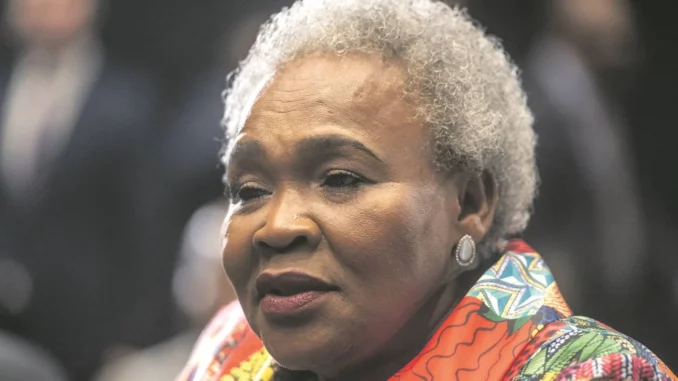
Who is Sisisi Tolashe?
Sisisi Tolashe is a veteran South African politician, anti-apartheid activist, and women’s rights advocate from the Eastern Cape.
A lifelong member of the African National Congress, she has served in a wide range of public positions spanning more than two decades from the Eastern Cape Provincial Legislature (2001–2008), to the national Secretariat of the ANC Women’s League (2008–2015), to the National Assembly (2016–2018 and 2019–present), to the Executive Mayoralty of the Enoch Mgijima Local Municipality (2018–2019), to her current position as Minister of Social Development.
She is also a member of the ANC National Executive Committee (NEC), a position she has held (with interruption) since December 2007. She was elected President of the ANCWL in July 2023, succeeding Bathabile Dlamini.
| Nokuzola Gladys Tolashe | |
|---|---|
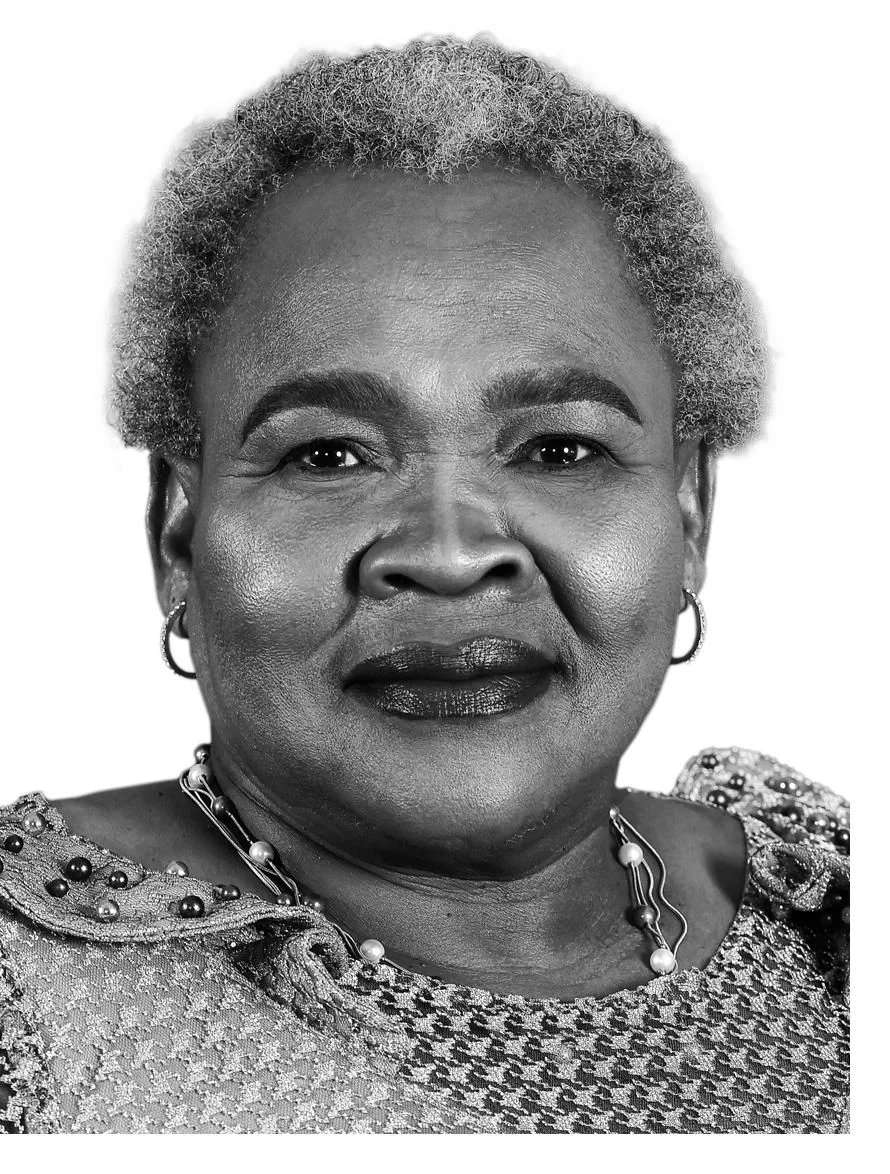 Nokuzola Gladys Tolashe: History · Bio · Photo
|
|
| Wiki Facts & About Data | |
| Full Name: | Nokuzola Gladys Tolashe |
| Stage Name: | Sisisi Tolashe / Sisi Tolashe |
| Born: | December 21, 1959 |
| Age: | 66 years old |
| Birthplace: | Queenstown (now Komani), Eastern Cape, South Africa |
| Nationality: | South African |
| Occupation: | Politician · Former Anti-Apartheid Activist · Women's Rights Advocate |
| Religion: | Christianity |
| Spouse: | Senzo Mchunu (married; also a Cabinet minister) |
| Children: | Five (including Nanilethu Tolashe and Kanyisa Tolashe) |
| Relationship: | Married |
Early Life
Nokuzola Gladys Tolashe was born on December 21, 1959, in Queenstown, a town in the middle of the Eastern Cape province of South Africa, now officially known as Komani.
She was born, raised, and educated entirely in Queenstown, making it not just her place of birth but the foundational community of her identity, her political awakening, and eventually her elected public service.
She grew up during one of the most repressive and turbulent periods in South African history. The country was in the iron grip of the apartheid system a legally enforced regime of racial segregation, dispossession, and institutionalised white supremacy that pervaded every aspect of life for Black South Africans from the cradle to the grave.
For a young Xhosa-speaking girl growing up in the Eastern Cape the birthplace of many of the ANC’s most towering historical figures, including Nelson Mandela and Walter Sisulu the political environment was particularly charged.
The Eastern Cape had long been the heartland of ANC resistance and Black political consciousness, and young Sisisi grew up in a community where the struggle for liberation was not an abstraction but a lived, daily reality.
It was in this environment that Sisisi Tolashe’s political consciousness was formed. While still a young student, she threw herself into the structures of the anti-apartheid movement joining student and youth organisations that were mobilising against the apartheid state.
She became active in civic organisations aligned with the United Democratic Front (UDF) the broad coalition of anti-apartheid organisations that served as the internal resistance movement aligned with the exiled ANC during the 1980s. Her activism encompassed women’s organisations, youth structures, and civic bodies, reflecting the broad coalition-building approach of the UDF era.
Her activism had serious and immediate personal consequences. The apartheid state did not tolerate organised resistance, and Sisisi Tolashe paid a heavy price for her convictions.
According to official biographical records from the South African Presidency, she was detained for three years under Section 29 of South Africa’s Internal Security Act a provision that allowed for indefinite detention without trial and for a further two years under the State of Emergency regulations.
This means she spent a total of five years in prison as a result of her anti-apartheid activism, detained without conviction for the sole crime of demanding freedom and justice. This experience of imprisonment and resistance became the bedrock of her political identity and the source of the tenacity that would characterise her entire public career.
Education
Sisisi Tolashe received her primary and secondary education in Queenstown, Eastern Cape, attending local schools in the town where she was born and raised.
The apartheid education system characterised by the notorious Bantu Education framework, which was explicitly designed to provide Black South African children with an inferior, racially segregated, and deliberately limited education presented enormous structural obstacles to academic achievement for young people like Tolashe. Despite these systemic disadvantages, she pursued her schooling with commitment.
It is important to note that the specific details of Tolashe’s post-secondary or tertiary education qualifications have not been extensively documented in publicly available sources.
Her political biography reflects a career built primarily through party structures, activist work, and public service rather than formal academic qualifications a path shared by many of her generation of ANC leaders who came of age during a period when political engagement and survival often took precedence over formal education.
What is clearly documented is that she was born, bred, and educated in Queenstown, where she developed the political foundations of her career through direct participation in the anti-apartheid struggle, student activism, and the organisational structures of the ANC and its aligned bodies.
Her political education was, in many respects, acquired through decades of hands-on party work, legislative service, and grassroots community organising earning her a depth of practical political knowledge that formal credentials alone cannot confer.
Career
Anti-Apartheid Activism and UDF (1980s)
Sisisi Tolashe’s public career began in the most uncompromising of settings: the frontlines of the anti-apartheid struggle. As described above, she was active in the structures of the United Democratic Front and the ANC-aligned student, youth, and women’s movements throughout the 1980s.
She endured five years of imprisonment for her activism three years under Section 29 of the Internal Security Act and two years under the State of Emergency. These years of detention, though brutal, forged in her an unshakeable commitment to the liberation movement and to the ANC as its political expression.
Before the unbanning of the ANC in February 1990, she served across multiple UDF-aligned organisations, including structures focused on women, youth, and civic community empowerment.
Her work in these structures gave her deep roots in the community organising traditions of the Eastern Cape and established her as a respected voice within ANC circles in her province.
Eastern Cape Provincial Legislature (2001–2008)
On January 29, 2001, Sisisi Tolashe was sworn in to the Eastern Cape Provincial Legislature as an ANC member, filling a casual vacancy in the party’s caucus.
She served in the legislature until 2008, representing her community and contributing to legislative debates and committee work on matters including health, education, social development, women’s affairs, and public service delivery.
She was a vocal champion of causes affecting women and children in her constituency, raising issues of domestic violence, sexual harassment, maternal health, and HIV/AIDS in the legislative chamber.
A pivotal moment in her national political ascent came in December 2007, when she attended the ANC’s landmark 52nd National Conference in Polokwane the historic conference at which Jacob Zuma defeated Thabo Mbeki for the ANC presidency.
At this conference, with the endorsement of the Congress of South African Trade Unions (COSATU), Tolashe was elected as a member of the ANC National Executive Committee (NEC), receiving 1,574 votes from approximately 4,000 delegates and placing 59th among the 80 ordinary members elected to the committee. Her entry into the NEC marked her arrival as a figure of genuine national significance within the ANC.
ANCWL Secretary-General (2008–2015)
On July 6, 2008, at the ANC Women’s League’s national conference held in Bloemfontein, Sisisi Tolashe was elected as the national Secretary-General of the ANC Women’s League (ANCWL).
She succeeded Bathabile Dlamini in the role and served under incoming ANCWL President Angie Motshekga. Her deputy as Secretary-General was Mpai Mogori.
The ANCWL Secretary-General is a full-time, paid executive role based at Luthuli House the ANC’s national headquarters in Johannesburg and it brought Tolashe permanently into the national political spotlight.
Her seven-year tenure as ANCWL Secretary-General was one of the most eventful in the organisation’s recent history, encompassing the fallout from the ANC’s Polokwane conference, the run-up to the 2012 Mangaung conference, and the growing internal contestations within the ANC as the Zuma era took hold.
She was re-elected to the ANC NEC at the 53rd National Conference in December 2012, where she ranked 56th with 1,715 votes from 4,500 delegates. During this period, she was widely regarded as a supporter of then-ANC President Jacob Zuma.
However, both Tolashe and ANCWL President Angie Motshekga were voted out of their respective ANCWL leadership positions at the league’s long-delayed next elective conference in August 2015.
In the race for Secretary-General, Tolashe was defeated by Meokgo Matuba by a margin of 348 votes a significant and public political setback for a woman who had held the position for seven years. The defeat was a humbling reversal that temporarily sidelined her from the apex of ANC Women’s League power.
National Assembly First Stint (2016–2018)
On September 5, 2016, Tolashe was sworn in to an ANC seat in the National Assembly the lower house of South Africa’s Parliament replacing the late Raesibe Nyalungu.
During this period, she served on the Portfolio Committee on Communications and Digital Technologies and as an alternate member of the Portfolio Committees on Labour and Agriculture, Forestry and Fisheries.
She also continued to hold her seat on the ANC NEC until the party’s 54th National Conference in December 2017, at which she failed to gain re-election a second significant internal party reversal.
Her first stint in the National Assembly lasted less than two years. She resigned on February 25, 2018, ceding her seat to Daniel Jabu Kabini, in order to take up a new role closer to home.
Executive Mayor, Enoch Mgijima Local Municipality (2018–2019)
On February 26, 2018, just one day after her parliamentary resignation, Tolashe was elected by the ANC-dominated council as Executive Mayor of the Enoch Mgijima Local Municipality a municipality that encompasses her hometown of Komani (formerly Queenstown) and surrounding areas in the Chris Hani District of the Eastern Cape.
She replaced the embattled Lindiwe Gunuza-Nkwentsha as part of an ANC provincial leadership effort to stabilise what had become a chronically mismanaged and financially distressed municipality following its 2016 amalgamation.
Her tenure as mayor was brief approximately 15 months and turbulent. The municipality continued to struggle with severe financial and operational challenges.
The Auditor-General of South Africa issued an adverse audit opinion for the 2018–19 financial year, highlighting material misstatements in financial reporting, non-compliance with supply chain management regulations, and fruitless expenditure exceeding R10 million.
Some community members and ANC supporters within the municipality marched in defence of Tolashe, asking cooperative governance authorities to give her more time to stabilise the municipality. She was eventually succeeded as mayor by Sibusiso Mvana after the 2019 general election.
National Assembly Return (2019–2023)
In the May 2019 general election, Tolashe was nominated to return to Parliament, ranked 11th on the ANC’s regional party list for the Eastern Cape constituency. Upon her return, she was appointed to the Portfolio Committee on Transport and the Standing Committee on Public Accounts (SCOPA). On June 24, 2020, she was elected unopposed to chair the ad hoc parliamentary committee tasked with finding a successor to outgoing Auditor-General Kimi Makwetu. Her committee concluded its work in October 2020, unanimously recommending Tsakani Maluleke for the position a recommendation that was ultimately accepted. In 2021, she was appointed to the Committee for Section 194 Enquiry into the Public Protector. In May 2022, she was elected to the Provincial Executive Committee of the Eastern Cape ANC.
At the ANC’s 55th National Conference in December 2022, Tolashe made a dramatic political comeback, being re-elected to the ANC National Executive Committee. She was elected narrowly, ranked 77th of the 80 ordinary members with 973 votes from approximately 4,400 delegates a considerably more modest tally than her earlier NEC elections, but a return nonetheless to the highest decision-making body of the ANC.
ANCWL President (July 2023 – present)
The most significant political milestone of Tolashe’s recent career came in July 2023, when she contested and won the presidency of the ANC Women’s League at the organisation’s first elective conference since 2015 held at Nasrec in Johannesburg. Tolashe ran against former ANCWL President Bathabile Dlamini and Thembeka Mchunu, defeating both to reclaim leadership of the league she had once served as Secretary-General. Her election was widely seen as a victory for the Ramaphosa-aligned faction of the ANC, as she was supported by delegates aligned with President Ramaphosa and his reform agenda. At the conference, ANC President Ramaphosa tasked the new leadership with ensuring that 40% of government procurement goes to women-owned businesses.
Her election as ANCWL President represented a remarkable political comeback from being voted out of the ANCWL leadership in 2015 and losing her NEC seat in 2017, she had rebuilt her support base and ascended to the very top of the organisation from which she had been ejected.
Deputy Minister in the Presidency for Women, Youth and Persons with Disabilities (March 2023 – July 2024)
On March 6, 2023, President Cyril Ramaphosa appointed Tolashe as Deputy Minister in the Presidency responsible for Women, Youth and Persons with Disabilities. In this executive role, she supported the lead Minister in coordinating cross-government efforts to mainstream gender equality, youth development, and disability inclusion. She delivered the 2023 budget vote address on June 6, 2023, highlighting priorities including resource allocation for inclusive programmes and collaboration with civil society. She was simultaneously serving as ANCWL president from July 2023, making her one of the most powerful women in South African public life.
Minister of Social Development (July 2024 – present)
Following the May 2024 general elections in which the ANC lost its outright parliamentary majority for the first time since 1994 and was forced into a Government of National Unity (GNU) President Ramaphosa reconstituted his cabinet. On July 3, 2024, Sisisi Tolashe was elevated to the full position of Minister of Social Development, one of South Africa’s most critical cabinet portfolios. The Department of Social Development administers the South African Social Security Agency (SASSA), which distributes hundreds of billions of rands in social grants including the Child Support Grant, the Old Age Pension, and the Social Relief of Distress (SRD) grant to tens of millions of South Africans every month. It is one of the most consequential departments in the entire South African government, with a massive reach into the lives of the country’s most vulnerable citizens.
Controversies and Scandals (2025–2026)
Since assuming the Social Development portfolio, Sisisi Tolashe has found herself at the centre of an escalating series of governance controversies that have been extensively documented by investigative outlets including Daily Maverick, News24, and the Sunday Times, and which have generated mounting calls for her dismissal from the cabinet.
The Chinese SUV Scandal
The most explosive and widely reported controversy centres on two luxury BAIC X55 SUVs, collectively valued at approximately R1 million, which were reportedly donated by Chinese officials to the ANC Women’s League. Tolashe initially claimed in parliamentary responses that the vehicles were donated to and intended for the ANCWL. However, vehicle registration records revealed that both SUVs had been registered in the names of Tolashe’s adult children Nanilethu Tolashe and Kanyisa Tolashe rather than in the ANCWL’s name. When pressed, the ANCWL publicly denied ever receiving or having any record of the donation. The Chinese Embassy declined to comment.
Tolashe has been accused of failing to declare the vehicles in her Members’ Interests disclosure as required by the Code of Ethical Conduct, and of misleading Parliament about their destination. According to reports, she reportedly told the ANC Integrity Commission that she had kept the vehicles in her children’s names to shield them from creditors owed money by Luthuli House an explanation that critics found wholly inadequate. In response, ActionSA MP Dereleen James laid criminal charges against Tolashe at the Cape Town Central Police Station for misleading Parliament, and the Democratic Alliance (DA) filed additional charges and asked pointed parliamentary questions about whether she had obtained presidential permission to accept and retain the gift. Tolashe has refused to resign, maintaining that only President Ramaphosa has the authority to remove her from office.
Director-General Affair and Defiance of the President
Investigative reporting by Daily Maverick beginning in September 2025 revealed serious governance failures within the Department of Social Development under Tolashe’s leadership. The most damaging related to the appointment and subsequent treatment of Director-General Peter Netshipale. Cabinet had approved Netshipale’s appointment for a one-year fixed-term contract in March 2025, at an annual remuneration package of R2,259,984 plus a non-pensionable allowance. When DA MP Alexandra Abrahams posed a parliamentary question on this in April 2025, Tolashe responded that the contract was for five years directly contradicting the Cabinet decision. When called before Parliament’s Social Development Committee in October 2025, she attributed the discrepancy to “a clerical error, not an intentional act.” Critics were unconvinced.
More seriously, it emerged that Tolashe had unlawfully charged Netshipale with misconduct and advertised for his replacement both actions requiring the President’s delegation of powers under the Public Service Act, which she did not have. President Ramaphosa wrote a formal letter to Tolashe making clear she had no legal authority for either action. The letter, reported by Daily Maverick in April 2026, represented an extraordinary public presidential rebuke of a sitting cabinet minister though it was not accompanied by dismissal.
Nepotism Allegations: Unqualified Chief of Staff
Tolashe was also accused of nepotism for appointing a 22-year-old with only a part-time IT qualification and, by all accounts, no meaningful professional experience as her Chief of Staff. The appointee was reported to be a niece of Tolashe’s special adviser, Ngwako Kgatla. After whistle-blowers raised the alarm and media investigations brought the appointment to public attention, Tolashe reversed it but not before the episode had been added to the accumulating dossier of governance failures attributed to her leadership of the department.
The Special Adviser Controversy
A deeply troubling sub-plot of the overall Tolashe governance scandal involves her special adviser, Ngwako Kgatla. Investigative reporting by Daily Maverick revealed that Kgatla was appointed to the Department of Women, Youth and Persons with Disabilities when Tolashe was deputy minister there, and followed her to the Department of Social Development when she was elevated to Minister. Critically, documents showed that while employed in government, Kgatla continued to draw a second government salary as a “business development manager” at Northwest Transport Investment (SOC) Ltd amounting to an additional R47,103 per month in apparent violation of public service conflict of interest regulations. The department reportedly knew about this double-dipping since 2024 without taking action. Further reporting alleged that Tolashe appeared to be shielding Kgatla from disciplinary action.
Adding to the controversy, Daily Maverick published reports alleging that leaked message exchanges suggested a romantic relationship between Tolashe and Kgatla, which, if accurate, would raise additional questions about her impartiality in decisions affecting his employment and accountability.
The “Food Aide” Allegation
Among the most disturbing allegations reported in 2026 is the claim that Tolashe appointed a domestic worker officially listed as a “food aide” on the Social Development payroll but stationed the employee at her private home in the Eastern Cape rather than at her official ministerial residence. Further reporting alleged that the employee was required to pay a portion of her government salary to Tolashe’s daughter for household upkeep. If proven, this would constitute a serious abuse of public resources for private gain.
Tolashe’s Response and Parliament’s Reaction
In her appearances before Parliament, Tolashe has consistently pushed back against the allegations, blaming former department spokesperson Lumka Oliphant whom the department dismissed for what it characterised as a campaign of misinformation. Oliphant, however, has maintained publicly that her claims are based on publicly verifiable documents, and has stated categorically: “I did not lie to Parliament, she did.” As of May 2026, Parliament’s portfolio committee on social development has been intensifying its oversight of the minister, and multiple opposition parties have filed formal criminal charges and called for Ramaphosa to dismiss her. The President had, as of the time of writing, not acted.
Personal Life
Marriage to Senzo Mchunu
Sisisi Tolashe is married to Senzo Mchunu, one of South Africa’s senior cabinet ministers. The couple are widely described as one of South Africa’s most high-profile political couples, having met while both were working for the ANC and having been together for over two decades.
Together they have five children, including two adult daughters named in media reports: Nanilethu Tolashe and Kanyisa Tolashe who became publicly known when the two Chinese SUVs were registered in their names.
Senzo Mchunu’s own political career has not been without controversy: he served as Minister of Police and came under significant scrutiny for his decision to disband the SAPS Political Killings Task Team (PKTT) the unit responsible for investigating political assassinations in KwaZulu-Natal, including the Sindiso Magaqa murder case. President Ramaphosa acknowledged that he had not approved Mchunu’s decision.
Mchunu subsequently went on an extended leave of absence, the cost of which was borne by the public purse. The parallel controversies surrounding Tolashe and Mchunu have made the couple a lightning rod for criticism of the Ramaphosa administration’s approach to accountability.
Social Media
Sisisi Tolashe maintains an active presence on social media, which she uses primarily for ministerial communications, ANCWL announcements, and political commentary.
- Twitter / X: @SisisiTolashe Her primary public platform, joined in May 2023. Her bio identifies her as “Minister of Social Development || President of the ANCWL || NEC Member.” She posts regularly about her ministerial activities, ANCWL events, and ANC political developments. Her account has attracted significant public attention during the 2025–2026 controversy period, with critical comments from South Africans and opposition politicians regularly appearing in her replies.
- Facebook: She maintains a Facebook presence used for constituency updates and political announcements, particularly for audiences in the Eastern Cape.
Net Worth
Sisisi Tolashe’s net worth is not publicly disclosed. As a long-serving public official who has held a series of paid positions including as full-time ANCWL Secretary-General, member of the Eastern Cape Legislature, National Assembly MP, Executive Mayor, Deputy Minister, and now full Minister she has accumulated decades of public sector income. South Africa’s Ministers receive a substantial salary and benefits package, and her husband Senzo Mchunu’s ministerial salary further reflects the family’s considerable combined income from public service.
The controversy around the Chinese SUVs valued at approximately R1 million and other alleged benefits associated with her ministerial position have cast a shadow over questions of her personal financial conduct. Opposition parties have called for a full investigation into all her financial disclosures.
No accurate independent estimate of her net worth has been published, and the full extent of her personal assets beyond those directly disclosed in her parliamentary Members’ Interests register remains unknown to the public.
Awards and Recognition
- Election to ANC National Executive Committee (December 2007) Receiving 1,574 votes from approximately 4,000 delegates at the ANC’s 52nd National Conference in Polokwane; candidacy endorsed by COSATU
- Election as ANCWL National Secretary-General (July 2008) At the ANCWL National Conference in Bloemfontein
- Re-election to ANC NEC (December 2012) ANC’s 53rd National Conference, receiving 1,715 votes
- Elected Unopposed as Chair Ad Hoc Parliamentary Committee on the Appointment of the Auditor-General of South Africa (June 2020)
- Election as ANCWL National President (July 2023) At the ANCWL National Conference at Nasrec, Johannesburg, defeating Bathabile Dlamini and Thembeka Mchunu
- Appointment as Minister of Social Development (July 2024) By President Cyril Ramaphosa
FAQs About Sisisi Tolashe
Who is Sisisi Tolashe?
Sisisi Tolashe, whose full name is Nokuzola Gladys Tolashe, is a South African politician and former anti-apartheid activist from Queenstown (Komani), Eastern Cape. She is the current Minister of Social Development and President of the ANC Women’s League, as well as a member of the ANC National Executive Committee.
When was Sisisi Tolashe born?
She was born on December 21, 1959, in Queenstown (now known as Komani), Eastern Cape, South Africa. She is 66 years old as of 2026.
Who is Sisisi Tolashe’s husband?
She is married to Senzo Mchunu, a senior South African politician who has served as Minister of Police and Minister of Water and Sanitation. They have been married for over two decades and have five children together.
What is the Chinese SUV scandal involving Sisisi Tolashe?
Two BAIC X55 luxury SUVs worth approximately R1 million were donated by Chinese officials and reportedly intended for the ANC Women’s League. Instead of being registered in the ANCWL’s name, they were registered in the names of Tolashe’s adult children, Nanilethu and Kanyisa Tolashe. The ANCWL denied receiving the vehicles. Tolashe maintained the cars were for the league, but registration records contradicted her. ActionSA and the DA filed criminal charges against her for allegedly misleading Parliament about the vehicles.
Has Sisisi Tolashe resigned over the controversies?
No. As of May 2026, Tolashe has refused to resign, stating that only President Cyril Ramaphosa has the authority to remove her from her ministerial position. Despite mounting calls from opposition parties and the media for her dismissal, the President had not acted as of the time of writing.
What role does Sisisi Tolashe play in the ANC Women’s League?
She was elected President of the ANC Women’s League (ANCWL) in July 2023 at the organisation’s national conference at Nasrec, Johannesburg. Before that, she served as ANCWL Secretary-General from July 2008 to August 2015, before being voted out of that role.
How long was Sisisi Tolashe detained during the apartheid era?
She was detained for a total of five years three years under Section 29 of the Internal Security Act (which permitted detention without trial) and two years under the State of Emergency regulations.
What is the Ngwako Kgatla controversy?
Ngwako Kgatla is Tolashe’s special adviser who allegedly drew two government salaries simultaneously one from the Department of Social Development and another from Northwest Transport Investment (SOC) Ltd. Tolashe allegedly shielded him from disciplinary action. Daily Maverick further reported leaked messages suggesting a personal romantic relationship between Tolashe and Kgatla, raising questions about the impartiality of decisions affecting his accountability.
When did Sisisi Tolashe become Minister of Social Development?
She was appointed Minister of Social Development by President Cyril Ramaphosa on July 3, 2024, following the May 2024 general elections and the formation of the Government of National Unity.
What is Sisisi Tolashe’s ethnicity?
She is Xhosa, one of the major Bantu ethnic groups of South Africa, primarily associated with the Eastern Cape province.
Conclusion
Sisisi Tolashe’s life story encompasses the full arc of post-apartheid South Africa’s political journey from the heroism of the liberation struggle, through the promise and compromises of democratic governance, to the accountability failures and governance controversies that now define her tenure as a cabinet minister.
A woman who endured five years of detention without trial in the service of her country’s freedom, who rebuilt her political career twice after being voted out of senior positions, and who ascended to two of the most powerful positions available to a woman in South African public life she represents both the resilience of the ANC’s activist tradition and the institutional rot that has increasingly corroded public confidence in that tradition.
The controversies of 2025 and 2026 the Chinese SUVs registered in her children’s names, the unlawful treatment of her Director-General, the nepotistic appointment of an unqualified Chief of Staff, the double-salaried special adviser, the alleged domestic worker on the public payroll are not merely bureaucratic failures.
They represent a pattern of behaviour that South Africans have come to recognise as symptomatic of a governing culture where accountability is negotiable and the rules apply differently to those with political protection.
Whether President Ramaphosa will ultimately act, whether the criminal charges laid by opposition parties will result in prosecution, and whether the ANCWL’s formidable political constituency will continue to shield her from consequences these are the questions that will determine the final chapter of Sisisi Tolashe’s ministerial career. For now, she remains in office, defiant, and at the centre of one of South Africa’s most closely watched governance battles of 2026.
Related People






Leave a Reply