
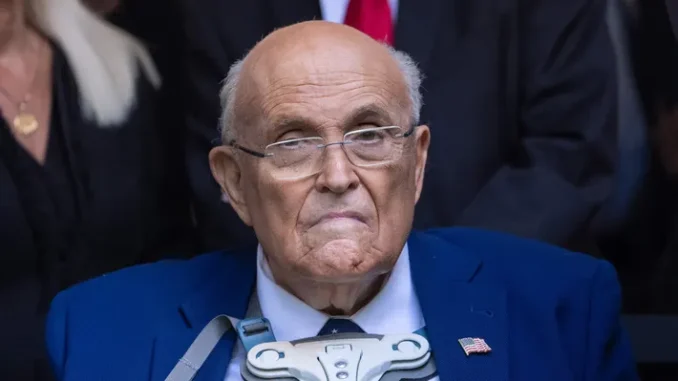
Rudolph William Louis Giuliani, known to the world as Rudy, is one of the most consequential, controversial, and ultimately tragic figures in modern American political life.
Once celebrated as “America’s Mayor” for his steady and compassionate leadership in the immediate aftermath of the September 11, 2001 terrorist attacks on New York City, and before that as one of the most effective federal prosecutors in the history of the United States Southern District of New York, Giuliani spent the final decades of his career systematically dismantling the very legacy he had spent a lifetime building.
His story encompasses extraordinary professional achievement: prosecuting the New York Mafia’s Commission, dismantling Wall Street’s most brazen insider trading rings, transforming one of the world’s most dangerous cities into one of its safest, and standing as a symbol of American resilience on the darkest day in the nation’s modern history. It also encompasses a stunning fall from grace: the promotion of baseless election fraud claims following the 2020 presidential election, disbarment in both New York and Washington D.C., a $148 million defamation judgment, bankruptcy proceedings, multiple criminal indictments, and most recently, hospitalisation in critical condition in Florida at the age of 81. His biography is, in many ways, a study in the fragility of reputation and the long consequences of choices made in the final chapters of a life.
| Rudolph William Louis Giuliani | |
|---|---|
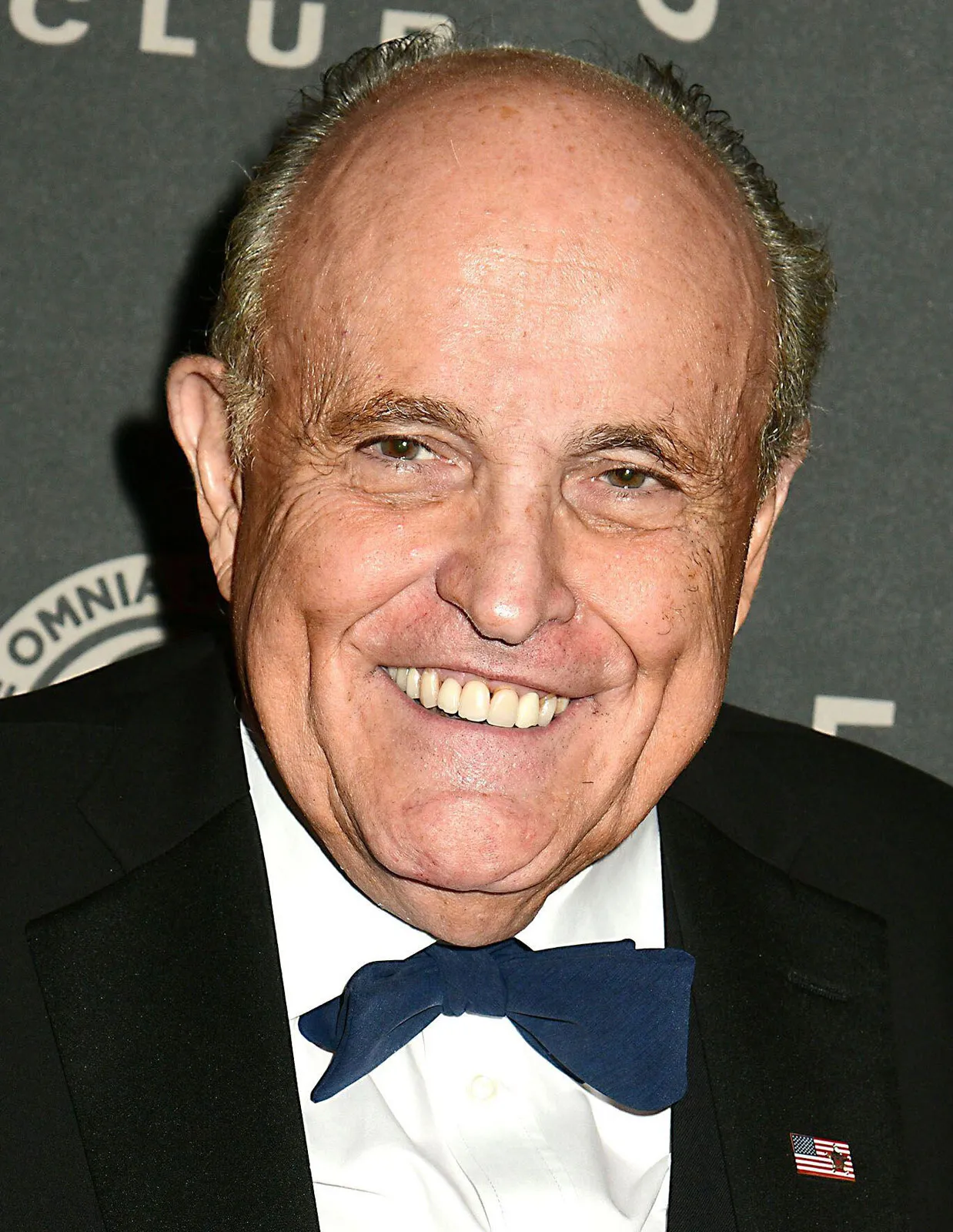 Rudolph William Louis Giuliani: History · Bio · Photo
|
|
| Wiki Facts & About Data | |
| Full Name: | Rudolph William Louis Giuliani |
| Born: | 28 May 1944 |
| Age: | 82 years old |
| Birthplace: | Brooklyn, New York City, New York, United States |
| Nationality: | American |
| Occupation: | Former Politician, Former Lawyer (disbarred), Former Mayor of New York City |
| Religion: | Roman Catholicism |
| Parents: | Harold Giuliani (Father, deceased); Helen Giuliani (Mother, deceased) |
| Spouse: | Regina Peruggi (1968–1982); Donna Hanover (1984–2002); Judith Nathan (2003–2019) |
| Children: | Andrew Giuliani (son, with Donna Hanover); Caroline Giuliani (daughter, with Donna Hanover) |
| Net Worth: | Estimated $1 Million – $10 Million (self-declared); substantially encumbered by over $150 million in debts and legal judgments |
Early Life
Rudolph William Louis Giuliani was born on 28 May 1944 in the Flatbush neighbourhood of the Brooklyn borough of New York City, into a large Italian-American working-class family. He was the only child of Harold Giuliani and Helen Giuliani, both of whom were themselves children of Italian immigrants who had come to America in the early twentieth century seeking a better life. The Giuliani family, like many Italian-American families of their generation, was deeply embedded in the Catholic faith and in the neighbourhood fabric of Brooklyn, a community of cops, firefighters, tradespeople, and small business owners.
Rudy has often described his childhood as one surrounded by uniforms, the men and women in his extended family who served in law enforcement and the fire service. He recalled: “I grew up with uniforms all around me and their stories of heroism.” This early immersion in the culture of public service and law enforcement would prove foundational to his identity and career choices.
However, the full story of Harold Giuliani, Rudy’s father, was considerably more complicated than the idealised picture Rudy often painted in public. Harold Giuliani had been arrested in 1934 for robbing a milkman at gunpoint and served approximately a year and a half in Sing Sing Prison. He also worked as an enforcer for his brother Leo’s mob-connected loan-sharking operation in Brooklyn. Rudy Giuliani has said he was only aware as an adult that his father “had gotten into trouble as a young man,” but did not know the specifics until much later in his life. Nevertheless, Harold was by all accounts a devoted and attentive father who was determined not to allow his son to repeat his own mistakes. When Rudy was seven years old, Harold moved the family from Brooklyn to Garden City South on Long Island, a deliberate effort to distance his son from the mob-connected members of the extended family and give him a better environment in which to grow up.
Growing up on Long Island, Rudy attended the local Catholic school, St. Anne’s, and later won a place at Bishop Loughlin Memorial High School in Brooklyn, a prestigious Catholic institution that required a daily commute back into the city. He was an excellent student and, significantly, spent several years seriously considering a vocation to the priesthood. He studied theology extensively during his college years before ultimately deciding his calling lay not in the Church but in the law.
Education
After graduating from Bishop Loughlin Memorial High School, Rudy Giuliani enrolled at Manhattan College in the Riverdale neighbourhood of the Bronx, where he pursued an undergraduate degree in Political Science. He was an intellectually serious and engaged student, graduating in 1965 with a Bachelor of Arts degree. During his time at Manhattan College, his consideration of the priesthood faded as his interest in law and public service grew.
Following his Manhattan College graduation, Giuliani applied to New York University School of Law, one of the most prestigious law schools in the United States, and was accepted. He graduated from NYU Law School in 1968 with a Juris Doctor (J.D.) degree, having built an impressive academic record. He graduated in the top ten of his class, a performance that opened doors to some of the most sought-after legal clerkships in New York’s federal judiciary.
After graduating, he clerked for Judge Lloyd Francis MacMahon, United States District Judge for the Southern District of New York, one of the most respected and powerful federal courts in the country. That clerkship proved pivotal. It gave the young Giuliani his first taste of federal law enforcement at the highest level and built connections within the Southern District that would define the next decade of his career.
Career
Early Political Affiliation and Vietnam War Draft
Rudy Giuliani began his political life as a Democrat, a reflection of his Italian-American, Catholic, working-class Brooklyn background, which aligned him naturally with the Democratic Party of the 1960s. He worked as a Democratic Party committeeman on Long Island in the mid-1960s and volunteered for Robert F. Kennedy’s 1968 presidential campaign. He voted for Democratic presidential candidate George McGovern in 1972. His conscription was deferred during the Vietnam War while he was enrolled at Manhattan College and NYU Law. Upon his 1968 graduation, he was classified 1-A (available for military service), but in 1969 his law clerkship for Judge MacMahon resulted in a 2-A reclassification as an essential civilian. In 1970, he was reclassified 1-A again but received a high 308 draft lottery number and was not called up.
United States Attorney’s Office, Southern District of New York (1970–1975)
In 1970, Giuliani joined the United States Attorney’s Office for the Southern District of New York as an Assistant United States Attorney, one of the most prestigious federal prosecution offices in the country. He proved to be a gifted and aggressive prosecutor from the outset. One of his early notable cases came when he helped convince New York Police detective Robert Leuci to work undercover within the NYPD to expose police corruption. Based on Leuci’s testimony and evidence, 52 New York City police officers were indicted on corruption-related charges, a landmark law enforcement achievement later immortalised in the book and film Prince of the City. He also won a conviction against Democratic Congressman Bertram Podell for accepting a $41,000 bribe to secure federal airline route rights. By the age of thirty, Giuliani had risen to become the third-highest-ranking official in the Southern District’s prosecution office.
Ford Administration, Associate Deputy Attorney General (1975–1977)
In 1975, Giuliani switched his party registration from Democrat to independent. Around the same time, he was recruited by the Gerald Ford administration for a position in Washington, joining the Department of Justice as Associate Deputy Attorney General and Chief of Staff to Deputy Attorney General Harold “Ace” Tyler. This was a significant step up in seniority and gave Giuliani his first experience of federal government from the inside. The following year, he also volunteered for Ronald Reagan’s primary challenge against Ford. When Ford lost the 1976 presidential election to Democrat Jimmy Carter, Tyler brought Giuliani into his private law practice at Patterson, Belknap, Webb and Tyler in New York City, where Giuliani worked from 1977 to 1981.
Associate Attorney General and Return to Justice (1981–1983)
When Republican Ronald Reagan won the presidency in 1980, Giuliani changed his party registration from independent to Republican and sought a return to federal public service. Through contacts he had developed in Washington, he was appointed Associate Attorney General of the United States, the third-highest position in the entire U.S. Department of Justice, serving under Attorney General William French Smith. In this role, he oversaw the Department’s criminal, civil rights, and civil divisions and played a major role in shaping federal criminal justice policy in the early Reagan era.
United States Attorney, Southern District of New York (1983–1989)
In June 1983, President Reagan appointed Giuliani as United States Attorney for the Southern District of New York, his home turf, and the most prestigious U.S. Attorney posting in the country. He served in this role for six extraordinary years, building what many legal historians consider one of the most consequential prosecution records in American federal law enforcement history.
His announcement upon taking the role, that his top priority would be to defeat organised crime in New York City, was not rhetoric. He immediately authorised a massive law enforcement operation involving 350 FBI agents and 100 New York Police detectives investigating the “Five Families” of the New York Mafia: the Bonanno, Colombo, Gambino, Genovese, and Lucchese crime families. Using the Racketeer Influenced and Corrupt Organisations (RICO) Act with unprecedented ambition, Giuliani prosecuted the bosses of all five families simultaneously in the landmark 1985–1986 “Commission Trial”, the first federal prosecution to target the ruling body of the American Mafia as a criminal enterprise. All five bosses were convicted and sentenced to prison terms ranging from 39 to 100 years, in what the media described at the time as the most significant blow against organised crime in American history.
He also led the prosecution of the “Pizza Connection” case, a massive international heroin and cocaine smuggling operation run by the Sicilian Mafia through pizza parlours across the United States, obtaining 22 convictions. On Wall Street, he prosecuted a wave of insider trading cases with equal vigour. Ivan Boesky, the legendary arbitrageur, was prosecuted under Giuliani and received a 3.5-year sentence plus a $100 million fine after cooperating and informing on others. Michael Milken, the so-called “junk bond king,” was indicted by Giuliani under the RICO Act on 98 counts of racketeering and fraud and ultimately pleaded guilty, paying $600 million in fines, at the time the largest securities fraud settlement in history. When Giuliani resigned as U.S. Attorney in January 1989, he was arguably the most famous law enforcement official in the United States.
First Mayoral Campaign, Defeat (1989)
In 1989, Giuliani ran for Mayor of New York City as the Republican nominee, challenging Democratic Manhattan Borough President David Dinkins. It was a close and bitterly fought race. Dinkins won narrowly, becoming New York City’s first African-American mayor. The defeat was a significant setback for Giuliani, who spent the next four years in private practice while remaining politically active and publicly visible.
Mayor of New York City (1994–2001)
In 1993, Giuliani ran against Dinkins again in a rematch. Campaigning under the slogan “One City, One Standard” with a relentless focus on crime, public safety, and quality of life, he defeated Dinkins by approximately 50,000 votes out of nearly two million cast, becoming the first Republican elected Mayor of New York City since John Lindsay in 1965. He took office on 1 January 1994.
His first term was marked by dramatic and measurable results on public safety. He appointed William Bratton as Police Commissioner and implemented the CompStat system, a computer-based crime mapping and accountability system that was later replicated by police departments nationwide. He embraced the “broken windows” theory of policing, cracking down on minor quality-of-life offences including graffiti, public urination, X-rated theatres, sidewalk vending, subway turnstile jumping, and jaywalking. The results were extraordinary: during his eight years in office, violent crime in New York City was cut by roughly 50%, and murders fell by a staggering 67%. New York, once synonymous with danger and disorder, became one of the safest large cities in the United States.
He also oversaw the largest welfare-to-work initiative in American history, reducing the city’s welfare rolls by approximately 640,000 people, nearly 60%, by transforming welfare offices into job placement centres. He re-elected in 1997 with 57% of the vote, a remarkable margin in a city where registered Democrats outnumber Republicans by a ratio of five to one.
However, his mayoralty was not without significant controversy. His policing tactics drew fierce criticism from New York City’s Black and Latino communities. Tensions reached a peak in February 1999 when four plainclothes white police officers shot unarmed West African immigrant Amadou Diallo 41 times in the doorway of his Bronx apartment building, killing him. Giuliani’s initial defence of the officers, and his perceived lack of empathy for Diallo’s family, generated enormous public anger. He also dismantled an affirmative action programme for minority and women government contractors and was frequently accused of valuing loyalty over competence in his staff appointments. His abrasive personal style generated sustained animosity from large sections of the New York press and public even as his approval ratings among other segments of the population remained high.
In 1999, Giuliani announced a campaign for the New York Senate seat against First Lady Hillary Clinton, a race that quickly became a national spectacle. However, in April 2000, he was diagnosed with prostate cancer. The health scare, combined with mounting public controversy over his policing record and over revelations that he was having an affair with Judith Nathan, a fact he announced publicly before informing his wife Donna Hanover, led him to withdraw from the Senate race in May 2000.
September 11, 2001, “America’s Mayor”
On 11 September 2001, 72 days before the end of his mayoral tenure, al-Qaeda terrorists hijacked four commercial aircraft. Two were crashed into the Twin Towers of the World Trade Center in Lower Manhattan. Both towers collapsed within hours. A total of 2,752 people were killed in New York alone, the deadliest attack on American soil in history.
Giuliani arrived at the World Trade Center site within minutes of the second plane’s impact. He spent the day coordinating emergency rescue operations in the chaos of the immediate aftermath, walking through the smoke-filled streets of Lower Manhattan to communicate directly with survivors, first responders, and the media. He held multiple press conferences through the day and into the evening, providing the city, and the nation, with a steady, calm, resolute voice of leadership at a moment of almost incomprehensible horror. His coordination of rescue operations is credited with helping save as many as 20,000 lives. That evening, he told the city and the nation: “Tomorrow New York is going to be here. And we’re going to rebuild, and we’re going to be stronger than we were before.”
His handling of September 11 transformed his public image from a divisive, polarising mayor into a symbol of national unity and strength. Time magazine named him Person of the Year for 2001. Queen Elizabeth II awarded him an honorary KBE (Knight Commander of the Order of the British Empire) in 2002. French President Jacques Chirac dubbed him “Rudy the Rock.” Former First Lady Nancy Reagan presented him with the Ronald Reagan Presidential Freedom Award. He left office at the end of 2001 with approval ratings that had reached extraordinary heights.
Post-Mayoral Career (2002–2016)
After leaving the mayoralty in January 2002, Giuliani founded Giuliani Partners, a global security consulting firm that drew on his public safety and emergency management expertise, and quickly established it as one of the leading firms in the post-9/11 homeland security consulting market. He was named Consulting Magazine’s Consultant of the Year for 2002. In 2005, he joined the Texas law firm Bracewell and Patterson as a senior partner, and the firm was renamed Bracewell and Giuliani. He joined the New York firm Greenberg Traurig as a partner in January 2016.
In 2008, he ran for the Republican presidential nomination, entering the race as the early national polling frontrunner, largely on the strength of his September 11 legacy. His campaign, however, was hampered by his relatively liberal positions on abortion, immigration, and gun control, which made him deeply unpopular with the Republican Party’s conservative base. His unusual tactical decision to skip the early-voting states of Iowa, New Hampshire, and South Carolina and focus entirely on Florida proved catastrophic. He came in a distant third in the Florida primary and withdrew from the race in January 2008, endorsing Senator John McCain.
Trump’s Personal Attorney and the 2016–2020 Period
Giuliani was a vocal and early supporter of Donald Trump’s 2016 presidential campaign, becoming one of his most prominent surrogates. Following Trump’s election, he was considered for multiple cabinet positions, including Secretary of State and Attorney General, but was ultimately not offered a cabinet role. In January 2017, Trump named him Cybersecurity Adviser. In April 2018, Giuliani joined Trump’s personal legal team, becoming one of the president’s most publicly visible attorneys as the Special Counsel investigation led by Robert Mueller into Russian interference in the 2016 election proceeded.
From mid-2019 onward, Giuliani became the central figure in a parallel diplomatic effort involving Ukraine. He conducted an unofficial “back channel” with Ukrainian officials, pressing them to open a corruption investigation into Burisma, the Ukrainian energy company whose board included Hunter Biden, son of then-former Vice President Joe Biden. These activities became the central issue in the first impeachment inquiry against President Trump, announced by Speaker Nancy Pelosi in September 2019. Trump was impeached by the House in December 2019 but acquitted by the Senate in February 2020. Giuliani continued to play a central role in Trump’s political orbit throughout 2020.
2020 Election Fraud Campaign
Following the November 2020 presidential election, which was won by Democratic candidate Joe Biden, Giuliani became the leading public face of Trump’s efforts to challenge and overturn the results. He held a series of press conferences making sweeping and legally unsupported allegations of widespread voter fraud, including a now-infamous press conference held at the Four Seasons Total Landscaping company in Philadelphia, a booking error that was intended to be the Four Seasons Hotel, that became one of the most lampooned moments in modern American political history.
He filed or directed dozens of lawsuits challenging election results in multiple states. Virtually all of these legal challenges were dismissed by courts, including by Republican-appointed judges, for lack of evidence. One of his most damaging specific claims involved two Georgia election workers, Ruby Freeman and her daughter Wandrea “Shaye” Moss, whom he accused, without evidence, of manipulating ballot counts by surreptitiously passing USB drives and illegally accessing voting systems at State Farm Arena in Atlanta. These accusations were false. The claims destroyed the women’s lives, subjecting them to a sustained campaign of death threats, racial harassment, and physical intimidation that forced them to flee their homes.
On 6 January 2021, the day Congress was scheduled to certify Biden’s electoral college victory, Giuliani spoke at the pro-Trump rally on the National Mall that preceded the storming of the United States Capitol by a violent mob of Trump supporters. In his speech, he called for “trial by combat.” The Capitol was subsequently attacked, Congress was forced to evacuate, and the certification was temporarily halted. Giuliani later claimed his “trial by combat” language was “hyperbolic.”
Controversies
Law Licence Suspended and Disbarment (2021–2024)
In June 2021, Giuliani’s licence to practise law was suspended in New York State, pending investigation into his conduct relating to the efforts to overturn the 2020 election results. On 2 July 2024, he was formally disbarred in New York, meaning his licence was permanently revoked. He was also disbarred in Washington D.C. These disbarments effectively ended his legal career of more than five decades.
$148 Million Defamation Judgment (2023)
In December 2023, a federal jury in Washington D.C. found Giuliani liable for defaming Ruby Freeman and Shaye Moss and awarded them $148 million in damages, one of the largest defamation judgments in American history. The jury found that his false claims about the two election workers had caused devastating harm to their reputations, safety, and wellbeing. A federal judge subsequently upheld the verdict. The judgment was later reduced slightly to just under $146 million on appeal. In January 2025, Giuliani reached a settlement with Freeman and Moss that allowed him to retain his home and most valuable possessions in exchange for an agreed payment arrangement.
Bankruptcy and Financial Collapse (2023–2024)
Immediately following the $148 million defamation verdict, Giuliani filed for Chapter 11 bankruptcy protection in December 2023. In his bankruptcy petition, he listed assets valued at between $1 million and $10 million against debts of over $153 million, including the defamation judgment, federal and state tax liabilities, and millions in unpaid legal fees from Trump-related cases. The bankruptcy case was characterised by the presiding judge, U.S. Bankruptcy Judge Sean Lane, as an exercise in deliberate obfuscation. Lane described Giuliani as a “recalcitrant debtor” who had failed to provide “an accurate and complete picture of his financial affairs.” The judge noted that Giuliani had not even retained an accountant, “the most rudimentary of steps”, and had failed to disclose business interests including a coffee brand and a book contract. On 12 July 2024, Lane dismissed the bankruptcy case, leaving Giuliani vulnerable to creditors and prohibiting him from refiling for bankruptcy for at least one year.
Georgia Criminal Indictment (2023)
On 15 August 2023, Giuliani was among 19 defendants criminally indicted by a Fulton County, Georgia grand jury on charges related to the alleged conspiracy to interfere with Georgia’s 2020 presidential election results. He surrendered at Fulton County Jail and was released on bond. He pleaded not guilty to all charges. The Georgia case was subsequently dismissed by prosecutors, in part following Giuliani and others being pardoned by President Trump in November 2025, though prosecutors noted that presidential pardons do not cover state charges.
Arizona Indictment
Giuliani also faced criminal charges in Arizona related to the fake electors scheme, a plan to submit slates of false presidential electors to Congress in multiple states won by Biden. He pleaded not guilty to those charges as well, and as of early 2026, that case remained ongoing.
Noelle Dunphy Lawsuit
A former employee, Noelle Dunphy, filed a $10 million civil lawsuit against Giuliani alleging sexual assault, harassment, and wage theft. The lawsuit included audio recordings that were cited as supporting evidence for the allegations. Giuliani denied all the allegations, and the case remained in civil litigation.
WABC Radio Show Cancellation
Giuliani’s WABC radio talk show was cancelled after he continued to discuss on-air his discredited theories about the 2020 election, a decision the station made in connection with the legal and reputational fallout from his defamation case.
Car Accident (2025)
In August 2025, Giuliani suffered significant injuries when a car he was travelling in was struck from behind on a highway in Manchester, New Hampshire. He was hospitalised with a fractured thoracic vertebra, multiple lacerations and contusions, and injuries to his left arm and lower leg. He was subsequently reported to be recovering.
Hospitalisation in Critical Condition (May 2026)
On 3 May 2026, the day before this biography was last updated, Giuliani’s spokesman Ted Goodman announced that the 81-year-old former mayor had been hospitalised in Florida and was in critical but stable condition. The specific reason for his hospitalisation was not disclosed. On Friday, 1 May 2026, Giuliani had hosted his online streaming show “America’s Mayor Live” from Palm Beach, Florida, during which he was heard coughing and noted that his voice was “a little under the weather.” President Donald Trump confirmed the hospitalisation on Truth Social, describing Giuliani as a “True Warrior and the Best Mayor in the History of New York City, BY FAR.” As of the publication date of this biography, Giuliani remains hospitalised.
Awards and Recognition
- Time Magazine Person of the Year, 2001, for his leadership during and after the September 11 terrorist attacks.
- Honorary Knight Commander of the Order of the British Empire (KBE), conferred by Queen Elizabeth II in 2002.
- Ronald Reagan Presidential Freedom Award, presented by former First Lady Nancy Reagan.
- Consulting Magazine Consultant of the Year, 2002, for Giuliani Partners’ work in emergency preparedness and public safety.
- Young Artist Foundation’s Former Child Star Lifetime Achievement, N/A (note: this pertains to a different subject; Giuliani himself received the accolades listed above).
- Recognition from Harvard University’s Kennedy School of Government for his welfare reform and crime reduction record.
- Dubbed “Rudy the Rock” by French President Jacques Chirac following his post-9/11 leadership.
Social Media
Rudy Giuliani maintained an active presence on social media platforms, particularly X (formerly Twitter) and through his streaming shows, until his hospitalisation in May 2026. His digital presence in his later years was focused primarily on defending President Trump, promoting his discredited 2020 election fraud claims, and hosting his streaming programmes.
- X (Twitter): @RudyGiuliani, used extensively to promote his political commentary and engage with conservative media. His account generated considerable controversy for continuing to promote election fraud claims even after his disbarment and the defamation judgment against him.
- America’s Mayor Live: A streaming show he hosted on X, from which he broadcasted as recently as Friday, 1 May 2026, days before his hospitalisation.
- The Rudy Giuliani Show: A streaming programme broadcast on LindellTV, the platform associated with MyPillow CEO and election denier Mike Lindell.
Personal Life
Rudy Giuliani has been married three times. His first marriage was to Regina Peruggi, a second cousin, in 1968. They divorced in 1982, and the marriage was subsequently annulled by the Catholic Church on the grounds of consanguinity. In 1984, he married television journalist and actress Donna Hanover, with whom he had two children: Andrew Giuliani, born in 1986, and Caroline Giuliani, born in 1989. The marriage deteriorated publicly and acrimoniously. While still mayor and still married to Hanover, Giuliani commenced a relationship with Judith Nathan, an event he announced publicly at a press conference before informing his wife. The resulting public divorce was widely covered by the New York tabloid press and became one of the most discussed personal scandals of his mayoral tenure. He and Hanover officially divorced in 2002.
He married Judith Nathan in May 2003. They remained married for sixteen years before Nathan filed for divorce in April 2018, citing an irretrievable breakdown of the marriage. The proceedings were reportedly contentious, and the case was resolved through a confidential settlement in December 2019. Since his third divorce, Giuliani has not been publicly linked to a new long-term relationship.
His son Andrew Giuliani has pursued a political career of his own, running unsuccessfully in the 2022 Republican primary for Governor of New York. His daughter Caroline Giuliani has spoken publicly about her opposition to her father’s political views and activities, particularly his involvement in efforts to overturn the 2020 presidential election. She has described herself as a supporter of liberal political values and has written and spoken about the difficulty of publicly disagreeing with a parent whose actions she finds deeply troubling.
Giuliani is a devoted fan of the New York Yankees and has attended many games at Yankee Stadium throughout his life. He is known for his appreciation of opera and has performed on stage with the New York City Opera. He plays the piano and has performed at public events. He enjoys cigars and has described himself as a committed Roman Catholic, though his personal conduct across his marriages and public life has at times sat in tension with Catholic teaching.
Net Worth
Rudy Giuliani’s financial situation as of 2025–2026 is one of the most dramatically altered of any major American public figure. At the peak of his post-mayoral career, when Giuliani Partners was generating substantial consulting income, his legal practice was active, and his speaking fee commanded significant sums, his net worth was estimated at tens of millions of dollars. However, his financial position has collapsed catastrophically in the wake of his 2020 election legal activities.
In his December 2023 bankruptcy filing, Giuliani declared assets valued at between $1 million and $10 million, against liabilities exceeding $153 million. By the time his bankruptcy case was dismissed in July 2024, he had approximately $94,000 in cash available and was drawing down on a retirement account that had been worth nearly $2.5 million in 2022. He has resorted to crowdfunding via platforms like GiveSendGo, raising over $105,000 by November 2024 to cover legal fees and living expenses, and launched a coffee brand (“Rudy’s Coffee”) and a podcast to generate income. His Manhattan apartment, once listed at $6 million, remained unsold.
He has acknowledged that the Trump campaign and Republican National Committee owe him approximately $2 million in unpaid legal fees, though Trump’s organisation has paid some of his expenses. His primary income sources in his final active years consisted of his streaming shows, speaking appearances, podcast revenue, and the nascent coffee brand. His outstanding legal exposure, including the defamation settlement, ongoing lawsuits from Dominion Voting Systems and Smartmatic, the Noelle Dunphy civil suit, and the Arizona criminal case, continues to represent potentially massive additional financial liabilities.
Frequently Asked Questions (FAQs)
Who is Rudy Giuliani?
Rudy Giuliani is a former American politician, lawyer, and federal prosecutor who served as the 108th Mayor of New York City from 1994 to 2001, previously as U.S. Attorney for the Southern District of New York from 1983 to 1989, and as a personal attorney and public advocate for President Donald Trump. He is widely known for his leadership following the September 11, 2001 attacks and for his role in promoting false election fraud claims following the 2020 presidential election.
When and where was Rudy Giuliani born?
He was born on 28 May 1944 in the Flatbush neighbourhood of Brooklyn, New York City, United States.
How old is Rudy Giuliani?
As of May 2026, Rudy Giuliani is 81 years old.
Why was Rudy Giuliani disbarred?
He was disbarred in New York on 2 July 2024, and separately in Washington D.C., for his conduct in promoting false and unsupported claims about the 2020 presidential election, including making false statements to courts, clients, and the public about alleged widespread voter fraud for which he had no credible evidence.
How much did Rudy Giuliani owe in the defamation case?
A federal jury in December 2023 ordered Giuliani to pay $148 million in damages (later reduced to just under $146 million on appeal) to Georgia election workers Ruby Freeman and Shaye Moss, whom he had falsely accused of election fraud. He reached a settlement with the two women in January 2025.
How many times has Rudy Giuliani been married?
Three times, to Regina Peruggi (1968–1982), Donna Hanover (1984–2002), and Judith Nathan (2003–2019).
Does Rudy Giuliani have children?
Yes. He has two children with his second wife Donna Hanover: Andrew Giuliani (born 1986) and Caroline Giuliani (born 1989).
What happened to Rudy Giuliani after the 2020 election?
After the 2020 election, Giuliani led efforts to legally challenge and overturn the results on behalf of President Trump. These efforts resulted in his law licence being suspended and then permanently revoked (disbarment), a $148 million defamation judgment against him, criminal indictments in Georgia and Arizona, bankruptcy proceedings, and the cancellation of his radio show.
Is Rudy Giuliani in jail?
As of May 2026, Giuliani is not in jail. He surrendered at Fulton County Jail in Georgia in 2023 following his indictment but was released on bond. The Georgia case was subsequently dismissed. He remains free while the Arizona criminal case continues. He is currently hospitalised in critical but stable condition in Florida.
What is Rudy Giuliani’s net worth?
In his 2023 bankruptcy filing, Giuliani declared assets of between $1 million and $10 million against debts exceeding $153 million. His financial situation has deteriorated severely due to legal judgments, unpaid legal fees, and the collapse of his earning power following his disbarment.
Conclusion
Rudy Giuliani’s biography is one of the most dramatic in modern American public life, a story that arcs from extraordinary achievement to extraordinary catastrophe, spanning more than five decades of public service, legal brilliance, political controversy, and ultimately, ruinous personal choices. He dismantled the American Mafia’s ruling Commission. He prosecuted Wall Street’s most brazen financial criminals. He transformed one of the world’s most dangerous cities into one of its safest. And he stood, steady and resolute, in the smoke-filled streets of Lower Manhattan on the darkest day in his city’s modern history.
That the same man would spend his final active years promoting claims that courts found to be false, claims that destroyed the lives of ordinary public servants, cost him his law licence, triggered a $148 million judgment against him, and reduced him to crowdfunding for living expenses, is a tragedy of Shakespearean proportions. Whatever one’s political views, the arc of Rudy Giuliani’s life compels reflection on how legacy is built, how it can be lost, and what it means when a person of genuine achievement chooses, in the end, to use that achievement in service of claims that history will judge harshly.
As he lies hospitalised in Florida at the age of 81, the world that once called him “America’s Mayor” watches and waits, holding in tension the memory of what he once was, and the reckoning with what he ultimately chose to become.
Related People



Leave a Reply