
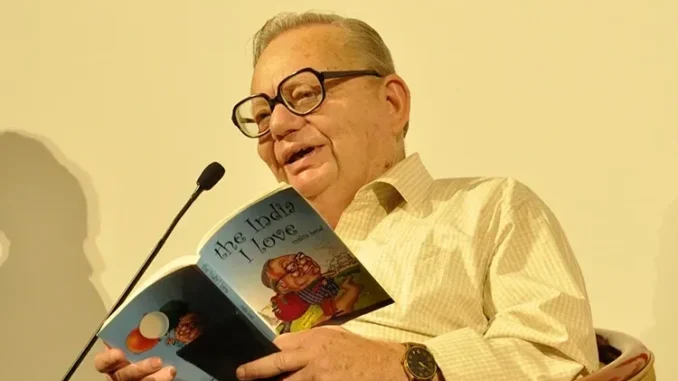
Ruskin Bond is the most widely read English-language author in India, and at 91 years of age, one of the most active.
For more than seven decades, he has written from his home in the mountains of Uttarakhand, stories about children, the natural world, friendship, longing, and the quiet grace of small-town India, producing over 500 short stories, essays, novels, and books for children.
His first novel, The Room on the Roof, won a prestigious British literary prize when he was just in his twenties. His country honoured him with the Sahitya Akademi Award, the Padma Shri, and the Padma Bhushan.
In 2025, now in his tenth decade, he published three new books. No other figure in Indian English literature has his combination of longevity, productivity, and genuine love from readers of every age and background.
| Ruskin Bond | |
|---|---|
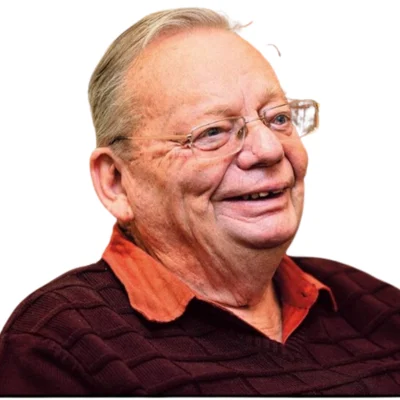 Ruskin Bond: History · Bio · Photo
|
|
| Wiki Facts & About Data | |
| Full Name: | Ruskin Bond |
| Born: | 19 May 1934 |
| Age: | 92 years old |
| Birthplace: | Kasauli, Himachal Pradesh, British India (now India) |
| Nationality: | Indian |
| Occupation: | Author, Poet |
| Parents: | Aubrey Alexander Bond (father), Edith Clarke (mother) |
| Relationship: | Never married |
Early Life
Ruskin Bond was born on 19 May 1934 in Kasauli, Himachal Pradesh, then part of British India. His father, Aubrey Alexander Bond, was an Englishman who had worked as a teacher, at one point instructing the princesses of the Jamnagar royal family, and later served in the Royal Air Force during the Second World War. His mother, Edith Clarke, was also of British origin.
His parents separated early, and Ruskin was raised in various parts of India, including Jamnagar, Shimla, and Dehradun. The instability of a broken home marked his early years profoundly, and themes of solitude, longing, and the search for belonging would recur throughout his literary work.
Ruskin’s father was his greatest influence and the central emotional anchor of his childhood. When Aubrey Bond died while Ruskin was still a young boy, the loss left a wound that never fully healed. His mother later remarried, and Ruskin’s relationship with his stepfather was difficult.
He spent much of his childhood in the boarding school environment, surrounded by the hills and forests of North India, which became the landscape of his imagination and the setting of nearly all his finest work.
Growing up, Bond was always the quiet, bookish child, more comfortable with a novel and the sounds of the forest than with the rough-and-tumble of other boys. He wrote his first story as a teenager, and by the time he was 17 had drafted the novel that would eventually become The Room on the Roof. He was, even as a child, clearly and irrevocably a writer.
Education
Ruskin Bond was educated at Bishop Cotton School in Shimla, one of India’s most prestigious residential schools, founded in 1859 and long regarded as a premier institution of English-medium education in the country. He completed his schooling there and, after a period in England, returned to India permanently.
His education was largely literary and self-directed; he has often spoken of books and the natural world as his truest teachers.
Career
Ruskin Bond’s writing career spans more than 70 years and encompasses virtually every prose form: the novel, the novella, the short story, the essay, the memoir, the nature piece, the ghost story, the children’s book, and the poem.
His output is remarkable not only for its volume, over 500 published works, but for its consistent quality and unfailing readability.
His career began with the short novel The Room on the Roof, written when he was 17 years old. The semi-autobiographical book follows a young Anglo-Indian orphan named Rusty who runs away from his guardian’s strict household in Dehra Dun to live freely among Indian friends. Published in London by André Deutsch in 1956, the book won the John Llewellyn Rhys Prize in 1957, a British award given to writers of the Commonwealth who have produced a work of outstanding promise. Bond was the first Indian to win it.
After a period working as a clerk in London and struggling to make a living as a writer, Bond returned to India in the mid-1950s, a choice that proved decisive.
He settled in Delhi briefly, then in 1963 made his permanent home in Mussoorie (later Landour), where he has lived ever since. The hills became both his subject and his sanctuary. Over the following decades he produced an extraordinary body of work rooted in the landscapes, characters, and quiet rhythms of life in the Indian mountains.
Among his most celebrated works are The Blue Umbrella (1980), a delightfully compact story of a young girl and a coveted umbrella that was adapted into a Bollywood film by Vishal Bhardwaj in 2007; A Flight of Pigeons (1978), a historical novella set during the Indian Rebellion of 1857; and his much-loved Rusty series, which chronicles the semi-autobiographical adventures of his alter ego across multiple books and short stories. His collections of ghost stories, including Ghost Stories from the Raj, have also found devoted readerships across generations.
Bond received the Sahitya Akademi Award in 1992 for Our Trees Still Grow in Dehra, a collection of autobiographical stories. The Government of India awarded him the Padma Shri in 1999 and the Padma Bhushan in 2014, the latter being one of the country’s highest civilian honours. In 2012, he received the Bal Sahitya Puraskar from the Sahitya Akademi for his contribution to children’s literature.
In 2025, Bond, then 90 years old, published three new books: Life’s Magic Moments, How To Be You, and Another Day in Landour, demonstrating a creative vitality that has astonished admirers across the literary world.
Awards and Nominations
- 1957 — John Llewellyn Rhys Prize — The Room on the Roof — Won
- 1992 — Sahitya Akademi Award — Our Trees Still Grow in Dehra — Won
- 1999 — Padma Shri (Government of India) — Won
- 2012 — Bal Sahitya Puraskar, Sahitya Akademi — Children’s Literature — Won
- 2014 — Padma Bhushan (Government of India) — Won
Social Media
- Instagram: @ruskinbondofficial
- Facebook: @RuskinBondOfficial
Personal Life
Ruskin Bond has never married. He came close to marriage twice in his life, but on both occasions circumstances, including family opposition and financial constraints, intervened. Having grown up in a broken home, he has spoken of his ambivalence about conventional family life.
Instead, he made his own family with an adopted Indian family, the Adhinaths, with whom he has lived in Landour for decades. He calls them his family and has written warmly about the warmth and companionship they have brought him.
Bond lives in Ivy Cottage, a charming residence in Landour, near Mussoorie, surrounded by the Himalayan forests that have provided the landscape for so many of his stories. He is a familiar and beloved figure in the town, and readers travel from across India to meet him, often finding him at the Cambridge Book Depot bookshop in Mussoorie, where he has long made a practice of signing books and chatting with visitors.
In a 2025 interview with Harper’s Bazaar India, Bond spoke candidly about the physical effects of ageing, weakened eyesight, slower movement, while noting that his passion for writing and his love for the hills remained entirely undiminished.
Net Worth
No verified net worth figure is currently available. Ruskin Bond’s income derives from book royalties, reprints, literary awards, and the continued commercial success of adaptations of his work, including the Bollywood film adaptation of The Blue Umbrella.
He has consistently lived simply and without ostentatious wealth, in keeping with the modest, nature-focused life he has always celebrated in his writing.
Selected Works
- The Room on the Roof (1956) — Debut novel; John Llewellyn Rhys Prize winner
- The Neighbour’s Wife and Other Stories (1967) — Short stories
- A Flight of Pigeons (1978) — Historical novella
- The Blue Umbrella (1980) — Novella; adapted into 2007 film
- Our Trees Still Grow in Dehra (1991) — Stories; Sahitya Akademi Award winner
- Rain in the Mountains (1993) — Nature writing and memoir
- The Night Train at Deoli and Other Stories — Short story collection
- Rusty the Boy from the Hills — Children’s fiction
- Ghost Stories from the Raj — Ghost stories
- Scenes from a Writer’s Life — Memoir
- Lone Fox Dancing — Autobiography
- Life’s Magic Moments (2025)
- How To Be You (2025)
Conclusion
Ruskin Bond is a living national treasure of India, a writer whose simplicity is his greatest sophistication, whose attachment to a single mountainside has produced a literary universe of extraordinary range and feeling.
He has written for children and adults, for city readers and country ones, for scholars and for people who have never read another book.
Now 91 and still writing from Ivy Cottage, he embodies a kind of creative integrity and personal contentment that very few writers, at any age, in any country, ever achieve.
Related People




Leave a Reply